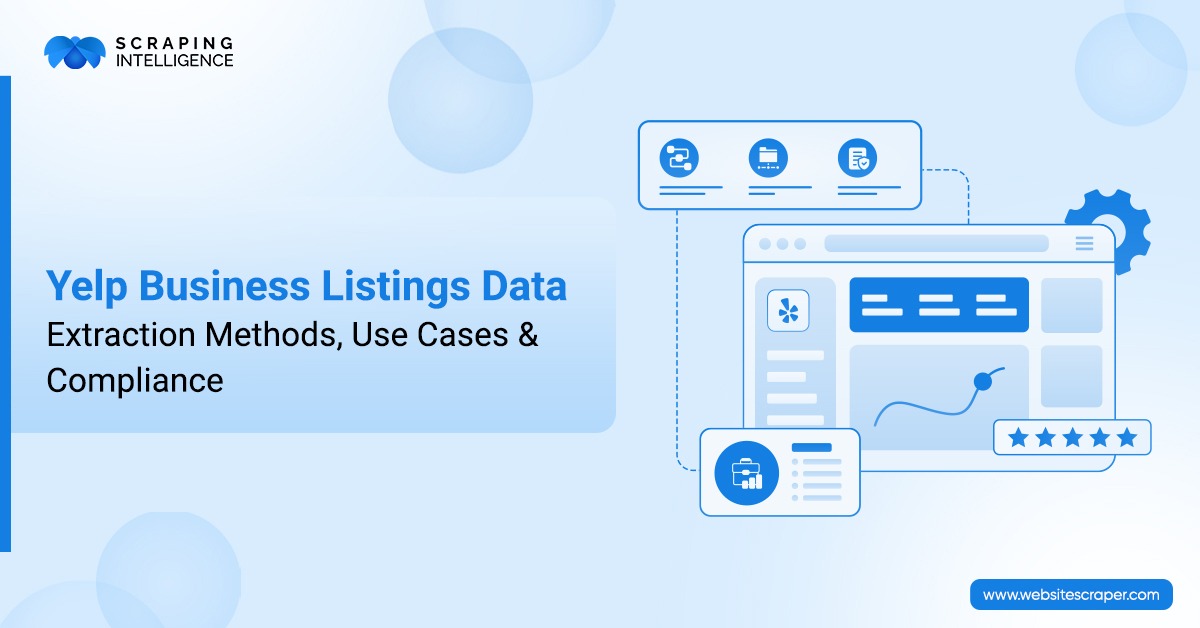
Yelp Business Listing Data Extraction: Methods, Use Cases & Compliance
Category
Directory
Publish Date
February 16, 2026
Author
Scraping Intelligence
Yelp business listings data extraction is a crucial factor for many companies looking to gain competitive intelligence about businesses within the United States and to gain accurate insight into local businesses through its 200 million reviews of millions of businesses, helping direct both short- and long-term strategies.
Many organizations struggle with unstructured Yelp business listing data. Collecting this data usually involves a lot of manual work and offers limited access. When a company closes, changes its rating, or a business enters the same market as its competition, those changes don't always show up in your manual processes.
Many companies will be frustrated when they use manual collection, APIs, and other basic scraping methods to meet their data requirements. These traditional approaches limit how much data you can gather and often produce incomplete datasets, which ultimately reduce the accuracy of your analysis.
To address these problems and enable organizations to use Yelp's raw data to gain valuable business insights, Scraping Intelligence has identified solutions.
What Yelp Business Listings Data Includes?
Yelp data scraping involves extracting and organizing business information from the platform to enable strategic decision-making and competitive analysis. This process collects comprehensive business details, customer feedback, and operational information that can be transformed into actionable insights for market research, lead generation, and business expansion strategies.
Business Identification Data - Extract essential information including business name, category classification, physical address, and precise location coordinates for geographical mapping and competitor analysis.
Customer Sentiment Analysis - Gather customer ratings, review counts, and sentiment data from user feedback to understand consumer preferences and satisfaction levels across different businesses.
Operational Intelligence - Collect operational details such as business hours, available amenities, pricing information, and accepted payment methods to gain comprehensive market insights.
Strategic Applications - Utilize scraped data for lead scoring optimization, market expansion planning, competitor benchmarking, and strategic market analysis.
Data Transformation - Convert raw scraped data into structured, analysis-ready formats that enable quick insight generation and sustainable tracking of evolving consumer trends.
Geographic Market Mapping - Leverage location coordinates and address data to perform location-based analysis and identify competitor distribution patterns across different regions.
Methods to Extract Yelp Business Listings Data
Check out the techniques web scraping, APIs, and automation tools to get organized Yelp business listings data quickly and easily.
Yelp API: Capabilities & Limitations
The Yelp Fusion API is a powerful tool for businesses and developers to request structured data (dB) about businesses through authenticated requests. However, many limitations prevent enterprises from using it for enterprise-wide analytics.
For example, daily API call rate limits that limit standard accounts to almost 5,000 calls mean that businesses can't perform comprehensive market analysis across the vast number of businesses located in any given region. Additionally, the data available through the API is incomplete compared to what is listed on Yelp's public listing pages.
Yelp has strict approval processes, requiring a business justification for any use cases outside the standard use, which may therefore limit the ability to complete multiple smaller use cases. It means that while the API can provide real-time lookups for specific businesses, it falls short when it comes to representing the entire market.
Scraping Intelligence utilizes a combination of various extraction methods to fill the gap in making complete datasets available.
Web Scraping Yelp Business Listings
Yelp business listing scraping methods vary widely, from simple browser automation to complex systems that use multiple servers. Selenium is an example of a basic tool for automating web browsing. However, there are drawbacks to using such tools. Primarily, it's slow, and you're not likely to be able to use this tool to scrape lots of data from many sites (multiple sites) simultaneously.
You can use multiple servers and distributed crawlers to send requests from different servers and use different IP addresses, which helps keep your extraction speed high while keeping traffic and requests to your website(s) low.
Both methods can extract Yelp business listings into a structured file (e.g., CSV or JSON) that you can then load into your database.
The modern scraping setup automatically handles things like dynamic content loading, bot detection, and data validation. However, building and maintaining these systems requires significant engineering resources and ongoing monitoring.
Managed Data Extraction Services (Recommended)
Compliant Yelp data extraction services will save you the burden of having to create your own engineering solution while still providing you with the reliability of your company's data at an enterprise level.
Scraping Intelligence is an example of a company that uses dedicated infrastructure to gather business listings from Yelp.
Using these services provides you with a scalable, monitored data pipeline with service-level agreements to protect your interests. It also allows your team to receive clean, validated data without having to manage scraper maintenance, proxy rotation, or logic updates. It will significantly reduce the time necessary to get insights from weeks to days.
Scraping Intelligence uses a variety of delivery methods tailored to your needs, including scheduled exports, API endpoints, and direct database integration. Additionally, our systems automatically reconfigure when the target website makes structural changes, ensuring uninterrupted data delivery for your business processes.
Real-World Use Cases for Yelp Business Listings Data
Businesses leverage Yelp data to monitor competitors and see how their ratings compare, and make their local market strategy better. Explore the real-time use cases of using Yelp business listing data
Lead Generation & Sales Intelligence
Sales teams use Yelp's business listings for analytics to create validated, or "verified," B2B lead lists broken out by industry and geography (location). Restaurant suppliers can track new openings by monitoring Yelp business listings in specific target zip codes.
Service provider lead scoring uses the business's overall rating/score on Yelp, the total number of reviews, and the business's stated amenities. High-rated businesses (4+ stars) with lots of reviews typically represent well-established businesses with procurement budget capacity. Consequently, sales teams will prioritize their efforts to reach out to these companies based on their lead scoring.
Scraping Intelligence delivers an enriched Yelp listings dataset with contact information appended from multiple sources. Now, all basic listings can become potential sales leads if they include a phone number, an email address, and the decision-maker's name.
Market & Competitive Analysis
Analysts studying the market analyze business density, average ratings, and category saturation to assess the competitive landscape. A map of your competitors' locations will help to identify areas of low competition and areas with too much competition or saturation.
Analysis of ratings trends can pinpoint businesses with declining ratings and that are therefore vulnerable to loss of market share. A change in review volume can indicate growth in a firm that could pose a potential threat to your position in the marketplace. As a result, your Strategic Planning Team will adjust its strategies and positioning in response to these signals from a competitor.
Scraping Intelligence provides historical snapshots for year-over-year comparisons of your market's evolution. Our Yelp data scraping services help you track competitor ratings, see new businesses entering the market, and identify any closures. This information is crucial for understanding your competition.
Location Intelligence & Expansion Planning
Retail chains and franchises use Yelp data to find good places to expand. They analyze ZIP codes to identify areas with many shoppers but few competitors. It helps them decide which locations are most likely to succeed.
By using demographic overlays alongside aggregate business density data, retailers can estimate location performance before committing to a capital investment. Successful retailers typically enter markets with a strong track record of success in similar industries.
Using Scraping Intelligence, businesses can enhance their ability to extract Yelp business listing data, including demographic variables, foot traffic estimates, and household income data. These enhancements allow retailers to use complex models to rate potential business locations, thereby reducing the risk of opening a new location.
Review & Reputation Analytics
Brand managers can use sentiment monitoring to assess how their brand is doing in different locations. It helps them spot problems quickly when ratings drop.
Conducting a competitive sentiment analysis will help you determine and understand the significance of competitor review text. It enables you to identify any advantages or disadvantages your competitors may (or may not) have, as well as new or anticipated changes in consumer behavior.
By mining customer feedback, you can analyze the recurrence of complaints and the presence of positive attributes in customer reviews to improve products or services.
Scraping Intelligence can leverage natural language processing (NLP) to convert qualitative review commentary into structured, quantifiable intelligence, such as sentiment scores, topic clusters, and attributes (e.g., performance reviews). Scraping Intelligence provides a dashboard for acquired data and enables data-driven decisions.
Compliance & Legal Considerations When Extracting Yelp Data
Yelp business listings data extraction separates public information from restricted content. Public information includes the business name, address, rating, and number of reviews. Follow the robots.txt file and respect rate limits to protect the servers.
Using safe strategies helps reduce legal risks for companies, especially those in the U.S. Scraping Intelligence focuses on legal compliance and responsible site crawling. They offer a compliant Yelp data extraction service that adheres to all laws and policies to ensure long-term data access rather than short-term gain.
Why Data Teams Choose Managed Yelp Data Extraction
By removing the overall time required for infrastructure setup and development, managed extraction services greatly reduce the time needed to extract valid datasets.
Through the use of extraction services via Scraping Intelligence, your engineering team can easily receive quickly available (analytics-ready) datasets that have normalized schemas, consistent formats, deduplicated records, and geocoded, thereby reducing the preparation efforts required by your team.
In addition, your engineering teams do not have to deal with any long-term maintenance issues related to parsing updates, receiving IP address blocks, or dealing with CAPTCHA type issues, because we provide 24/7 monitoring, automated alerts and a proactive process to adapt to changes made to your data sources to provide your company with reliable data pipelines as well as continuous operations supporting your company in its critical business analytics and decisions.
How Scraping Intelligence Delivers Yelp Data at Scale?
Scraping Intelligence specializes in delivering large-scale Yelp data through customized extraction processes designed to meet diverse business requirements. The service provides flexible configuration options, multiple delivery methods, adaptive scheduling, and compliance-focused practices to ensure reliable and continuous data access for enterprise needs.
Customized Extraction Logic - Define extraction parameters based on specific business requirements, including geographic area selection, business category filtering, custom data fields, and preferred update frequency to match your operational needs.
Flexible Data Delivery Options - Access extracted data through multiple formats including CSV files for spreadsheet analysis, JSON feeds for application integration, or API endpoints for real-time data access, all accompanied by comprehensive schema documentation.
Adaptive Update Scheduling - Receive data updates tailored to industry dynamics and business urgency, ranging from daily refreshes for rapidly changing markets to periodic updates based on new data availability and sector-specific requirements.
Quality Monitoring and Transparency - Track data quality and extraction performance through both individual record monitoring and comprehensive dashboard analytics to ensure data accuracy and consistency across all deliveries.
Compliance-Focused Methodology - Benefit from legally reviewed extraction practices with continuous methodology evolution to ensure compliant data access, minimize legal risks, and maintain reliable, uninterrupted data delivery.
Enterprise-Scale Infrastructure - Leverage robust infrastructure capable of handling large-volume data extraction while maintaining data integrity and delivery reliability across extended time periods.
Conclusion
By using Yelp's business listings data extraction, data teams can access actionable intelligence to generate leads, conduct competitive analysis, and plan for future success at the local level. With various data extraction methods available, managed service providers offer clients the best combination of scalability, reliability, and compliance.
Scraping Intelligence offers a full suite of Yelp data scraping services that extract Yelp data via automated web scraping, eliminating the engineering overhead of data collection and providing datasets ready for analysis upon receipt. Our technology handles all the technical complexity of extracting the data, so your team can focus on generating business growth by analyzing insights from that data.
The competitive advantage in extracting and using Yelp data does not come from accessing it, but from quickly understanding and making strategic decisions based on it before your competitors do. Therefore, deciding which extraction partner to choose will directly affect how quickly your organization can capitalize on the many market opportunities identified in the data on local businesses.
Do you need Yelp business listings data without the hassle of engineering work?
Scraping Intelligence provides a high-quality Yelp listings dataset to help speed up your analytics projects. Contact our data experts at Scraping Intelligence to discuss your needs and receive a custom proposal within 24 hours.
Frequently Asked Questions
Is it legal to extract Yelp business listings data?+
You can use publicly available data for your business, but the rules vary depending on local laws and how you gather it. To reduce risks, follow the site's terms of service, use ethical web-crawling practices, and consider third-party services that provide Yelp data extracts.
What data fields can be extracted from Yelp business listings?+
When looking at business data, some key details are important. These include the business name, category, address, latitude and longitude, phone number, website, operating hours, rating, review count, price range, and available amenities. For deeper insights, businesses can also look at customer reviews, images, and past performance data. This information helps understand how a business is doing and how well it engages with customers.
Yelp API vs web scraping: which is better for data teams?+
The Yelp API provides real-time updates, making it compliant. However, its coverage area is limited. Using web-scraping tools will enable a user to build more extensive datasets and track historical information. Many teams will use both types of data in a hybrid approach, leveraging ethically managed scraping alongside API data.
How accurate is scraped Yelp business data?+
Well-designed extraction systems usually achieve high accuracy for structured data. Methods like checking locations, removing duplicates, and confirming formats improve reliability. These steps help ensure that datasets are ready for analysis and can be trusted.
Can Yelp business data be used for lead generation?+
Yes, business data that anyone can access helps with targeted lead generation. You can use filters like category, location, and ratings. To get more contact details or better insights about prospects, you may need to add extra information.
How often should Yelp listings data be refreshed?+
Refresh schedules depend on how quickly industries change. Fast-moving industries need more regular updates, while stable industries usually refresh data every quarter. Companies should set their refresh rates based on what their business processes need for operation or analysis.
Do I need a dedicated infrastructure to scrape Yelp data?+
Creating internal systems requires a combination of engineering, maintenance, and careful observation to ensure efficiency and effectiveness. Managed extraction services simplify the collection of information across various environments, allowing users to focus on insights rather than on tools and technical intricacies. These services also handle essential tasks such as data updates and the management of blocked attempts to collect information, providing a streamlined approach to data management.
Share this article:
About the Author
Scraping Intelligence
Scraping Intelligence Editorial Team is a collective of data specialists, analysts, and researchers with expertise in web scraping, data extraction, and market intelligence. The team produces well-researched guides, actionable insights, and industry-focused resources that help businesses unlock the value of data and make informed, strategic decisions.
Latest Blog
Explore our latest content pieces for every industry and audience seeking information about data scraping and advanced tools.
Discover how real estate web scraping helps agents, investors & brokers extract listings, prices & market trends. See 7 key benefits of real estate data scraping.
Discover how AI-powered web scraping is transforming data extraction with LLMs, machine learning, automation, real-time data, and intelligent web crawling.