How to Build a Scalable Amazon Scraper in Python Using APIs
Category
E-commerce & Retail
Publish Date
Feb 20, 2026
Author
Scraping Intelligence
Amazon currently hosts well over 350 million product listings across its global marketplaces. Demand for Amazon product data scraping has expanded sharply in recent years, particularly across pricing intelligence, catalog management, and competitive market analytics. Most teams begin with a lightweight Python script that works fine for hundreds of records. The problems surface when volumes climb into the hundreds of thousands.
This guide explains how to build an Amazon scraper in Python using an architecture that holds up in production. The approach centers on API integration, async execution, and structured output pipelines, all tuned for reliability at scale in 2026.
Why Traditional Amazon Scrapers Break Under Load?
The failure modes are consistent enough that experienced data engineers can predict them. If you are trying to build an amazon scraper in python without a dedicated anti-detection layer, these problems are not hypothetical.
IP Blocking and CAPTCHA Escalation
Amazon's bot detection watches request fingerprints, timing gaps, header patterns, and IP history at the same time. Reusing the same IP pool for any serious volume gets you blocked, usually within minutes. At low traffic Amazon drops requests silently. Once volumes climb, it escalates to CAPTCHA challenges that freeze the entire pipeline.
Manual IP rotation buys some time. It does not solve the fingerprinting problem, and engineers spend hours tuning proxy configs that Amazon updates its detection around anyway.
JavaScript-Heavy Pages and Layout Volatility
An Amazon product page delivered as raw HTML is missing most of the data you actually want. Prices, stock status, and seller details all populate after JavaScript runs. Pull the HTML without rendering it and you get a partial snapshot, often with placeholder values where real data should be.
Headless browsers fix this but create a different set of tradeoffs. High memory per instance, slow per-request throughput, and Amazon has gotten considerably better at detecting headless browser signatures over the past couple of years. Running a browser fleet at scale is its own engineering burden on top of the scraping work.
Data Inconsistency Across Regions and ASINs
Pricing on amazon.com differs from amazon.co.uk, and both differ from amazon.ca. A scraper pointed at one locale generates data that is structurally wrong for any multi-market use case. This kind of inconsistency tends to stay invisible until someone runs a report and notices prices that make no sense for a given region.
High Maintenance Cost of Headless Browsers
Amazon A/B tests layouts regularly. Any change that affects the DOM breaks XPath selectors and CSS patterns without warning. Teams maintaining their own amazon scraper python setups often discover that parser maintenance is eating a larger share of engineering time each quarter. The ratio of fix-work to actual analysis work keeps shifting in the wrong direction.
Scraping Amazon with Python: API-First Architecture
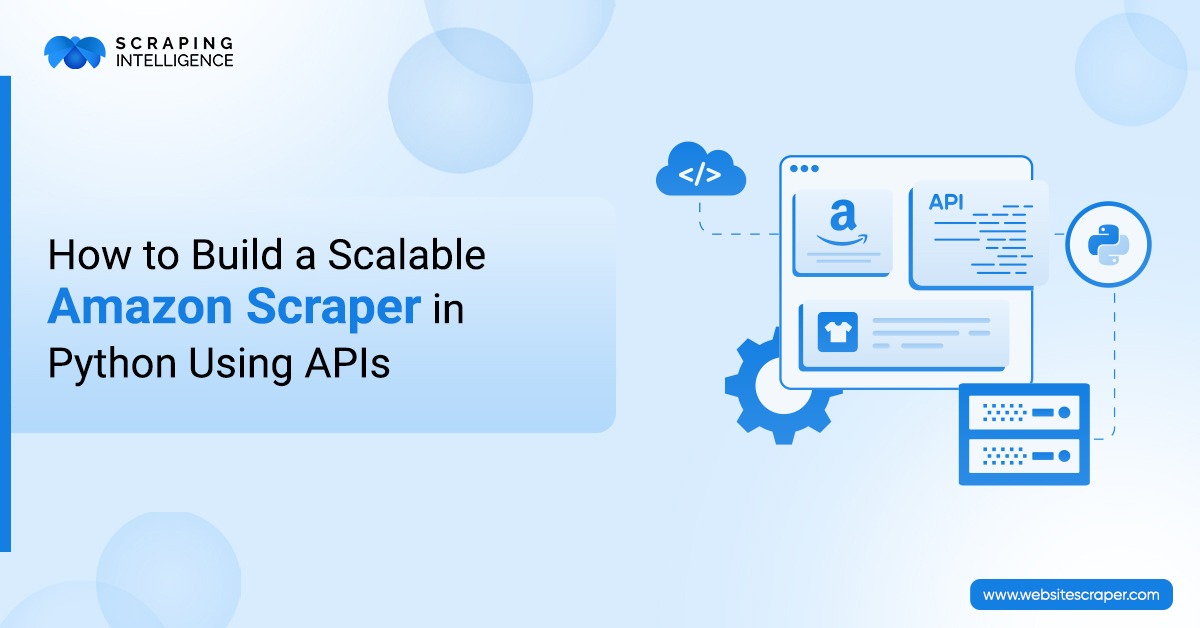
The practical solution to scalable amazon scraping without blocking is to split the problem in two. Anti-detection, IP management, and JavaScript rendering go to a dedicated scraping API. Data orchestration, batching, and output handling stay in your Python code. Each layer does what it is actually good at.
This is the approach that enterprise data teams have landed on for amazon data scraping using api pipelines running at sustained volume. It is not the flashiest architecture, but it is the one that keeps working six months after launch.
Core Components
Python ingestion layer: Your code. Handles request orchestration, task queuing, retry logic, output normalization. The part your team owns and controls
Amazon scraping API: Handles anti-blocking, IP rotation, geo-targeting, CAPTCHA resolution, JavaScript rendering, and response parsing. You send it an ASIN; it sends back structured data
Async task execution: Worker queues running on Celery, Redis Queue, or asyncio push ASIN requests through concurrently rather than one at a time
Structured output: Normalized JSON or CSV written directly to your database, warehouse, or analytics system with no additional parsing step
Why APIs Win Over Pure Scraping?
Proxy pool sourcing, rotation scheduling, and IP reputation tracking
Browser fingerprint randomization and user-agent management
CAPTCHA solving integrations and success rate monitoring
Parser rewrites whenever Amazon pushes a layout change
Infrastructure cost spikes tied to escalating block rates
Step-by-Step: How to Build a Scalable Amazon Scraper in Python?
Check out the steps to develop a Scalable Amazon Scraper in Python that handles large-scale data extraction efficiently and reliably.
Step 1: Define Data Requirements
The most common mistake in amazon product data scraping python projects is writing the ingestion code before anyone has agreed on what fields are actually needed. That produces pipelines that collect everything, normalize nothing, and require a second pass to become useful. Start with outputs.
Core fields: ASIN, product title, price, availability status, star rating, review count, seller name
Regional scope: Confirm which marketplaces are in scope before building: amazon.com, amazon.co.uk, amazon.ca, and any others
Step 2: Choose an Amazon Scraping API
The choice of amazon scraper python api shapes everything downstream. A poorly matched API introduces latency, inconsistent schemas, and support gaps that compound at volume. Production requirements are specific:
CAPTCHA resolution and header management handled server-side, not client-side
Concurrency limits that match your actual ASIN volume without artificial throttling on your end
Structured field-level output, not raw HTML that needs a second parsing layer
Geo-targeting parameters so regional marketplace selection happens at the API call level
Scraping Intelligence offers amazon data scraping using api infrastructure built for sustained enterprise workloads. SLA-backed uptime and normalized data output give your pipeline a foundation that does not degrade when request volumes spike.
Step 3: Python Implementation
Below is a working pattern for Amazon Product Data Scraping python using asyncio and httpx. It sends concurrent ASIN requests to the scraping API and returns normalized results:
import asyncio
import httpx
async def scrape_asin(session, asin, marketplace='US'):
    payload = {
        'asin': asin,
        'marketplace': marketplace,
        'render_js': True
    }
    response = await session.post(
        'https://api.scrapingintelligence.com/amazon',
        json=payload
    )
    return response.json()
async def batch_scrape(asin_list):
    async with httpx.AsyncClient(timeout=30) as session:
        tasks = [scrape_asin(session, asin) for asin in asin_list]
        results = await asyncio.gather(*tasks, return_exceptions=True)
    return [r for r in results if not isinstance(r, Exception)]
Four things that make this pattern reliable at scale:
Batch requests in groups of 50 to 100 ASINs. Fewer round trips, lower per-ASIN overhead, faster overall throughput
asyncio.gather runs everything concurrently. Sequential calls at 100,000 ASINs per day take days. Parallel calls take hours
Exponential backoff on retries. Three attempts with doubling delays catches the majority of transient API failures before they become data gaps
Normalize at the ingestion layer. Price formats, currency strings, and null fields vary by region. Standardize before writing to storage, not after
Step 4: Scaling the Pipeline
Single-process asyncio has a ceiling. Once the scalable amazon scraper in python pipeline needs to process sustained high volume, the architecture shifts to distributed workers pulling from a shared queue. Each worker runs independently. Throughput scales by adding workers, not by modifying code.
Message queue: Push ASIN identifiers into Redis, Amazon SQS, or RabbitMQ. Workers consume from the queue with no coordination needed between them
Rate limiting: Token bucket or leaky bucket algorithms at the worker level prevent request floods that breach API concurrency limits
Horizontal scaling: Add worker instances as volume grows. The queue absorbs demand spikes without requiring changes to worker logic
Dead-letter monitoring: Failed records route to a dead-letter queue for reprocessing. Alerts trigger when failure rates cross one percent
API vs Browser-Based Amazon Scraping (Quick Comparison)
Choosing the right enterprise amazon scraping architecture comes down to trade-offs across scalability, maintenance burden, and cost predictability. This table covers what matters in production:
Factor
API-Based Scraping
Browser Automation
Raw Python Scraping
Scalability
High, grows linearly
Low, resource-bound
Medium, IP-limited
Maintenance
Minimal
Heavy, constant patching
High, breaks on layout changes
Block Risk
Very Low
High
Very High
JS Rendering
Built-in
Yes, resource intensive
Not supported
Cost at Scale
Predictable
Unstable
High infrastructure cost
Setup Time
Hours
Days to Weeks
Days
Data Quality, Compliance & Ethics
Amazon data scraping using api at enterprise scale is a legal and operational matter, not just a technical one. Teams that treat compliance as an afterthought create exposure that lasts well beyond the data collection project itself.
robots.txt is a boundary, not a suggestion. Amazon lists endpoints that are off-limits to automated access. Hitting those endpoints is an explicit violation, and no business justification changes that
Account-level data is out of scope. Anything behind a login wall, inside seller portals, or tied to user accounts is a different legal category than public product pages. Do not mix them
Analytics use is broadly defensible. Price Monitoring, catalog tracking, and market research sit in accepted territory. Packaging scraped data as a resale product raises different legal questions
Managed platforms carry compliance infrastructure. Purpose-built scraping providers build controls into their stack that most internal teams do not prioritize when building in-house
Amazon restricts certain types of automated access through its Terms of Service. Legal review before going live is not optional for enterprise deployments, particularly in regulated industries.
At some point, the cost of maintaining a custom scalable amazon scraper in python exceeds the value of the data it collects. Most teams reach this point gradually and recognize it only after the ratio has already shifted badly against them.
Switch to a managed solution when any of these are true:
Daily ASIN volume tops 100,000 and the internal pipeline cannot keep pace reliably
Scraper maintenance is eating more engineering time than data analysis is getting
Formal SLA commitments on data freshness and delivery uptime are now required
Compliance audits or regulated industry requirements are now touching the pipeline
The team has no dedicated infrastructure capacity for managing distributed scraping systems
Scraping Intelligence handles the infrastructure layer so analytics teams spend their time on data, not on keeping collection pipelines from falling apart.
Enterprise Use Cases
Organizations running amazon scraper python api pipelines in production use the output across a range of commercial functions. These five account for most of what enterprise teams are actually doing with Amazon data.
Price Intelligence & Repricing
Retailers pull competitor prices across thousands of ASINs and push that data into repricing engines. In fast-moving categories, pricing decisions happen on hourly cycles, not daily ones. A team updating prices manually from weekly spreadsheets is structurally slower than a competitor whose repricing runs on live data. That gap compounds.
Catalog Monitoring and Brand Protection
Brand teams run daily automated sweeps looking for unauthorized sellers, hijacked listings, and MAP violations across their ASIN portfolio. Speed matters here. Every day a hijacked listing runs is a day of lost sales and potential brand damage. Manual monitoring at portfolio scale is not realistic.
Seller & Buy Box Tracking
Buy Box ownership shifts throughout the day, driven by price, fulfillment method, and seller performance metrics. Tracking those shifts over time reveals patterns: which sellers consistently win the Buy Box, at what price thresholds, and under what inventory conditions. That data directly informs pricing strategy and inventory planning decisions.
Market Share Analytics & BI Dashboard Ingestion
Amazon category data feeds into Tableau, Power BI, and Looker for weekly market share reporting and competitive benchmarking. The requirement is not just that the data exists, it is that it arrives consistently formatted. Inconsistent schemas produce reports leadership cannot trust, which makes the whole data program questionable regardless of how good the underlying collection is.
Frequently Asked Questions
Can I build a scalable Amazon scraper in Python?+
Yes, and the key is offloading anti-detection to an API so your Python code handles orchestration only. That split lets the pipeline scale past 100,000 ASINs per day without constant engineering intervention.
Is using APIs better than scraping Amazon directly?+
For sustained production workloads, yes. Direct scraping requires managing proxies, CAPTCHA solvers, and JS rendering yourself. API-based scraping removes all three and delivers predictable per-request costs with stable output schemas.
How do enterprises scrape Amazon without getting blocked?+
Managed scraping APIs handle IP rotation, fingerprint randomization, and geo-targeting server-side. Async batching and rate controls on the client side reduce behavioral signals that Amazon detection systems flag.
What data can be extracted from Amazon using Python?+
ASINs, product titles, prices, availability, star ratings, review counts, seller names, Buy Box holders, and category rankings, pulled from any regional Amazon marketplace your pipeline targets.
Is Amazon scraping legal for analytics purposes?+
Collecting publicly visible product data for analytics is widely accepted. Violating Terms of Service or accessing account-level data creates legal exposure. Get legal review before deploying at enterprise scale.
How scalable is an Amazon scraping API?+
Production APIs handle thousands of concurrent requests. Pair that with horizontal worker scaling and queue-based distribution and pipelines reach hundreds of thousands of ASINs per day without degrading.
When should I stop building my own Amazon scraper?+
When maintenance time exceeds analysis time, volume tops 100,000 ASINs per day, or SLA and compliance requirements come into play. Managed infrastructure delivers better returns at that point and beyond.
Let's Talk About Your Data Needs
Tell us what data you need, and we'll help you find the right solution.
Scraping Intelligence Editorial Team is a collective of data specialists, analysts, and researchers with expertise in web scraping, data extraction, and market intelligence. The team produces well-researched guides, actionable insights, and industry-focused resources that help businesses unlock the value of data and make informed, strategic decisions.
Latest Blog
Explore our latest content pieces for every industry and audience seeking information about data scraping and advanced tools.
Compare real estate data APIs vs. web scraping costs, including setup, infrastructure, maintenance, and data quality, to find the right solution for your needs.
See how the travel industry uses web scraping to track fares, room rates, availability, and reviews, plus how to choose the right data extraction solution.