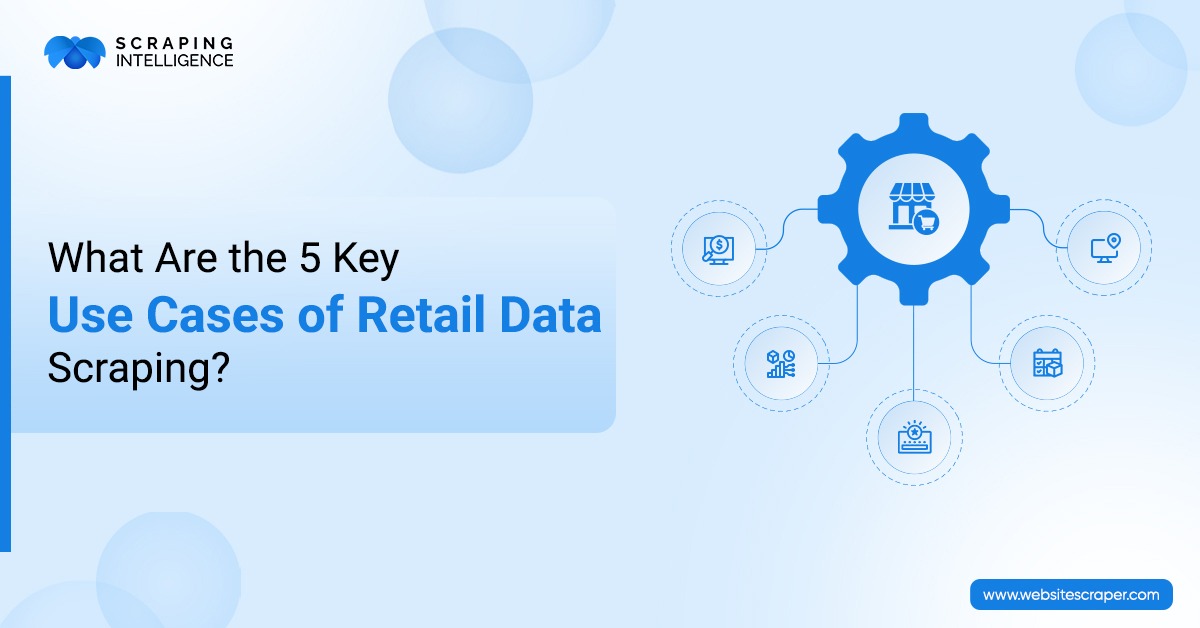
What Are the 5 Key Use Cases of Retail Data Scraping?
Category
E-commerce & Retail
Publish Date
January 19, 2026
Author
Scraping Intelligence
Retail data scraping is an essential automated tool for gaining a competitive edge in e-commerce. Scraping collects critical business intelligence from competitors' websites, as well as from industry entry libraries and marketplaces, and delivers it to retail competitors in real time! Brands need immediate access to the most reliable information to make informed decisions now!
Scraping Intelligence has identified five key areas of use for retail brands and e-commerce businesses to increase the availability of web and market data. Use the five use cases below to improve your performance.
Product pricing fluctuates hourly; product catalogues are constantly expanding, and consumer preferences change almost daily! A manual data collection process cannot keep pace with the constant fluctuations and changes in the retail sector.
In our blog, we'll examine how leading brands are using data scraping technology to improve pricing strategies, catalogue management, customer understanding, inventory monitoring, and market trend identification.
What is Retail Data Scraping and Why Does It Matter?
Retail data scraping is an automated method for gathering product specs and prices, product reviews, and inventory information from e-commerce and retail websites and platforms. Retail data scraping allows businesses to conduct competitive analysis, track industry trends, and use data analytics to make decisions that will positively impact their bottom line.
Scraping Intelligence has assisted many retail businesses by turning raw web data into useful information through data scraping (data extraction). Over time, using retail scraping has proven to give companies an edge of 23%-35% over those who solely rely on manual research methods.
Due to the rapidly changing retail landscape, automated data collection is a vital part of a company's ability to remain relevant. Also, businesses that do not track competitor prices, product availability, or consumer sentiment will continue to lose market share to competitors that are more quickly and responsive to customer needs.
1. How Can Price Monitoring Transform Your Retail Strategy?
Price monitoring is changing how stores compete, set prices, and make plans. The following use cases will highlight how monitoring a competitor's pricing strategy in real time can help businesses make better and more profitable retail choices.
Real-Time Competitive Pricing Intelligence
Retail price monitoring has become an increasingly important use of data scraping technologies, as retailers need to monitor what their competitors charge for identical or similar items. This information allows retailers to adapt their pricing tactics as necessary while still protecting their own profit margins.
Scraping Intelligence enables companies to automate scraping competitor prices across multiple platforms simultaneously. Depending on the size and type of each company's catalog, the number of products monitored by Scraping Intelligence clients ranges from 50 to 500 per day.
Take a real-life example: A mid-sized electronics retailer uses Scraping Intelligence's services to monitor competitor prices across five major retail chains every 6 hours. When competitor A reduces the cost of a well-selling smartphone, Scraping Intelligence notifies the retailer quickly so they can decide whether to match the price, add value to their offer, or maintain their existing pricing.
Dynamic Pricing Implementation
Dynamic pricing requires constant market monitoring for retailers to be successful. Retailers today monitor their competitors' prices, demand patterns, and their own inventory levels many times throughout the day. Dynamic pricing will not work unless there is a reliable source of real-time data available to support it.
Fast-fashion retailers are an example of how this system operates in the fashion retail space. They monitor their competitors' pricing hour by hour throughout peak shopping season; therefore, they can change their prices based on demand signals and competitor positioning. This can increase revenue by 15% to 25% compared to static pricing models.
Scraping Intelligence also delivers automated price adjustment solutions to assist clients. They provide a means for automatic price adjustments based on different marketplace conditions, such as competitor pricing, inventory levels, seasonality, historical sales, and so on, at any time.
2. Why is Product Intelligence Essential for Retail Success?
Below use cases will help retailers learn about how their items do in terms of pricing, demand, competition, and customer behavior with the help of product intelligence.
Comprehensive Product Catalog Analysis
Retailers not only track prices using Retail Product Intelligence. They also track and understand what is sold, including product specifications, product category attributes and images, product descriptions, and how product categories are defined by their competition.
Retail Scraping Intelligence enables retailers to identify key market trends, find product gaps in the marketplace, and/or discover new opportunities. A home goods retailer, for example, has used our Retail Scraping service to identify that its competitors are currently not offering many eco-friendly products. Hence, the retailer quickly expanded its eco-friendly product assortment to capitalize on the segment's growth.
Retailers can also analyse all products in a particular industry to gain insight into which features of each product are most interesting to their customers. An analysis of thousands of provided product listings will reveal patterns regarding the materials used, sizes available, colours, various functionalities offered, and how this attribute set can influence a customer's decision to purchase.
Inventory and Availability Tracking
Having access to stock levels is a key indicator of a competitor. When you know what is not readily available at your competitors and how many sales those items have generated, your company can stock them to meet demand.
Scraping Intelligence clients monitor their competitors' stock-out rates and any changes to their supply chains or product offerings. It allows the client to optimize inventory management and determine which products to include in their online store offerings.
Tracking competitors' product introductions or discontinuations provides retailers with valuable insight into the changing product offerings in their respective categories. It allows businesses to coordinate their product launch timing properly.
3. How Does Customer Sentiment Analysis Drive Better Decisions?
Customer sentiment analysis helps businesses understand what people really feel about their products, services, and brand. Below use cases will provide a clear view of how sentiment analysis can drive better decisions.
Review and Rating Data Mining
Customer reviews provide insight into how customers feel about a product and include complaints and suggestions for features they would like to see. The challenge of sifting through thousands of customer reviews on multiple sites is that it is impractical to do so manually; therefore, automated methods for scraping the reviews are necessary.
Scraping Intelligence collects customer reviews from retail sites for its clients. It applies sentiment and trend analysis to the review data using advanced natural language processing (NLP) techniques to identify patterns of customer sentiment (both positive and negative).
An example of this process would be a furniture company that used our review scraping service to collect competitor product reviews - more than 10,000 in total. Our analysis of reviews indicated that a common complaint across all brands was that customers found the assembly instructions to be complicated. Once this issue was identified, the furniture company revised its product documentation to make it more straightforward and added "simple assembly" to its product features, resulting in a 40% increase in customer satisfaction survey scores.
Question and Answer Data Extraction
Retail websites often allow customers to submit product questions, which reflect genuine concerns or gaps in information that may affect a customer's decision to purchase.
By collecting this data, retailers can determine which product information their customers are seeking before purchase, then create product descriptions that answer those questions, removing roadblocks to purchase and improving conversion rates.
Additionally, by reviewing competitors' product Q&A sections, retailers can identify ways to improve their own customer service. Questions that keep appearing in their Q&A sections indicate the retailer needs to provide better product information or improve how they market their products.
4. What Role Does Market Research Play in Retail Strategy?
Market research helps retailers understand customer needs, buying behavior, and market gaps using real data. These insights turn into clear use cases that guide smarter decisions in pricing, product selection, and overall retail strategy.
Trend Identification and Forecasting
By scraping retail sites, we can see trends before they go mainstream. Companies that track retail launches, new product lines, and promotions can see shifts and make decisions proactively.
Scraping Intelligence uses micro-trends identified through scraping as precursors to larger market trends. For example, over six months, we have seen a 300% increase in searches and listings for "sustainable packaging". By capitalizing on this microtrend first, many of our clients gained a first-mover advantage.
The analysis of seasonal trends via historical scraping is also a significant benefit to retailers. Analysis of how a product sells, its prices, or its promotions will help a retailer plan product inventory and the timing of marketing campaigns.
Assortment and Category Analysis
Scraping category, subcategory, and product group data from a competitor's catalog is a great way to gauge how effectively retailers structure and present their products to the end consumer.
Retailers can analyse assortment width and depth to determine which product categories they prioritise, based on their purchasing decisions. For example, a sporting goods retailer recently discovered through Scraping Intelligence that its top competitors have been increasing the number of different yogas they sell (yoga equipment), so it modified its purchasing strategy to take advantage of this increased customer demand.
Where performance metrics are available by category, they will identify which product segments are generating the most revenue and engagement for those retailers. They can ultimately inform retailers' strategic decision-making on how, where, and when to allocate resources to focus on broader growth.
5. How Can MAP Monitoring Protect Your Brand?
MAP monitoring helps brands keep pricing consistent across online channels and stop unauthorized discounts. It protects brand value, supports fair competition, and ensures partners follow agreed pricing rules.
Minimum Advertised Price Compliance
It is difficult for manufacturers that sell to multiple retailers to maintain consistent prices across all their retail partners. When manufacturers do not enforce MAP, it harms manufacturers' brand image and creates internal problems for independent retailers.
Scraping Intelligence has a MAP monitoring solution that provides comprehensive reporting on thousands of retail partners' product listings, marketplace sales, and unauthorized sales channels, and sends notifications to our clients when their retail partners violate the manufacturers' MAP policy (including real-time alerts).
For example, we had a client who was a Consumer Electronics Manufacturer. Upon analyzing the MAP monitoring data we provided to them, they learned that 23% of their retail partners were repeatedly violating the MAP guidelines. This discovery led the manufacturer to enforce compliance measures with its retail partners, resulting in increased brand equity for the manufacturer and higher sales/profit margins for the retail partners.
Unauthorized Seller Detection
Protecting your brand is more than just monitoring prices. Unauthorized sellers typically sell counterfeit or grey-market products that undermine your brand's integrity, making it imperative that you identify and address them to maintain your brand's integrity.
Scraping Intelligence's scraping solutions detect unauthorized sellers using automated scraping technology to compare the active product listings you have with those of authorized retailers. By tracking sellers' locations, product authenticity indicators, and pricing patterns associated with grey-market activity, you can identify unauthorized sellers.
We also monitor product descriptions and images to help identify counterfeit listings. While many counterfeiters steal product photos and copy genuine product descriptions, they tend to use a slightly different presentation style than legitimate sellers.
What Technical Considerations Matter for Retail Scraping?
Retail scraping needs a strong setup to collect accurate data without errors or blocks. Key use cases include tracking prices, stock levels, and competitors at scale while keeping data fresh and reliable.
Data Quality and Accuracy
Scraping from retail sites involves more than just pulling data from a site. Retail scraping consists of providing accurate, consistent formatting for the extracted data, as well as access to that data (e.g., via a web-based product feed). Providing inaccurate or inconsistent data can lead to revenue losses (in the tens of thousands to millions of dollars) due to incorrect business decisions made with erroneous data.
Scraping Intelligence has a team of professionals who use multiple validation methods to ensure we have accurate pricing data. We check pricing data from various sources, verify that the format is consistent across them, and identify data anomalies that might indicate an error in either the scraping or a retailer's website update.
We also handle many of the complexities of current retail website designs, including JavaScript, anti-scraping methods, and frequent layout changes. Our infrastructure automatically adapts as sites change, so we can continue to provide accurate data without interruption.
Scalability and Performance
Retailers require scalable scraping to meet their business requirements. A start-up may start with 50 products across 5 websites, but an enterprise retailer will have 100,000 products sourced from hundreds of global suppliers.
Scraping Intelligence offers projects of any size the ability to use our existing system for their web data extraction. Our system can handle millions of data points each day without losing speed or reliability.
We offer different ways to get your data, including an API, a database, and a custom dashboard. This makes it easy to connect with your existing business processes.
How Do Legal and Ethical Considerations Affect Retail Scraping?
Legal and ethical practices define how retail data can be collected and used safely. Following rules helps businesses avoid risks, respect website policies, and use scraped data responsibly for real-world insights.
Compliance and Best Practices
When conducting retail data scraping, businesses should continuously operate in accordance with applicable laws and comply with the site's terms of service. While most pricing and product information online is not protected by copyright, businesses should still adopt a responsible approach when scraping data.
Scraping Intelligence uses industry-standard best practices to limit the load on target websites, and we adhere to any robots.txt file(s) associated with each site.
All scraping performed by Scraping Intelligence is done with automated tools configured with rate limiting to ensure it does not interfere with the regular operation of any target website.
We only collect data that is publicly available and can be accessed by anyone using a regular web browser. We do not use any methods to get data from restricted areas, like password-protected sites or any other security measures that are meant to keep personal information private.
Data Privacy Considerations
When scraping data from retailers, the main focus is usually on product details, pricing, and overall customer feedback, not individual consumer records. However, organizations must handle any data they collect responsibly and follow all relevant laws and rules about data protection.
Scraping Intelligence guides our customers on complying with data-handling best practices and compliance obligations. With our guidance, we help our customers determine which data types require special protection and how to provide the necessary security for their specific use cases.
Conclusion
The five best ways to use scraped retail data are Price Monitoring, Product Intelligence (formerly known as Pricing Intelligence or Price Information), Customer Sentiment Analysis, Market Research, and MAP Monitoring. Each application type has a different value for customers based on their market position, competition, and goals.
At Scraping Intelligence, we provide custom-tailored scraping solutions tailored to each client's specific needs. From a basic price monitoring service to complete multiple-dimensional market intelligence, Scraping Intelligence will provide you with the reliable and accurate data needed to make the best decisions for your business.
The retail industry is changing quickly; therefore, companies that use automated data collection have a significant advantage over competitors who rely on manual research or on intuition to decide what to do next. Retailers who work with knowledgeable scraping companies will gain the competitive intelligence they need to succeed in today's ever-changing retail landscape.
Frequently Asked Questions
How often should I scrape competitor prices?+
Different industries operate using different dynamics. The dynamics of a rapidly changing sector (electronics, for example) will prompt faster scraping (every hour) than in a slower-changing industry. Thus, Scraping Intelligence recommends starting with daily scraping until you better understand your competitors' behaviour patterns, and then building your scraping schedule to accommodate them.
Is retail data scraping legal?+
Yes, extracting publicly available information from retailers via scraping is generally considered legal. Courts have ruled that scraping public data does not violate copyright. Scraping Intelligence is solely focused on gathering publicly available product listings, pricing, and customer reviews that any shopper can access.
What data formats does Scraping Intelligence provide?+
With Scraping Intelligence, you can get the following types of data in the following formats: JSON, CSV, Excel, andDirect DB. Also, an API is available to retrieve data in real time. Custom dashboards can be created to visualize the data and easily connect it to your existing business systems.
How quickly can I start receiving data?+
Scraping intelligence projects start within 3-5 days for the majority of projects, with some simple price monitoring starting as early as 24-48 hours. More complex multi-source scraping projects will need a setup and testing period of 1-2 weeks.
Can you scrape websites with anti-scraping measures in place?+
Scraping Intelligence is an expert in providing web scraping services for companies that want to pull data from sites that have data protection features. By utilizing advanced technologies like rotating IPs, browser emulation, and adaptive algorithms, we can effectively extract data from websites safeguarded by CAPTCHA, IP blocking, and JavaScript.
What ROI can I expect from retail scraping?+
The majority of Scraping Intelligence customers experience tangible benefits in 90 days or less. Pricing optimization often leads to 2-5% higher margins; Product Intelligence can provide up to a 20% increase in revenue across all product categories; MAP Monitoring has been shown to reduce margin erosion by 15-30%. In total, the average ROI for businesses will range from 300% to 500% in year one of use.
Let's Talk About Your Data Needs
Tell us what data you need, and we'll help you find the right solution.
Scraping Intelligence Editorial Team is a collective of data specialists, analysts, and researchers with expertise in web scraping, data extraction, and market intelligence. The team produces well-researched guides, actionable insights, and industry-focused resources that help businesses unlock the value of data and make informed, strategic decisions.
Latest Blog
Explore our latest content pieces for every industry and audience seeking information about data scraping and advanced tools.
Compare real estate data APIs vs. web scraping costs, including setup, infrastructure, maintenance, and data quality, to find the right solution for your needs.
See how the travel industry uses web scraping to track fares, room rates, availability, and reviews, plus how to choose the right data extraction solution.