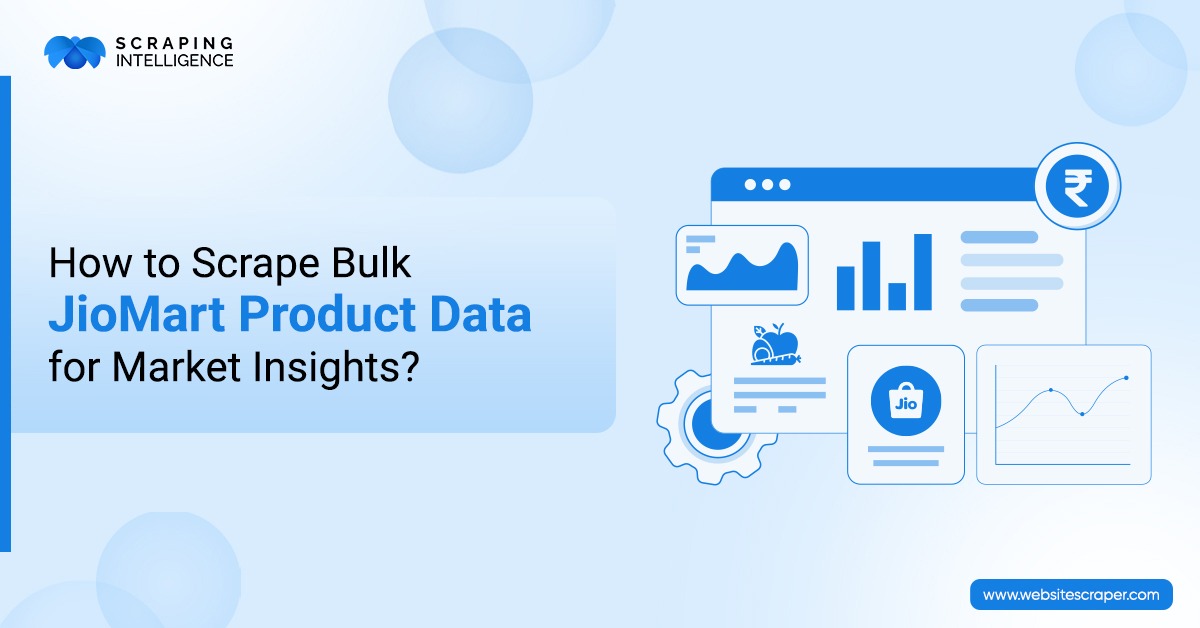
How to Scrape Bulk Product Data from JioMart for Market Insights?
Category
Grocery
Publish Date
January 30, 2026
Author
Scraping Intelligence
By using available grocery and general merchandise data, companies can price their products, project demand for an item, and compare their products to those of others competing in that market. JioMart, as India's fastest-growing online retailer, has access to this extensive pool of data. Depending on their roles (Marketers, Analysts, or E-Commerce), JioMart helps individuals and organizations collect data to gain insights into overall marketplace trends, discover competitive products, define pricing, plan inventory, set benchmarks for competitors, etc.
Although every e-commerce store has a set of terms and conditions for collecting data, the way you collect this information must be beyond reproach to prevent the e-commerce store from being flooded with unwarranted requests or irrelevant data.
This blog provides the framework for collecting bulk product datasets from JioMart for your market research purposes while adhering to JioMart's Terms of Service and treating JioMart with the respect it deserves. It will outline what types of JioMart product data would be most helpful, how to plan your data extraction, what tools you can use, and how to convert raw JioMart product data into actionable market intelligence.
This roadmap will be broken down into user-friendly topics that address specific, applicable, and real-world issues. Upon completion of this website, you will have the ability to collect bulk datasets of JioMart product information for analysis and insights into pricing strategy development, category expansion, future forecasting, competitive analysis, and market research—all without violating rules or jeopardizing your brand.
What Does "Scraping Bulk Product Data" Mean?
The process of gathering bulk product data is an automated way of collecting structured data about product items from a website or e-commerce platform and storing it for later use (in a structured format, such as CSV, Excel, or a database). An example of this is JioMart, a well-known e-commerce platform that collects bulk product data from its website, including names, categories, prices, discount amounts, packaging sizes, stock levels, rating scores, and the companies associated with each product.
The term "bulk" is significant when considering how many products should be scraped. Instead of scraping one product at a time, companies typically need to scrape thousands of product listings to analyze trends across their entire inventory. For example, one retailer might want to know the average price for products of similar kinds and categories, and how often competitors have discounted these items. In contrast, another company that manufactures these products may want to analyze how many times this item was discounted.
The difference between scraping public data and scraping restricted-access data is also essential, as publicly-accessible product listings are typically 'appropriate' to scrape and analyze, provided that the company's terms, robots.txt file, and rate limits are adhered to, and never include bypassing any form of authentication or subscription fees to access this publicly-available information. Ethical data scraping should occur only from publicly available information at an appropriate level.
Why Use JioMart Product Data for Market Insights?
JioMart offers a wide range of products that can help companies learn where their products fit in the pricing and positioning structure of the Indian market. As they acquire bulk data, companies will be able to analyze it and answer critical questions such as: Who are the leading brands in the category? When do prices change? What pack sizes are available at different price points?
A company's ability to collect market intelligence through JioMart could benefit many aspects of the business. Pricing teams can learn how competitors are pricing their products and adjust accordingly. Category managers can identify underserved subcategories and build their assortment to address the gap. Marketing teams can learn from the successful use of titles, images, and descriptions to create effective product listings.
Another significant advantage of research conducted in this manner is the ability to analyze geographic and demand variation. Prices and product availability can differ significantly from city to city, so having bulk stock information allows a company to analyze and identify various demand trends for each city. Over time, the collected data will establish historical seasonal patterns of product demand, such as increased packaged food demand during the holiday season or increased demand for cleaning products at specific times of the year.
The JioMart dataset serves its users as an online snapshot of the market at any given moment. When combined with substantial data, JioMart becomes a vital resource for competitive intelligence, forecasting, and strategic planning.
Is It Legal and Ethical to Scrape JioMart Data?
Legality and ethics must be considered when collecting data from JioMart. Before starting your data collection, review JioMart's terms of use and robots.txt file to determine which data can be collected using automated tools and which areas of the website are not allowed for automated data collection. Make sure to collect only publicly available data that complies with the website's terms of use.
To scrape data ethically, avoid overwhelming the JioMart server with too many requests. Although you may need to collect data for business applications or large-scale data scraping activities, if this is the case, you should enter into contracts with the organization as well as make use of available APIs and licensed data vendors. Based on your intended purpose of using collected data, you should work directly with providers that provide access to their data through these forms of verification and validation.
When selecting an organization to partner with, consider those that have established themselves as leaders in collecting e-commerce data and are credible and compliant. Additionally, your use of the data should be clearly defined in advance: it will only be used for analysis, benchmarking, and market research, and will not be used to create any duplicate product or to mislead consumers about the value of your product or service.
When data collection is completed in compliance with both ethical and legal standards, data collection will no longer pose a liability; instead, it will become an asset for any business.
What Product Fields Should You Collect for Analysis?
The value of your information is based on the type of data you are collecting. You will want to begin by collecting core identifying data (product name, brand, category, and subcategory), as these are the basis for grouping items for comparison across your catalog. Next, you will want to collect all pricing information (MRP, selling price, discount percentage, promotion tags). You need to collect an additional critical type of data called availability. It will be indicated by stock status, delivery options, and regional availability, which will show both the demand for each product and its supply constraints. The rating, review count, and associated badges (e.g., "Best Seller") for each product will indicate popularity and customer preference.
When it comes to packaged goods, it is essential to collect basic pack sizes, unit prices, and variants (flavor, weight, format) for each packaged good to perform your price-per-unit analysis. Some additional helpful data to collect includes images of each product and short descriptions of each. The photos and brief descriptions are less useful for numerical analysis of information about packaged goods, but they can help evaluate how a packaged good is positioned in the market.
Make sure to collect all metadata, such as the collection date, the geographic location of the price, and the URL of the price information. It will allow you to create a time-series dataset and track price variation over weeks or months.
How Can You Plan a Responsible Scraping Workflow?
Create a practical plan for scraping data from a website. Determine the type of data you're interested in scraping, such as comparing different websites' prices or searching for gaps in various product categories, and how you would scrape, etc. You should also determine the frequency of scripting and the specific fields required.
Understand the website's structure. Create a web map showing where to find data, including category pages, product ranges, product details, and pagination. Check if you can access all the pages through the Sitemap or the Robots.txt file. Plan a crawling route that minimizes the number of requests to the website. Start with category pages and only crawl product pages when necessary.
Limiting requests helps protect the website and lowers the chance of your IP address being blocked. Include error-handling options for missing data or slow-loading pages. Additionally, have solutions ready in case the website's structure changes.
The accuracy of the information captured through web scraping is equally vital. You must develop validation rules to identify duplicates and out-of-stock products and to standardize prices and units. The combination of these means your data will be consistent and reliable. You should choose a schedule for web scraping to keep your dataset current, but if it is not absolutely required, do not scrape too often.
If done correctly, careful preparation will ensure that your web scraping is ethical and completed consistently and efficiently while utilizing the website's resources.
Most of the time, the raw data has not yet been prepared for analysis. Cleaning and organizing data is essential for preparing raw data for analysis. This involves removing duplicate and incomplete records, as well as normalizing text fields (such as brand names, categories, and measurements) into a consistent format. For example, "1 kg," "1000 g," and "1kg" should all be standardized to the exact representation.
When it comes to prices, ensure that numeric values are validated by removing any non-numeric characters. It's essential to check for outliers and flag any products without a price or with a cost of zero. Additionally, derive discount fields (such as percent off and price per unit), as these variables can provide more valuable insights than raw price information alone.
To clear and organise your data, set it up with one row per product and one column per attribute. Add timestamps and geographic indicators to enable trend analysis over time and across geographies. If you are dealing with large datasets, consider setting up a data warehouse (or a similar architecture) to enable high-performance processing.
Lastly, verify the accuracy of your data by performing a spot check against live page(s). If your data is clean, your ability to provide analysis that reflects the proper position will increase, enabling you to build stakeholder confidence in your findings.
How Can You Turn JioMart Data into Market Insights?
Analyzing data after cleansing is straightforward because the next step will be descriptive analysis (e.g., average prices per category, discount frequency, brand share, availability rates, etc.). It will help give you a snapshot of the current market.
Comparing your product price to the JioMart Price List shows whether your pricing is higher or lower than your competitors'. It also allows you to study other competitors' packaging and price-per-unit to determine your value proposition. By knowing which brands are the top competitors in each sub-category and which ones are new entrants, you can find areas of opportunity.
Analyzing the historical data will help discover trends over time. Tracking data will help determine when seasonal demand occurs, the timing of promotional cycles, and the volatility of price changes. For example, if you see discounts on items repeatedly over time, it could suggest excess inventory or a highly competitive environment.
Using charts and dashboards to present the final results helps inform ideas about promotions, assortment planning, and demand forecasting across pricing, supply chain, and marketing teams.
Conclusion
When done ethically, scraping JioMart for product information can yield valuable insights into consumer behavior and market trends. Companies should begin by establishing clear objectives for their web scraping efforts. It is crucial to identify all the product information that needs to be scraped from the website, whether that is done all at once or gradually over time. Analyzing this data in organized sets can help businesses make informed decisions based on what they learn from JioMart.
By using insights from JioMart scraping, companies can gain an edge over their competitors. They can adjust prices, compare themselves with rivals, expand their product range, and better understand industry trends. At Scraping Intelligence, we're excited to partner with businesses that may lack the resources or expertise in data scraping! Our collaboration ensures you receive precise, compliant data on JioMart products, so you can focus on shaping your data strategy without the hassle of data collection.
Frequently Asked Questions
Is it legal to scrape product data from JioMart?+
You can scrape data if it’s publicly available and if you follow JioMart’s rules and guidelines. Avoid bypassing any security measures or restrictions. Always collect data ethically and responsibly.
What type of product data can be collected from JioMart?+
You can gather information like product names, categories, prices, discounts, availability, pack sizes, ratings, and brand details. This data can help with pricing analysis, competitor tracking, and demand forecasting.
Which tools are best for scraping JioMart data?+
You can use no-code tools, Python scripts, or official APIs if they exist. Licensed data providers can also help. Services like Scraping Intelligence provide compliant datasets for businesses.
How can scraped data be used for market insights?+
Businesses use scraped data to monitor prices, benchmark against competitors, analyze categories, track promotions, and forecast trends. Clean, organized data helps make better decisions.
How often should JioMart product data be updated?+
It depends on your needs. You may need daily or weekly updates for pricing and promotions, while category analysis could be monthly. Avoid excessive scraping to stay compliant.
What are the risks of improper scraping?+
Improper scraping can lead to being blocked, legal problems, incorrect data, and damage to your reputation. Always follow ethical guidelines or work with trusted data partners for safe results.
Share this article:
About the Author
Scraping Intelligence
Scraping Intelligence Editorial Team is a collective of data specialists, analysts, and researchers with expertise in web scraping, data extraction, and market intelligence. The team produces well-researched guides, actionable insights, and industry-focused resources that help businesses unlock the value of data and make informed, strategic decisions.
Latest Blog
Explore our latest content pieces for every industry and audience seeking information about data scraping and advanced tools.
Learn how to scrape social media data ethically. Collect accurate, compliant data without risking bans or legal issues. Build a defensible dataset today!