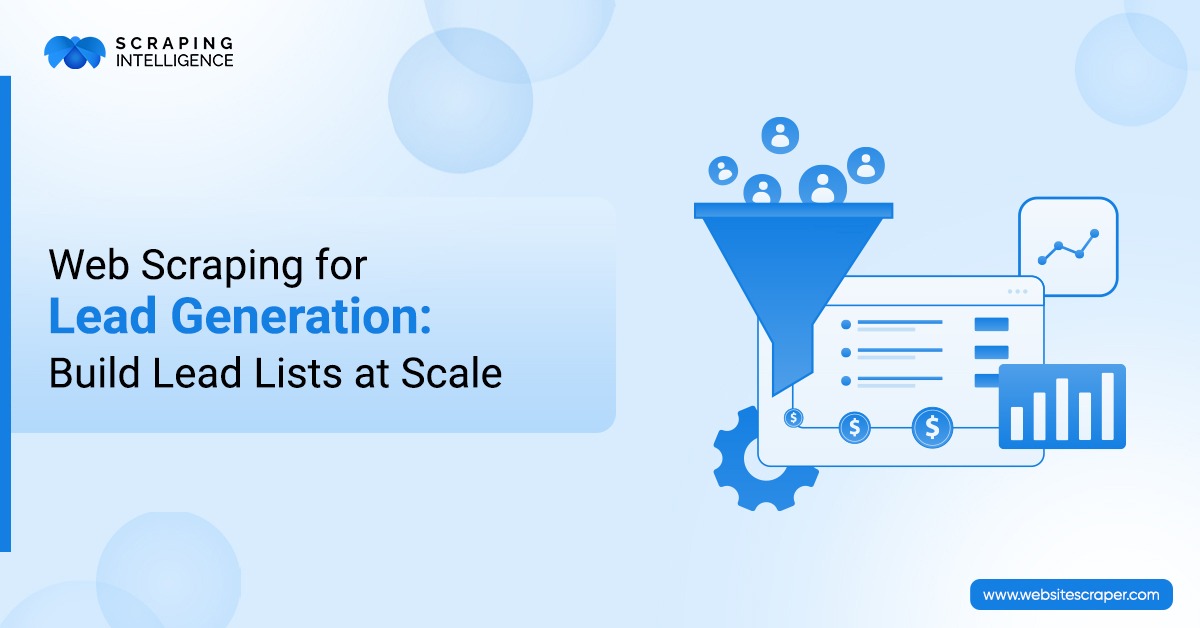
Web Scraping for Lead Generation 2026: Build Lead Lists at Scale
Category
Services
Publish Date
Jan 27, 2026
Author
Scraping Intelligence
For sales and marketing teams, generating quality lead lists will be one of the most significant challenges in 2026. According to old methods, generating high-quality lead lists involves either manually going through a long list of people or purchasing their contact details. Both methods take a long time and yield poor results. In many cases, a business's lead list is filled with outdated contact information and mis-targeted individuals, using up valuable money and time that could otherwise be spent growing revenue.
Modern-day business owners have found a solution to generating leads in a more scalable way—web scraping. With this efficient, automated process, businesses can retrieve data from thousands of websites, directories, and social networking sites to create high-quality, highly targeted lead lists at minimal cost. Companies can now generate a lead list of 10,000+ qualified prospects in days rather than months.
At Scraping Intelligence, we have enabled hundreds of companies to create new ways to generate leads with our intelligent web scraping solution. Our innovative solution can handle everything from collecting and verifying data to integrating it with your CRM, so your sales team can spend their time on what they are best qualified for closing deals.
In this complete guide, we cover how web scraping will enable your company to generate leads, which platforms offer the best data, legal issues you need to be aware of, and practical strategies for generating lead lists at scale. We provide proven techniques to accelerate growth and automate prospect research for startups looking to acquire their first customers, as well as for large enterprises expanding into new markets.
What Is Web Scraping for Lead Generation?
Scraping sites to find qualified leads has become a valuable tool for many companies. Organizations can automatically gather emails, phone numbers, job titles, business names, and other contact information using this technology, rather than conducting time-intensive manual searches.
At Scraping Intelligence, we offer automated solutions to help you find and collect quality leads from a wide range of different websites, such as LinkedIn, Industry Directories, Actual Company Websites, and Business listings. In addition, we can reduce lead acquisition costs by up to 70% compared to conventional methods.
Why Do Businesses Use Web Scraping to Generate Leads?
Web scraping automates data collection, thereby saving companies time and resources. Sales teams spend 40 -50 % of their time looking for leads before closing deals. Automating the data collection process lets the sales team focus on hunting down and qualifying leads rather than wasting time searching for prospects.
The benefits of web scraping are that you can build lists faster, have better targeting accuracy, and receive consistent quality of data over time, plus you get access to real-time data instead of using outdated databases. With real-time data, your business can be competitive in today's market.
According to research done by an industry organization, companies using automated lead generation methods have 50% higher conversion rates than those that do not. Therefore, web scraping is an essential tool for B2B companies that want to grow.
How Does Web Scraping Work for Building Lead Lists?
Using specialized software, web scraping systematically extracts data from HTML Code. This process includes four separate steps: defining target websites, establishing extraction parameters, running automated crawlers, and structuring the resulting data.
The first step in this process is to define a business's ideal customer profile to determine which types of websites that person is most likely to visit.
Once you've determined your target websites, scraping software will extract the necessary data fields (for example: name, address, phone number, email address, etc.) from those sites, and that information is then automatically stored in an Excel spreadsheet or a CRM.
Scraping Intelligence uses advanced parsing technology designed to work with dynamic websites, HTML5 content rendered to JavaScript, & multi-layer page structures, automatically updating when the site being scraped changes.
What Data Can You Extract for Lead Generation?
Lead scraping is effective because it collects so much information at once to help build an outreach strategy and qualify leads. This information includes, but is not limited to: names, email addresses, phone numbers, LinkedIn profiles, and job titles.
In addition, companies typically gather firmographic information about the businesses they are reaching out to, such as company size, industry type, location, website, and technology stack. With this information collected in one place, the most accurate targeting and messaging can be performed.
For example, when we scrape websites for C-level contacts at company C, we also gather all their relevant work history and skills for outreach. We also collect their social media profiles, any published articles or blog posts they have written, and any recent company news/announcements.
Which Platforms Work Best for Lead Scraping?
LinkedIn is the primary source for generating B2B leads, as it is a professional network with a higher concentration of target customers and accurate, up-to-date user profiles. Also, while company directories such as Crunchbase, AngelList, etc., and industry directories/marketplaces are excellent resources for finding prospects, the same applies to review websites such as G2, Capterra, and TrustRadius, which highlight companies seeking solutions in specific verticals.
Additionally, yellow pages, chambers of commerce, and directories issued by professional trade associations provide information about local businesses.
However, the scraping techniques for each source differ. Scraping Intelligence has developed methods for extracting data from sources using a specific approach that stays within the source's rate limits while still allowing the highest-quality data to be collected. Additionally, Scraping Intelligence handles all aspects of the scraping process; we manage authentication, pagination, and anti-scraping functions seamlessly.
Is Web Scraping Legal for Lead Generation?
Web scraping is legal based on how you scrape, where you get data from, and how you plan to use the data. If the data is publicly available (whether from websites or third-party vendors), it is generally okay to scrape and use it as part of a legitimate business operation, but you need to ensure you comply with applicable laws, including GDPR and CCPA.
The most significant distinction between public and private data is that anything that can be viewed on a page or feed without logging in is considered public, while anything behind a login or stored with an identification number is considered private and therefore requires permission to scrape.
At Scraping Intelligence, we ensure our data collection processes respect robots.txt files and the Terms of Service of the sites being scraped, and that we comply with state/regional data privacy regulations. We recommend that you seek legal advice before scraping any website across multiple geographical locations.
How Do You Build a Quality Lead List Through Scraping?
Quality lead lists require a strategy beyond simple data extraction. You should begin by defining what criteria you want to use for targeting. For example, you should determine the industry, company size, location, and the roles of the decision-makers.
Once you know how to define the criteria, you will start collecting leads, identify where your ideal customer resides, and set up your parameters for scraping those sites to collect only leads that meet the criteria of your perfect customer. The last step is to put in place a system to validate the email addresses and phone numbers you have collected.
Scraping Intelligence offers an added advantage of multi-stage filtering to eliminate duplicates, validate contact information, and add extra information to the records we create. Thus, our clients receive clean, ready-to-action lists for outreach. It allows sales teams to spend more time on qualified leads, rather than wasting time on bad leads.
What Tools and Technologies Enable Lead Scraping at Scale?
To create an effective professional prospecting system, you will need a reliable way to acquire new leads. Develop custom web scraping software using open-source Python libraries (e.g., BeautifulSoup, Scrapy). If coding isn't something you feel comfortable with, you can use several cloud-based options (e.g., ParseHub, Octoparse) that make web scraping easy to accomplish.
When working on a large-scale lead generation operation, scraping large amounts of data requires additional capabilities, including proxy rotation, CAPTCHA solving, and distributed crawling. As an enterprise business, you should expect to scrape millions of pages, while still being able to extract data accurately and quickly.
Scraping Intelligence has developed a proprietary scraping infrastructure using residential proxies, headless browsers, and machine learning-based models for scrapes.
How Can You Ensure Data Accuracy When Scraping Leads?
Accurate data leads to successful marketing campaigns, while incorrect contact information costs time & money and tarnishes the sender's reputation. The confirmation process helps validate all contact details for accuracy.
Verification methods include checking email address formats, validating domain names, and proper phone number formatting. In addition, comparing information across multiple sources can help identify discrepancies. Real-time verification APIs enable users to confirm whether an email address is deliverable before adding it to a contact list.
Scraping Intelligence uses a three-step validation process to ensure the accuracy of each record at extraction, during processing, and at delivery. Scraping Intelligence also adds timestamps to track data freshness, which allows customers to view the most recent information first.
What Are Common Challenges in Web Scraping for Leads?
The primary challenge to scraping is anti-scraping measures such as CAPTCHA, IP or rate limiting, and dynamic JavaScript loading.
Data inconsistencies between websites complicate the normalisation process. Many websites have different formats for telephone numbers, addresses, and names. Similarly, lists deteriorate with the age of the data contained.
Scraping Intelligence utilises intelligent request throttling, browser fingerprint randomisation, and adaptive parsing algorithms to overcome these issues. Scraping Intelligence is highly successful at scraping over 90% of anything off of any heavily protected website. Scraping Intelligence continually monitors websites to detect website changes, notifying you of changes within just a couple of hours to prevent your scraped data from being disrupted.
How Do You Integrate Scraped Leads Into Your Sales Process?
Transformation of raw data is necessary for sales teams to use it effectively. It means you need to set up the correct format for your CRM system (Salesforce, HubSpot, Pipedrive, etc.) to export all scraped leads. The extracted fields must be accurately matched to the CRM's properties so the data is imported into the correct fields. Once that is done, you will define your lead scoring criteria based on firmographic and behavioral signals. Afterwards, you'll need to set up automated workflows to send qualified leads to the appropriate sales reps.
Scraping Intelligence offers pre-built integrations with all major CRMs, enabling you to transfer data with a single click. We also provide custom field mapping and enrichment to add additional attributes to the records, such as estimated revenue and technologies in Use. Therefore, sales teams can receive contextualized leads ready for effective outreach.
What Compliance Considerations Apply to Scraped Lead Data?
Businesses must follow strict rules when collecting, storing, and using personal information. Regulations like GDPR require that companies have a valid reason for processing data. They must clearly explain where they got the data and allow individuals to request access to or deletion of their personal information.
California's CCPA is very similar to GDPR, as it also provides California residents with the same basic protections. In addition, both CAN-SPAM and CASL require businesses to maintain records of how they collected the data used for commercial emails, to create an opt-out mechanism for recipients of commercial emails, and to comply with requests to delete their personal information.
Scraping Intelligence is available to assist its clients with compliance issues by collecting only business contact information, documenting how the data was collected, and enabling easy record removal. Scraping Intelligence recommends implementing clear privacy policies, including opt-out instructions, in all outreach communications. Furthermore, the legal team at Scraping Intelligence is up to date on the evolving regulations across all jurisdictions.
How Can You Scale Lead Generation With Web Scraping?
Increasing volume while maintaining quality requires an automated, standardized scraping process. To enable this automation, you will need automated scraper scripts that run on a schedule and add new listings to your database daily or weekly. Once you have this in place, you can slowly add additional platforms as you verify that the scraped data provides value.
Scraping multiple sites in parallel using a distributed system is possible by dynamically allocating resources based on traffic and workload. Performance metrics include the success of data extraction, the accuracy of the extracted data, and the speed of data processing.
Scraping Intelligence delivers a cloud-based scraping cluster that automatically scales as needed when demand peaks. It enables our customers to increase their monthly outbound lead volume from 1,000 to over 100,000 contacts, and to receive real-time dashboards with information on data collection progress, data quality, and data delivery status.
Conclusion: Transform Your Lead Generation With Scraping Intelligence
Speed, scale, and cost are significant advantages for businesses when building their prospect lists with web scraping technology rather than traditional methods. Companies that use automated lead generation can quickly identify better targets and respond to market changes faster than those that do not.
Scraping Intelligence offers businesses a powerful web scraping solution that is both technically advanced and compliant with regulations. Our platform extracts data, processes and validates it, enriches it, and delivers it directly to sales teams. It lets teams focus on making sales instead of just creating a list of prospects.
Frequently Asked Questions
Can web scraping get my IP address blocked?+
If aggressive scraping is not done correctly, it can result in IP blocking. Scraping Intelligence uses advanced methods to avoid this problem. We rotate IPs from over 50 countries, randomize request timing, and use headless browser technology. It helps us maintain 98% or higher uptime without IP blocks.
What's the difference between web scraping and buying lead databases?+
Web scraping enables the extraction of personalised, real-time data from a range of sources. Databases purchased provide information that is 6-12 months old and has less than 60% accuracy. Scraping Intelligence can provide current information with an accuracy rating of greater than 95% and customised data for less than the cost of each qualified lead.
Do I need technical skills to use web scraping for leads?+
Businesses can use web-scraping services to obtain data quickly and easily on their behalf, without needing any technical expertise, by partnering with professional web-scraping companies. For example, Scraping Intelligence offers complete solutions that also do not require any coding knowledge. You specify your targets, and they provide properly formatted lead lists sent straight to your CRM, along with an easy-to-use dashboard.
How do you maintain the quality of scraped lead data over time?+
Data on leads degrades by approximately 2-3% each month due to job changes or company changes. Scraping Intelligence provides an ongoing data-refreshing service that automatically keeps your lists up to date monthly or quarterly. We also provide alerts when key contacts change or leave their companies.
Can web scraping extract leads from LinkedIn without getting banned?+
Yes, we use compliant methods. Scraping Intelligence follows LinkedIn-specific extraction procedures while remaining within the platform's specified limits, implementing human-like browsing patterns and rotating accounts, and staying current with the terms of service. Our compliance has resulted in no account suspensions in over 500 client campaigns.
What types of businesses benefit most from web scraping for leads?+
SaaS, B2B, and Digital Marketing agencies all gain significant benefits from Web Scraping. Companies that focus on specific job titles, geography, or niche experiences get the most value. Examples of how to maximize lead/conv rate, Niche Leads (scraped or targeted), and offer product/service leads to the right audience are demonstrated through Scraping Intelligence's clients in Technology, Finance, Healthcare, and Professional Services. We see a 40%-60% increase in Conversion Rates across our respective industries.
Let's Talk About Your Data Needs
Tell us what data you need, and we'll help you find the right solution.
Scraping Intelligence Editorial Team is a collective of data specialists, analysts, and researchers with expertise in web scraping, data extraction, and market intelligence. The team produces well-researched guides, actionable insights, and industry-focused resources that help businesses unlock the value of data and make informed, strategic decisions.
Latest Blog
Explore our latest content pieces for every industry and audience seeking information about data scraping and advanced tools.
Compare real estate data APIs vs. web scraping costs, including setup, infrastructure, maintenance, and data quality, to find the right solution for your needs.
See how the travel industry uses web scraping to track fares, room rates, availability, and reviews, plus how to choose the right data extraction solution.