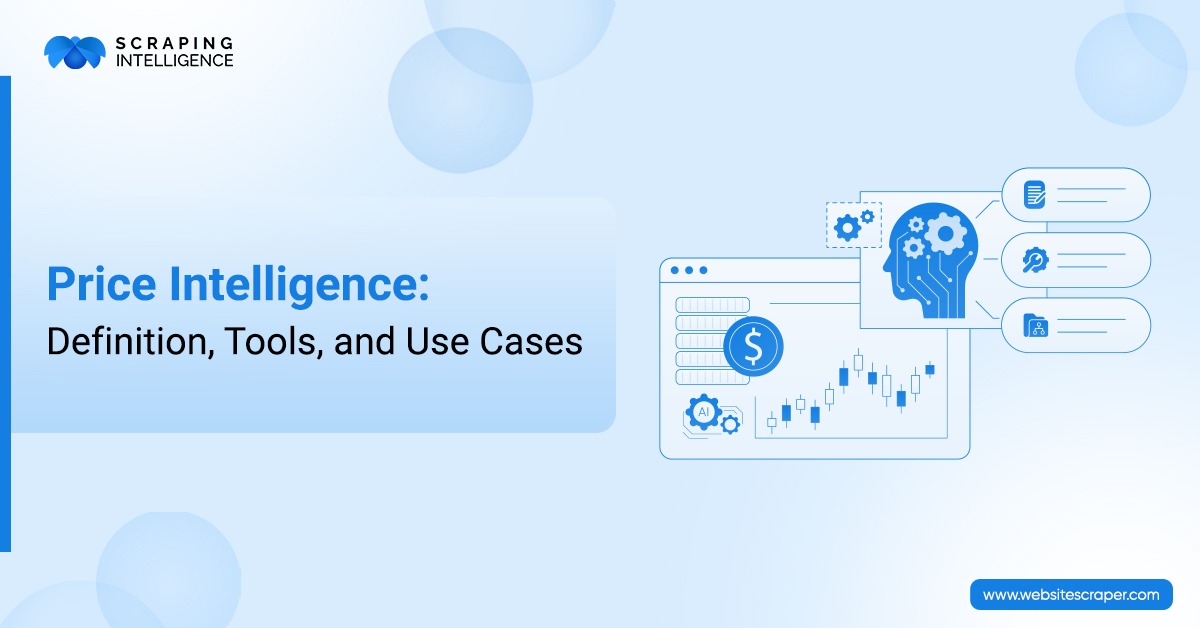
What Is Price Intelligence? Definition, Tools, and Use Cases
Category
Services
Publish Date
February 09, 2026
Author
Scraping Intelligence
The use of price intelligence is a necessity for businesses today and is absolutely imperative given the need for data-driven competitive pricing strategies. In today's digital market, companies are competing aggressively for the same customers. So if a business lacks an up-to-date pricing strategy, it risks losing market share to a more agile competitor.
To compete effectively in a hyper-competitive environment and establish a price point, companies must understand how competitors set prices for similar products and services. That is where businesses can get most of their benefit from price intelligence. Price intelligence has become a crucial component in the equation for data engineers, data leads, and analysts who perform analysis and implement these strategies correctly.
This blog post explains price intelligence, the tools that support it, and how companies can use it most effectively.
What Is Price Intelligence?
Price intelligence is the process of using technology and data to collect, analyze, and adjust pricing strategies on an ongoing basis. Price intelligence helps companies understand pricing by gathering data on competitors and applying advanced analytics. This understanding allows businesses to set the correct prices for their products and services. By doing so, they can increase profits while staying competitive in the market.
Key Elements of Price Intelligence
Price intelligence has several vital parts that work together:
Collecting data from competitors, online marketplaces, and changing market trends.
Using AI and machine learning to predict prices.
Change prices in real time and improve them continuously.
Analyze competitors to see where you stand in the market.
The purpose of price intelligence tools is to convert raw data into highly valuable information. With price intelligence tools, businesses can respond quickly and accurately to market changes, helping them stay competitive.
Why Does Price Intelligence Matter?
Switching from traditional to real-time, data-driven pricing for your products and services is a significant shift in how businesses operate. This change can give your company an advantage over competitors who still rely on price intelligence.
In the past, businesses set prices by adding a fixed markup to their costs. They also conducted manual price evaluations from time to time. Dynamic factors, including current market conditions, competitive responses, and consumer demand patterns, inform today's data-driven pricing decisions. Businesses can make more informed decisions and optimize revenue while still providing high-quality service to their customers.
Scraping Intelligence also enables businesses that use price intelligence to develop fully integrated programs that deliver results across a wide range of business sectors.
How Does Price Intelligence Work?
Understanding the process of price intelligence for businesses will help you apply it successfully. Price intelligence follows multiple processes that, when used together, create pricing strategies based on raw data.
Data Collection
Companies collect pricing data from many sources (such as web scraping, API endpoints, and crawl systems). Scraping Intelligence can accurately extract price data about your competitors, marketplaces, and other industry outlets.
By automatically navigating competitor websites, a Web Crawler collects data on product prices, sales promotions, and product availability. On the other hand, API access provides structured data directly from most marketplaces/suppliers. Each of these methods provides you with detailed coverage of the entire market.
Data Analysis
Once collected, price data requires advanced analysis. Pricing analytics platforms leverage big data analytics to find patterns, trends, and opportunities. Then, data engineers build reliable data pipelines to cleanse, normalize, and structure this information so you may analyze it.
By utilizing advanced analytics, businesses can uncover valuable insight into competitor pricing patterns and price elasticity by product category. Additionally, businesses will easily find optimal pricing for the goods or services they provide within their industry, taking into account their competitive position and the amount of profit margins they expect/need.
Automation & Optimization
Automated Dynamic Pricing Systems make pricing decisions through automated calculations based on predefined rules and market conditions. The system tracks competitor prices and changes our prices when certain limits are reached.
Price Optimization Software uses machine learning algorithms to determine the optimal price the business can charge, enabling it to respond quickly to market conditions within an hour instead of days.
Real-World Applications
Many industries use price intelligence to gain a competitive edge. For example, e-commerce retailers routinely monitor the prices of thousands of competitors each day to retain their market share.
Travel companies will change their airfares and hotel rates based on anticipated demand. Manufacturers of consumer goods will set the best pricing levels based on actual pricing data relative to the local marketplace where they sell their products.
Top Price Intelligence Tools and Platforms
Choosing the correct pricing optimization tool is vital in successfully executing a pricing strategy. The pricing optimization tools used in implementation will differ by industry, and their designs will align with each industry's unique technical specifications.
Popular Tools Categories
Price scraping tools form the foundation of data collection. It automatically scrapes competitors' websites for pricing information. Scraping Intelligence is a strong solution for complex websites and large amounts of data.
Competitive intelligence platforms enable data collection from multiple sources and provide analytical dashboards. It allows businesses to quickly see how competitors are positioning themselves in the market and spot trends.
Dynamic pricing is the most dynamic of all price intelligence solutions available today. Machine Learning helps algorithms predict the best offer price by looking at past prices, competitor actions, and expected demand.
Essential Tool Features
When evaluating price intelligence software, data engineers and analysts focus on specific capabilities.
The most common criteria include:
Real-time Data Updating, which means your decision-making is based on the latest market information.
AI can help predict trends and automatically improve processes.
You can create your own metrics and key performance indicators (KPIs) that fit your business.
The software can easily connect to your existing data systems via API integration.
Scalability allows you to handle more data as your business grows and to enter new markets.
Scraping Intelligence offers customizable solutions that integrate with your existing technology, ensuring a smooth implementation.
Use Cases of Price Intelligence
Price intelligence has been a great help in various sectors and several business types so far. The following examples illustrate how different businesses can use price intelligence technology to gain a competitive edge.
E-commerce & Retail
E-commerce businesses today face intense pricing pressure due to the many products available in the market.
To stay competitive while keeping their profits, retailers can use competitive pricing analysis to find the best prices for their products.
Online retailers can use price intelligence to track their competitors' prices on major websites. It helps them respond quickly to price changes and identify opportunities to adjust prices on items that aren't selling well.
By leveraging Scraping Intelligence for detailed competitor price monitoring, e-commerce retailers can capitalize on market opportunities. This approach can lead to more sales and stable profit margins.
Travel & Hospitality
Dynamic pricing was pioneered by the travel industry many years ago. Today, modern real-time price intelligence has evolved to a much higher level of sophistication.
Airlines use a variety of factors (i.e., competitor fares, booking patterns, seasonal demand, proximity to flight date) to adjust ticket prices. Hotels use similar methods to fill their rooms and increase revenue.
By working together, travel companies can boost income during busy travel periods and remain competitive during low-demand periods.
Consumer Goods
Companies that make or sell consumer goods face specific pricing challenges in their retail channels and regional markets. By leveraging price intelligence, these companies can effectively tackle pricing challenges, regardless of their complexity.
Companies employ pricing optimization techniques to determine how to bundle products, apply regional pricing in line with local markets, and establish a unique pricing strategy for each sales channel (retail, wholesale, and direct).
Software & SaaS
Compared to traditional product businesses, subscription-based businesses require a different pricing approach. Price intelligence helps SaaS businesses optimize their pricing tiers, feature packages, and renewal strategies.
By comparing competitor subscription models, feature sets, and pricing structures, software companies can position their products more effectively against competitors. Software companies also use data analysis to identify the optimal price point, enabling them to balance customer acquisition with lifetime value.
Why Price Intelligence Is Essential for Data Engineers and Analysts
Technical professionals play a key role in setting up and improving price intelligence systems. Their technical skills ensure that pricing data is accurate. They also ensure that the systems providing this data are reliable and add value to their organization.
Data-Driven Decisions
Organizations can use price intelligence to make better pricing decisions based on data rather than just intuition or outdated market assumptions. Data engineers build databases that collect and organize pricing data. They process this information into practical formats, like reports, and provide it to the Chief Pricing Officer (CPO) for decision-making.
Improved Accuracy
Accurate data is critical for proper pricing decisions. Whether the price is fair depends on how accurate the data are. Our engineers ensure accuracy by using validation algorithms, normalizing data, and monitoring data quality through online reporting dashboards. The tools developed by Scraping Intelligence can accurately gather data regardless of changes in how the target website presents that information.
Advanced Analytics
Data Analysts turn raw price data into valuable insights. They use time-series analysis, price elasticities, and predictive forecasts to understand competitors' strategies, spot market trends, and find areas for improvement. This work provides companies and clients with a clear understanding of market dynamics, helping them develop effective strategic plans.
How to Implement Price Intelligence in Your Business?
To use price intelligence effectively, follow a clear plan that reduces disruption and maximizes benefits.
1. Choose the Right Tools
Choose your pricing tools based on your business goals and objectives. Consider the following: the number of websites, how frequently you want to access pricing data from each site, and the complexity of retrieving pricing information from each site. Scraping Intelligence will provide the right tools for your specific needs.
2. Add to Your Data Infrastructure
Price intelligence data is delivered via api integrations from data engineers (e.g., database connections, api connections, data pipelines). So it can flow effortlessly from the primary data warehouse into existing analytics platforms or BI solutions.
3. Automatic Data Collection and Real Time
Develop automated schedule(s) for data collection while balancing currentness with resource consumption. Real-time price intelligence generally requires more frequent updates for fast-moving markets, but sometimes requires only infrequent updates, if at all, for categories of products that remain stable.
4. Identify and Track Key Metrics
Set up key metrics to measure how well your price intelligence system works. It includes the price competitiveness index, margin preservation rate, revenue impact from dynamic pricing, changes in conversion rates, and market share trends.
5. Optimize on an Ongoing Basis
Price intelligence is not a "set it & forget" system. Continuous optimization will produce improved accuracy and business impact over time. Review your pricing strategies weekly, develop new strategies through controlled experiments, and use test results to refine your pricing algorithms.
Conclusion
Price Intelligence offers companies new ways to approach their pricing strategies by providing access to large amounts of structured and unstructured data, advanced statistical methods, and sophisticated pricing automation tools. By using price intelligence technology, businesses are now experiencing greater competitive advantage and higher profitability.
Using the tools and methods discussed within this post, data professionals, analysts & business leaders can make real-time decisions based upon data-driven pricing strategies that accurately reflect the current marketplace. Additionally, this type of pricing intelligence technology can grow alongside your business, enabling you to expand into new geographic markets or additional product categories.
If your business would like to implement a fully integrated, data-driven price intelligence solution, please get in touch with Scraping Intelligence today. We will collaborate closely with you to support the technical aspects of the implementation. Our objective is to ensure you see a measurable return on your investment within a reasonable timeframe.
Frequently Asked Questions
What is the role of price intelligence in pricing optimization?+
Price intelligence helps businesses set better prices. It gathers information on competitor prices, market trends, and customer demand. This data allows algorithms to find the best price points for products.
How do businesses collect price intelligence data?+
Companies collect pricing information using web scraping, API integrations, and marketplace feeds. Scraping Intelligence specializes in automated methods for gathering prices, discounts, and product availability from competitor websites.
What tools are used for price intelligence?+
Price intelligence software helps businesses track product prices. It includes tools for web scraping, competitive analysis dashboards, and dynamic pricing systems that adjust prices automatically using AI. Scraping Intelligence provides tools for collecting, processing, and delivering this data.
Can price intelligence help businesses reduce costs?+
Price intelligence helps reduce costs. It does this by optimizing promotional spending, reducing manual pricing tasks, and preventing profit loss. Automated systems save time by eliminating the need for manual price checks while keeping prices competitive.
How does price intelligence impact e-commerce?+
Price intelligence changes how e-commerce businesses operate. It allows companies to monitor competitors in real time, adjust prices quickly, and develop more effective promotional strategies. Businesses that use these systems usually see higher conversion rates and improved profit margins.
Let's Talk About Your Data Needs
Tell us what data you need, and we'll help you find the right solution.
Scraping Intelligence Editorial Team is a collective of data specialists, analysts, and researchers with expertise in web scraping, data extraction, and market intelligence. The team produces well-researched guides, actionable insights, and industry-focused resources that help businesses unlock the value of data and make informed, strategic decisions.
Latest Blog
Explore our latest content pieces for every industry and audience seeking information about data scraping and advanced tools.
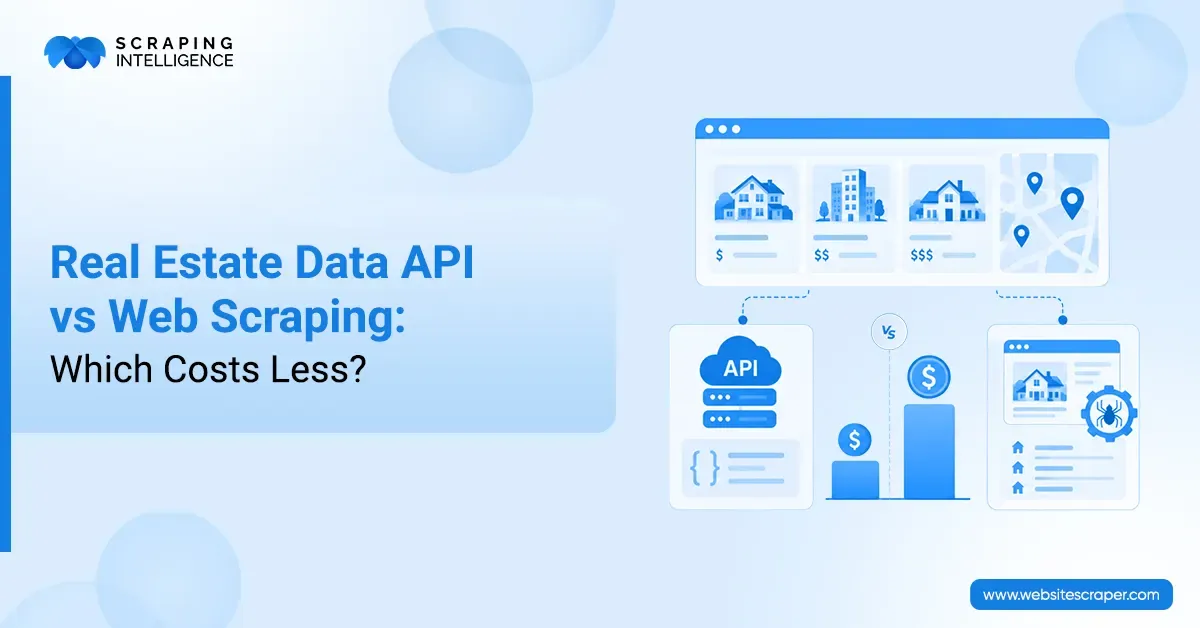
Compare real estate data APIs vs. web scraping costs, including setup, infrastructure, maintenance, and data quality, to find the right solution for your needs.
See how the travel industry uses web scraping to track fares, room rates, availability, and reviews, plus how to choose the right data extraction solution.