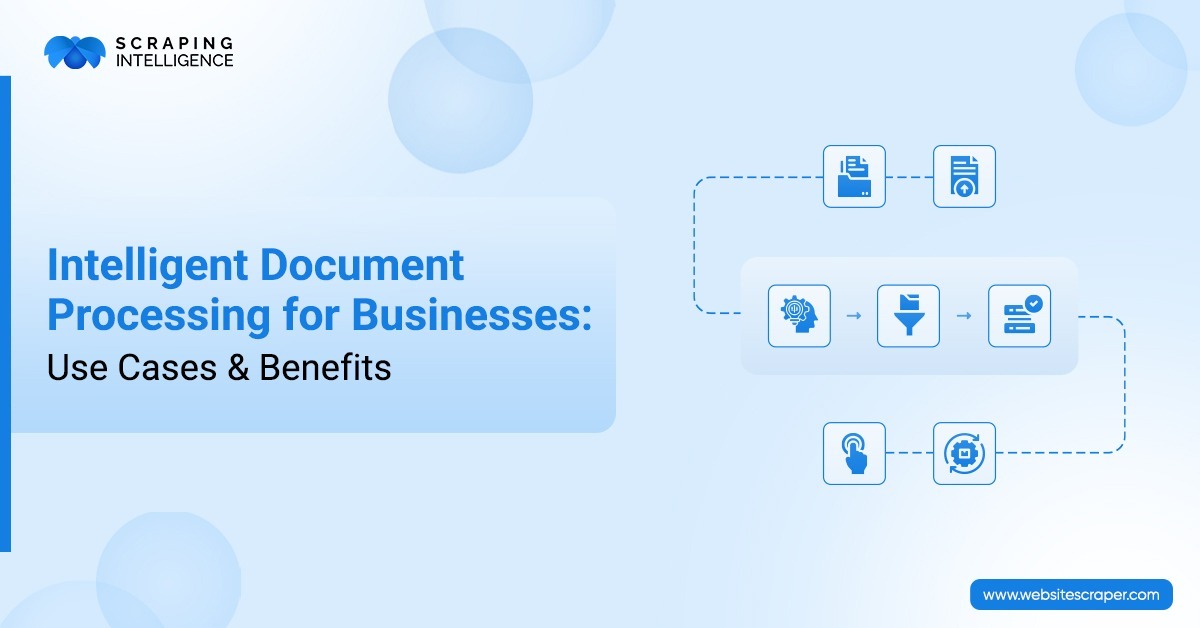
Intelligent Document Processing for Businesses: Use Cases & Benefits
Category
Artificial Intelligence
Publish Date
May 22, 2026
Author
Scraping Intelligence
A daunting volume of paperwork is a reality for many organizations. Invoices pile up, contracts sit unread, and customer forms fill folders. Additionally, employees can spend hours manually entering data, and manual data entry often leads to errors. Collectively, this problem costs businesses millions of dollars each year.
There is a more efficient way to handle document workflows. Intelligent Document Processing (IDP) is an artificial intelligence solution that automatically reads, extracts and archives information from virtually any document. Instead of hiring additional staff to manage growing document volumes, businesses can use IDP technology to process documents faster, more accurately, and at lower cost.
This guide explains IDP, how it works, its primary benefits, examples of IDP in action, and how to implement IDP effectively.
What is Intelligent Document Processing (IDP)?
Intelligent document processing is the application of AI to the capture, classification, and extraction of data from business documents, whether those documents are structured PDFs, handwritten forms, scanned receipts, or anything in between. Rule based tools from a decade ago needed a fixed template for every document layout. Swap a vendor's invoice format and the whole extraction failed. Document automation software built on IDP works differently: it reads document content the way a trained analyst would, inferring field meaning from context rather than position.
Core Components of IDP
OCR is Optical Character Recognition: To digitize scanned images, photos or printed content. OCR technology can recognize characters in typed text with 95% to 99% accuracy and continues to improve with each document processed.
NLP: NLP stands for Natural Language Processing. It can understand the meaning of a text versus simply identifying character positions, thus making it easier to accurately classify and extract data from document formats that were unfamiliar at the time they were set up.
Machine Learning Models: Work by adding to that database each time you process a document, thus improving your extraction accuracy over time. They are also able to better handle edge cases, strange layouts and new types of documents without requiring an update to a manual rulebook.
Document Types IDP Handles
Invoices and vendor receipts
Contracts and legal agreements
KYC packets and onboarding forms
Shipping records and customs paperwork
Medical records and insurance claims
Emails and unstructured file attachments
Why Businesses Need IDP in 2026?
According to IDC, organizations worldwide now manage over 7.5 trillion documents, a figure that grows year on year. U.S businesses lose more than $8 billion annually to manual document processing errors and delays. That cost bleeds across departments as late vendor payments, failed audit reviews, compliance gaps, and customer onboarding timelines that run far longer than they need to.
Regulatory scrutiny in finance, healthcare, and logistics has intensified. Inconsistent manual records are increasingly difficult to defend under audit. McKinsey research on business document automation established that AI-driven document workflows reduce data entry errors by 90 percent and cut processing time by 80 percent. At those performance levels, most organizations recover the platform investment within the first twelve months of deployment.
IDP vs. Traditional Document Processing
Feature
Traditional Processing
Intelligent Document Processing
Data Extraction
Manual entry or fixed templates
AI-driven, context-aware extraction
Document Types
Structured formats only
Structured, unstructured, handwritten
Accuracy Rate
60 to 75% with frequent errors
95 to 99% with ML validation
Processing Speed
Hours to days
Seconds to minutes
Scalability
Requires additional headcount
Scales automatically with volume
Cost per Document
High, labor dependent
Significantly lower at scale
Compliance Logging
Manual, inconsistent
Automated, timestamped logs
Key Benefits of Intelligent Document Processing
The business case for IDP solutions is grounded in six consistent, measurable outcomes:
Automated Data Extraction from Lengthy Complex Documents:
Invoice, contract, and form data extraction no longer requires manual entry—all data is pulled automatically without manual entry.
Higher Accuracy with AI Models: Extraction accuracy rate between 95% and 99%. Extraction errors related to employee fatigue are non-existent during heavy processing workloads when using AI-based extraction.
Faster Document Turnaround Times: Tasks that previously required 2 hours of staff time will be completed in minutes. Timely approval queues lead to on-time payments, while reducing invoice delays helps businesses avoid late payments.
Operational Costs Reduced: 40%-70% document data extraction cost through the first year of operations will provide most organizations with savings.
Audit Logs with Compliance-Ready Status: Date-stamped times will be automatically generated whenever a document is extracted. As a result of having organized and complete documentation in the event of any audit, all documentation will be fully documented and supported.
Seamless System Integration: Intelligent document processing platforms connect with existing enterprise systems, including ERPs, CRMs, and document management platforms. This ensures extracted data flows securely and automatically between systems without manual intervention.
Top Use Cases of Intelligent Document Processing
The top use cases of the Intelligent Document Processing are:
Invoice and Accounts Payable Automation
Invoice processing automation reads each vendor invoice regardless of layout, extracts line item data, matches it against purchase orders, and routes the document for approval without anyone touching a keyboard. Finance teams running IDP on AP workflows report invoice cycle times 60 to 80 percent shorter than their prior manual baseline.
Contract Analysis and Management
A missed renewal clause in a vendor contract is an expensive oversight. IDP applies NLP to scan contract language for renewal dates, non standard terms, and liability provisions, then flags anything that requires attorney review before it becomes a problem. Teams that automate invoice and contract processing together reduce legal and financial exposure simultaneously, without growing either department.
Logistics and Shipping Document Processing
OCR data extraction processes bills of lading, customs declarations, packing lists, and delivery receipts regardless of which carrier issued them. Extracted data enters the logistics platform immediately. Discrepancies are caught at the data entry stage, not discovered later when a shipment is already sitting at customs.
Customer Onboarding (KYC and Forms)
KYC verification requires reading identity documents, cross referencing regulatory requirements, and logging the outcome, all within tight compliance windows. IDP handles that process end to end. Banks and fintechs using AI data extraction services for onboarding consistently report verification timelines falling from multiple business days to under two hours.
Email and Unstructured Data Extraction
IDP parses incoming email content and attachments, identifies the data fields that matter, purchase order numbers, complaint categories, account references, and routes each item to the right team. Response times improve because items no longer sit waiting for manual reading and redirection.
Healthcare and Insurance Document Processing
Data in clinical records, prior authorizations and claims are important to patient outcomes and organizational liability. IDP accurately processes the above documents and is compliant with regulatory standards. Claims are processed 70% faster on average and care teams have reliable access to structured patient data from multiple departments.
Leverage greater efficiency, accuracy, and operational scalability with AI-powered Intelligent Document Processing (IDP) business solutions.
Cost Savings
Organizations that commit to IDP solutions typically reduce document processing costs by 40 to 70 percent in year one. Labor dependency drops sharply, error correction cycles shrink, and the per document cost falls as volume increases.
Time Efficiency
Eighty percent or better processing speed improvement is standard after IDP deployment. Staff previously tied up in data entry move to work that requires actual analysis rather than repetitive transcription.
Accuracy and Compliance
AI validation catches errors before bad data enters your systems. Every extraction event is logged with a timestamp, which simplifies compliance reporting considerably.
Scalability
End-of-quarter volume spikes, new product launches, rapid growth, none of these strain an IDP platform the way they strain teams doing the same work manually. Throughput scales without accuracy degrading or headcount increasing.
How to Implement Intelligent Document Processing?
Implementation quality separates organizations that see a return in year one from those that spend year one fixing avoidable data quality problems. A structured approach makes the difference.
Spot Document-Driven Workflows:
Find tasks that involve employees manually handling documents. Use workflows if you have a lot of documents and you make a lot of mistakes.
Define Extraction Requirements:
Prior to discussion with any vendors, create a list of required fields for your types of documents. Without this information, it will be extremely difficult to evaluate IDP platforms.
Explore AI-Powered IDP Solutions:
When evaluating the top IDP vendors, consider the following four critical factors: OCR accuracy, depth of NLP, integration with commonly used systems, and compliance logging. Avoid solutions that require custom development on existing document types because they are not production-ready.
Connect IDP Solution to Existing Systems:
To ensure that the IDP solution provides a seamless connection between your extracted data and endpoint, verify that the IDP solution works with your ERP, CRM, and Document Management Systems.
Train Specialized Model:
IDP solutions work well for any standards-based document type. For documents that are not standard, such as unique format, poor layout, or very high variance, you will need to train on the document type prior to deploying it using the IDP solution.
Monitor Performance and Plan for Future Expansion:
Performance will be tracked for the first quarter and will determine the timing of when to refresh models and which document-centric workflows can be automated next.
Scraping Intelligence builds intelligent document processing pipelines that integrate with existing infrastructure directly. No platform overhaul is required to get started.
Conclusion
Manual document processing has a measurable cost and a proven alternative. Intelligent document processing cuts that cost substantially, reduces error rates to near zero, and produces compliance records that regulators accept without question. The ROI case is well established across industries and the technology is mature enough that deployment risk is low.
Whether the priority is automated document processing for accounts payable, contract risk management, logistics operations, or patient record handling, the performance gains are consistent. Scraping Intelligence provides document data extraction and AI data extraction services designed around your organization's actual document environment, not a generic template. Contact Scraping Intelligence to identify where business document automation will create the most immediate operational impact.
Frequently Asked Questions
What is Intelligent Document Processing?+
Intelligent document processing is an AI-powered system that captures, classifies, and extracts data from business documents automatically, cutting manual handling and significantly improving data accuracy across operations.
How does IDP work?+
OCR digitizes document content, the NLP determines the meaning of the content and type of document, and the machine learning validates the extracted data and pushes it into the connected business systems.
What types of documents can IDP process?+
Invoices, contracts, KYC packets, shipping records, medical records, insurance claims, emails, and most other structured or unstructured document formats fall within scope for a properly configured IDP platform.
How accurate is OCR in IDP?+
OCR data extraction in current generation IDP platforms reaches 95 to 99 percent accuracy on printed and typed documents. Accuracy continues improving as the underlying machine learning models process more document volume over time.
Can IDP process handwritten documents?+
Dedicated handwriting recognition models handle handwritten content with accuracy that typically falls between 85 and 95 percent. Legibility and training data volume are the two main factors that determine where in that range performance lands.
Share this article:
About the Author
Scraping Intelligence
Scraping Intelligence Editorial Team is a collective of data specialists, analysts, and researchers with expertise in web scraping, data extraction, and market intelligence. The team produces well-researched guides, actionable insights, and industry-focused resources that help businesses unlock the value of data and make informed, strategic decisions.
Latest Blog
Explore our latest content pieces for every industry and audience seeking information about data scraping and advanced tools.
See how the travel industry uses web scraping to track fares, room rates, availability, and reviews, plus how to choose the right data extraction solution.
Discover how real estate web scraping helps agents, investors & brokers extract listings, prices & market trends. See 7 key benefits of real estate data scraping.