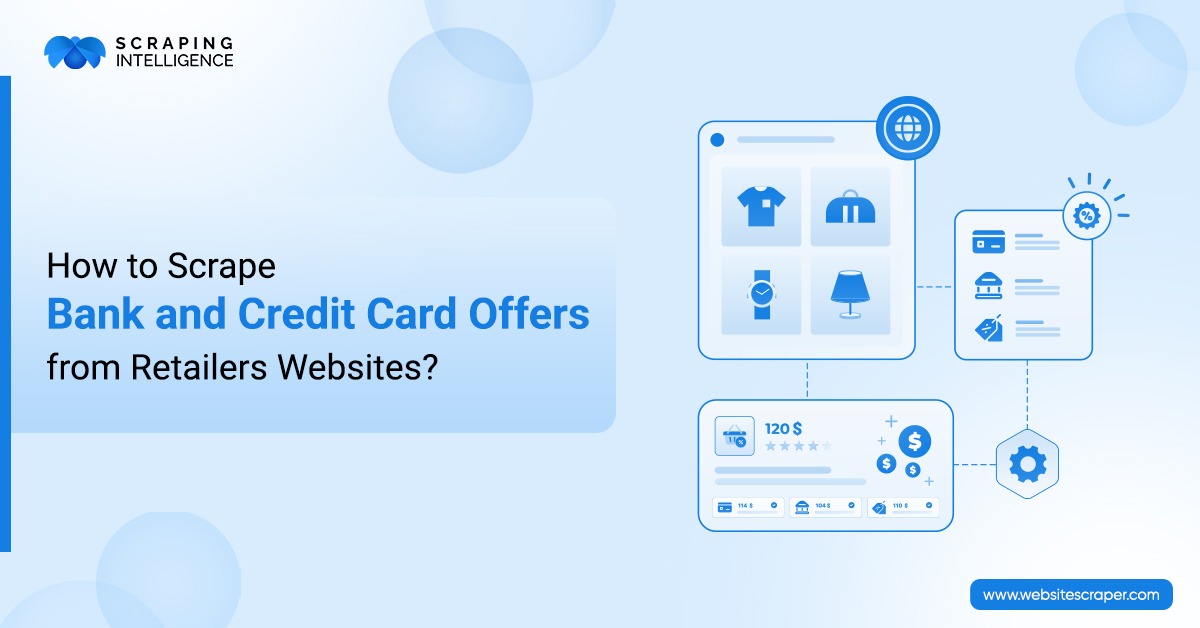
How to Scrape Bank and Credit Card Offers from Retailers’ Websites?
Category
E-Commerce & Retail
Publish Date
April 22, 2026
Author
Scraping Intelligence
Retailers today are constantly facing difficulties in staying ahead of the competition, strengthening brand presence, and delivering customer value. Bank and credit card offers include valuable data such as cashback, EMI options, and eligibility criteria, and more. This information is valuable for retailers and e-commerce business owners. Businesses with data scraped from a retailer's website, such as Amazon, Flipkart, eBay, etc., can gain a competitive advantage. Scraping Intelligence here can collect high-quality structured bank and credit card offers from these types of e-commerce sites so that you can easily outpace the competition. This blog describes a step-by-step process to scrape bank and credit card offers from retailers' websites.
What Are Bank and Credit Card Offers on Retail Websites?
Bank and credit card offers on retail websites refer to a discount, no-cost EMI, reward points, and others. This data empowers both banks and retailers to achieve higher overall revenue and stronger repeat business.
Let’s consider an e-commerce example of the Amazon website. We consider this platform because it is used worldwide for online shopping. Now, we can scrape data to collect typical percentages, partner bank names, targeted items, and minimum transaction amounts. This data is valuable for retailers to forecast evolving market trends and make data-driven decisions.
Why Scrape Bank and Credit Card Offers Data?
Retailers' websites feature important bank and credit card offers that banks and retailers use for various purposes.
Competitor Analysis: Bank and credit card data are essential for market analysis to understand competition. Retailers can use this data to understand the competition and identify their market position. They can even spot consumer trends to anticipate demand and plan inventory better.
Identify Customer Trends: Identifying customer preferences is crucial to run the business successfully. Banks or e-commerce site owners collect a massive amount of web data to tailor product offerings to match customer needs and increase satisfaction. Startups often struggle to stand out in the market. If they analyze competitors’ data to identify gaps, they can develop a unique value perception.
Pricing & Promotion Strategy: Businesses increase their revenue by attracting more customers. To do so, their pricing and promotion strategy should be effective enough to stay competitive. Retailers with web and credit card data help to achieve this goal. Information scraped from ShopClues, Myntra, and similar e-commerce websites includes details on cashbacks and discounts, welcome perks, and EMI, which help build brand loyalty and strengthen customer trust.
Campaign Benchmarking: If you are in the e-commerce business, you must track campaign success. By extracting and collecting potential competitors’ data can seamlessly measure your campaign performance. This data drives decision-making and supports smarter planning.
Real-time Deal Aggregation Platforms: Imagine having a personal assistant that scans the entire web for sales. That is exactly what a real-time deal platform does. By centralizing offers, it removes the clutter and helps you navigate the noise, making the path to your next purchase faster and significantly cheaper.
Affiliate Marketing Optimization: Retailers that utilize competitors’ data are likely to increase traffic and attract more customers. By targeting the right audience, organizations can develop effective promotion strategies. Web data provides a broader market presence, enhancing brand visibility.
Key Data Fields to Extract from Retail Websites
Fintech companies, banks, financial institutions, and others can automatically scrape large-scale data from retail websites to develop smarter strategies and save time and resources. The potential data they can gather is:
Instant discounts and percentages
Co-branded card promotions
By now and pay later deals
Limited-time sale offers
Signup or activation bonuses
Minimum purchase requirements
Category-specific offers
No cost-EMI options
Cashback
Bank name
Standard APR
Card name and type
Promotional APR
How to Scrape Bank and Credit Card Offers?
Scraping bank and credit card offers is relatively easy if you follow the steps mentioned below:
Step 1: Identify Target Retail Websites
First, identify the website you wish to scrape data from. It can be a popular e-commerce website, such as Amazon, Myntra, Flipkart, etc., or some niche platforms, such as electronics, travel, food, and more. This will provide accurate insights, save your time and resources, and avoid irrelevant sites.
Step 2: Inspect Website Structure
Inspect the website structure or HTML elements by pressing F12 in any browser. It will enable you to see offer banners and modals. If your target website uses dynamic webpages, you will be able to identify JavaScript-based offers.
Step 3: Choose the Right Scraping Tools
The third step is to use the Python programming language. We use it because it provides broad platforms such as Scrapy, BeautifulSoup, and Selenium to achieve our data scraping intention. An alternative way is to use official APIs (if available). You also need to consider headless browsers like Puppeteer and Chrome for seamless data extraction.
Step 4: Extract and Structure the Data
Now, to extract the structured and deeper data, parse the offer section. The next task includes normalizing collected fields such as bank, validity, discount, and more.
Step 5: Store and Automate Data Collection
When data scraping and normalizing are completed, you have to store it in the database, including JSON, SQL, and CSV. You can also set your scraping frequency to daily or real-time.
Challenges in Scraping Credit Card Offers Data
When you scrape data from any retail website or platform, you may face some challenges mentioned below.
Dynamic Content (AJAX/JavaScript rendering): Websites that load dynamic content via JavaScript or AJAX are a hard nut to crack. You can employ headless browsers, such as Chrome and Puppeteer, to extract rendered HTML.
CAPTCHA & Anti-Bot Protection: The common issue you face when you extract discounts, cashback offers, and other data from an e-commerce website is CAPTCHA. You can use a CAPTCHA solver or rotate IP addresses.
Frequently Changing Offers: Many websites frequently change their offers. You can solve this issue by automating the refresh cycle. Sometimes, this is to overcome this challenge, you may also schedule regular scraping.
Unstructured T&C Text: Inconsistency in the T&C text is another issue that you may have to face when you collect web information. Always apply the text parsing rules to extract key clauses. Another way is to use NLP techniques, which help identify legal patterns.
Geo-Specific Offers: This issue occurs when you specifically extract bank and credit card offers. Detecting user location enables you to match the correct offers. You can also use geo-targeted proxies when accessing region-specific data.
Use Cases of Bank and Credit Card Offers Data
The extraction of Bank and credit card offers data scraping has diverse use cases.
Price Comparison Platforms: By integrating card discounts, price comparison platforms can show extra savings. To make this possible, they should harvest data from e-commerce websites. Comparison Shopping Engines scrape and analyze competitors’ data to monitor cashback offers and attract potential customers. They provide personalized suggestions that align with user preferences.
Retail Analytics Dashboards: Data scraped from the e-commerce website is like a basic framework for analysis. This analysis is possible by developing a retail analytics dashboard. Businesses can use such a dashboard to benchmark the offers they are providing with competitors. This powerful way helps them identify stronger partnerships.
Affiliate Marketing Platforms: Affiliate marketing platforms enrich their deal listings by utilizing data collected from e-commerce websites, providing more attractive offers. They even personalize deals by card type and improve targeting & conversions. Through integrating cashback opportunities, affiliate marketing platforms boost user engagement.
Fintech & Banking Insights: Financial technology and banking insights empower fintech startups to analyze customer spending trends and understand purchase behavior. By detecting regional spending shifts, they can strengthen their retention strategies.
Deal Aggregation Websites: Discount aggregation or deal aggregation platforms use competitors’ to aggregate bank promotions into a centralized offer hub. Putting out these empowers deal-aggression websites to display card-linked deals, enrich deal listings, bundle retailer and card savings to show maximum discount value.
How Does Scraping Intelligence Help You Scrape Retailer Offers?
Aggregate Multi-Bank Offers: Scraping Intelligence enables you to expand offer coverage and capture wider opportunities. It helps you compare top banks to identify deals.
Detect Real-Time Promotions: Our organization identifies promotions in real-time, ensuring timely customer updates. We help your business track offers that frequently change to spot market trends quickly.
Clean Structured Output: Scraping Intelligence provides an enterprise-level data extraction service provider that ensures delivering clean and structured output for forecasting trends. It delivers data in a wide range of formats, including data in JSON, CSV, Excel, or your preferred format.
Automated Offer Monitoring: We develop a scraper that automatically monitors offers. Our firm ensures that you save your time and resources so that you can focus on other important business tasks. It reduces errors and increases trend forecasting ability.
Customize Solution: Scraping Intelligence provides customized solutions based on your business requirements. We have a flexible scraping model that can be adopted by any industry.
Data is a foundation that drives decision-making. Without an automated data scraping approach, you have to collect data manually; this process is slow and error-prone. It will also provide limited market visibility. If you want to stand out in the market, extracting bank and credit card offers from retailers' websites is significant.
This blog guides you through the process. Get started with Scraping Intelligence today.
Frequently Asked Questions
What are the bank and credit card offers on retail websites?+
Bank and credit card offers on retail websites, such as no-cost EMIs, discounts, reward points, and cashback schemes, are powerful marketing tools that help retailers and banks increase revenue and gain a competitive edge.
Who needs to scrape bank and credit card offers from retailers' websites?+
Bank and credit card offers from retailers' websites are primarily scraped by price comparison platforms, retail analytics dashboards, affiliate marketing platforms, deal aggregation websites, and retailer & e-commerce platforms.
What are the challenges in scraping credit card offers data?+
When you scrape credit card offer data from a retailer's website, you may face challenges such as dynamic content, CAPTCHA & anti-Bot protection, and frequently changing offers.
What bank and credit card offers can be scraped from retailers' websites?+
You can scrape bank and credit card offers, such as no-cost EMI, EMI cashbacks, reward points, discounts, etc.
Is scraping bank and credit card offers from retailers' websites legal?+
Scraping bank and credit card offers from retailers' websites is legal only if you do so ethically, by following regulations and terms of service.
Share this article:
About the Author
Scraping Intelligence
Scraping Intelligence Editorial Team is a collective of data specialists, analysts, and researchers with expertise in web scraping, data extraction, and market intelligence. The team produces well-researched guides, actionable insights, and industry-focused resources that help businesses unlock the value of data and make informed, strategic decisions.
Latest Blog
Explore our latest content pieces for every industry and audience seeking information about data scraping and advanced tools.