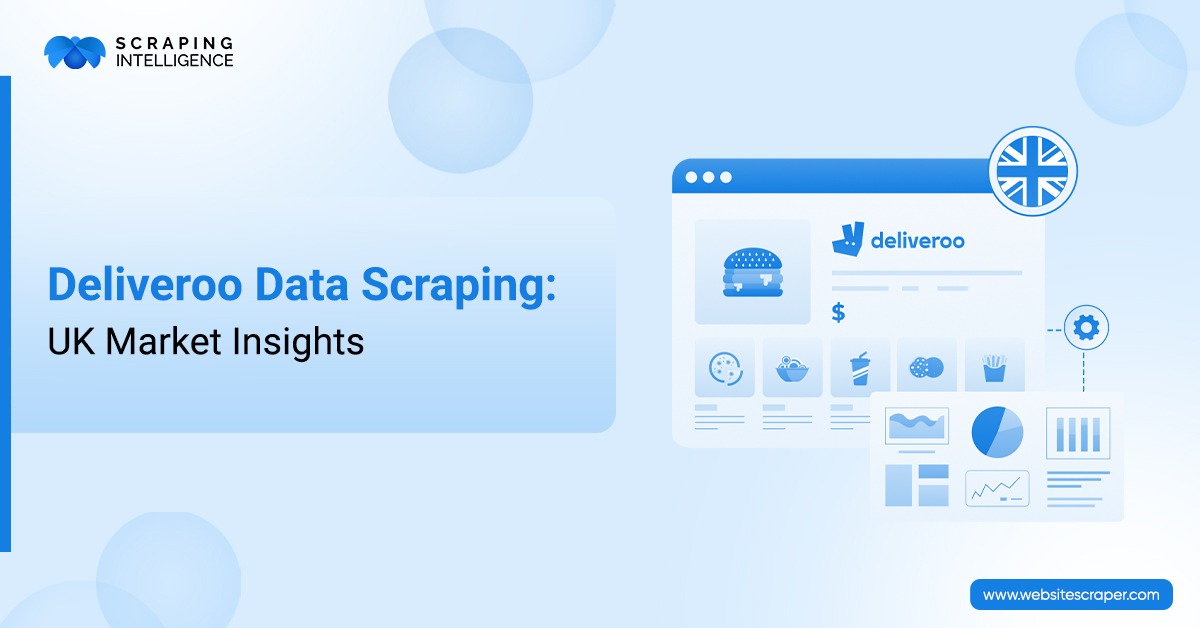
The Ultimate Guide to Deliveroo Data Scraping for UK Market Insights
Category
Food & Restaurant
Publish Date
April 17, 2026
Author
Scraping Intelligence
UK food delivery has turned into one of the most competitive digital markets in Europe. Restaurant owners change prices without notice. New ghost kitchens launch every week. Promotional strategies shift depending on what competitors do, sometimes within the same day.
Businesses that wait for quarterly reports or rely on manual platform checks are working with outdated information. That gap between what the market is doing and what a business knows about it creates real commercial risk. Structured, automated data extraction from major delivery platforms has become one of the most practical ways to close that gap. This guide walks through what Deliveroo data scraping involves, how it works technically, what the legal position is in the UK, and how it translates into usable market intelligence.
What Is Deliveroo Data Scraping, and What Does It Actually Cover?
Deliveroo data scraping means collecting publicly visible platform data automatically rather than manually. Every piece of information a regular visitor can see on Deliveroo without logging in is fair territory: restaurant names, addresses, full menus with prices, customer ratings, review counts, delivery time estimates, cuisine tags, operating hours, and active promotional offers.
The key distinction worth making early is that this process does not involve accessing private records, user accounts, or anything behind an authentication wall. It fetches surface-level data that Deliveroo already presents publicly, then organises it into structured formats suited to analysis.
Statista recorded the UK online food delivery market at over £14 billion in 2023. That figure alone explains why real-time Deliveroo restaurant data has become a serious intelligence asset rather than a niche technical exercise. Scraping Intelligence provides structured access to this data for UK businesses across research, operations, and investment.
What Data Is Actually Available Through Deliveroo Scraping?
Businesses new to Deliveroo web scraping frequently underestimate how much commercially relevant data the platform exposes publicly. The table below covers the main categories and what each one enables analytically.
Data Category
Analytical Application
Restaurant names and locations
Competitive mapping at the city and postcode level
Menu items with current prices
Pricing benchmarks and margin analysis
Customer ratings and review volumes
Brand performance and competitive health tracking
Delivery time estimates
Operational benchmarking across market segments
Cuisine categories and tags
Market segmentation and opportunity gap analysis
Live promotional offers
Campaign monitoring and offer strategy intelligence
Per restaurant operating hours
Demand pattern forecasting and availability analysis
Individual data categories answer specific questions. Combined across a city or region, they produce a granular, regularly refreshed picture of the UK food delivery landscape that internal business data cannot generate on its own.
How Does the Technical Process Work?
Businesses use Deliveroo web scraping capabilities to make informed decisions around hardware, timeframes, and the need for third-party support. Therefore, it's important to have a clear procedure to follow when performing this type of work.
Page mapping: Before any extraction can start, the right types of pages are found. Restaurant listing pages, individual menu pages, and location-filtered search results all have distinct data and need to be handled in different ways.
Request execution: Automated tools send requests to those pages at the browser level, getting content on a large scale while acting like a normal user.
JavaScript rendering: Deliveroo uses React, thus raw HTTP queries don't send back all the content. Before extraction starts, tools like Playwright or Puppeteer run the JavaScript to make sure nothing is missing.
Parsing and field extraction: CSS selectors or XPath expressions separate the data fields you need from the content of the site you got. At this point, BeautifulSoup takes care of much of the parsing logic.
Proxy rotation: To keep collecting Deliveroo data on a large scale, you need to use rotating residential proxies. Rate constraints and IP blocks stop the extraction operation all the time without this.
Validation and structuring: The raw data isn't consistent. The way things are formatted changes from page to page, the way things are encoded changes, and upgrades to the platform can modify the layout of fields without warning. Cleaning pipelines catches these problems before they get to any analytical environment.
Why Does Deliveroo Market Data Matter for UK Business Decisions?
Tracking Competitor Pricing Across UK Markets
Deliveroo restaurant data scraping gives pricing teams real visibility into what competitors actually charge across specific cities and postcodes, not estimates or surveys, but live platform data. A restaurant group operating across London, Leeds, and Bristol can pull menu price data from competing listings in each market and make direct comparisons.
The monitoring frequency matters as much as the data itself. Weekly price tracking produces actionable intelligence. Quarterly checks produce historical context with limited operational value.
Reading the Competitive Landscape Through Review Data
Ratings and review volumes from Deliveroo data extraction work as ongoing competitive health indicators. A brand whose rating has climbed steadily over twelve weeks is solving something operationally that deserves attention. One losing ground in the same period is signalling a problem worth understanding before it affects your own market position.
Review volume carries analytical weight independently from the score. Strong ratings supported by substantial review counts signal market credibility in ways that identical scores with thin review histories simply do not.
Spotting Demand That Nobody Is Adequately Serving
Aggregating Deliveroo menu data across a full city reveals cuisine categories that are consistently underrepresented in specific delivery zones. Ghost kitchen operators, franchise expansion teams, and food tech investors use this analysis to identify genuine commercial openings before they become visible to the broader market.
Scraping Intelligence supports this type of pre-entry analysis regularly, helping clients build the evidence base for market decisions before committing operational capital.
Is Scraping Deliveroo Data Legal in the UK?
The legal question comes up in almost every initial client conversation, and it warrants a specific answer rather than a vague reassurance.
Collecting publicly visible web data through automated means is broadly lawful in the UK. The most referenced legal precedent in this area is the US case hiQ Labs v. LinkedIn, in which the court determined that automated access to publicly available content does not constitute unauthorised computer access. UK legal analysis on equivalent matters has reached comparable conclusions.
To scrape data from Deliveroo, you need to abide by some rules:
For instance, you should only access what you can see without having to log in (no going around this).
You cannot collect any personally identifiable information from users of the platform.
Extracted data must be used only for legitimate business purposes and for the analysis or study thereof.
You must comply with the robots.txt file by following its guidance and distinguishing between your legal obligations and the preferences of the platform.
What Tools Does Professional Deliveroo Scraping Require?
The selection of Tools merely depends on target page complexity, extraction volume, and how the data will be used downstream. For Deliveroo web scraping specifically, the following options represent the current standard:
Playwright and Puppeteer: The practical standard for JavaScript rendered platforms. Both execute React content before extraction, ensuring complete data capture rather than empty structural shells
Scrapy: A Python framework built for high-volume crawling. Particularly well-suited to extractions spanning multiple UK cities or large sets of restaurant listings simultaneously
BeautifulSoup: Most effective as a parsing layer, processing HTML content after a headless browser has completed the rendering step
Residential proxy networks: Bright Data, Oxylabs, and comparable providers offer the IP rotation capacity required to sustain large scale operations without interruption
Scraping Intelligence managed pipelines: Fully built, actively maintained extraction workflows with defined delivery schedules, data quality guarantees, and client integration options
Building this infrastructure internally consistently costs more than businesses anticipate, particularly in ongoing maintenance. Platform changes break scrapers. Proxy networks require active management. Validation logic needs updating when page structures shift. Scraping Intelligence absorbs all of that operationally, so clients direct their resources toward analysis rather than pipeline maintenance.
How Scraping Intelligence Approaches UK Food Delivery Data?
Scraping Intelligence operates as a specialist data extraction provider with direct, sustained experience across UK food delivery platforms. For clients requiring structured Deliveroo market data, the service covers:
Menu price monitoring with daily or weekly refresh cycles depending on client requirements
Ratings and review aggregation for ongoing competitive performance tracking
Data delivery via API, CSV, Excel, or cloud storage integration, configured per client
Full normalisation and validation on every dataset before it leaves our environment
The client base spans market research consultancies, national restaurant groups, ghost kitchen operators, food tech companies, and investment analysts. What connects them is a consistent requirement for accurate, timely UK food delivery intelligence that arrives ready to use rather than requiring further cleaning or preparation.
Standard HTTP requests to Deliveroo pages return incomplete content because the actual restaurant and menu data loads only after JavaScript executes. Every accurate Deliveroo scraping operation therefore requires browser automation that completes rendering before extraction begins. Skipping this step produces unreliable output regardless of how well everything else is configured.
Detection and Blocking
Deliveroo runs layered detection systems including CAPTCHA triggers, fingerprint analysis, and behavioural pattern recognition. Scraping Intelligence addresses these through residential proxy rotation, request timing variation, and browser emulation configured to reflect genuine user session patterns.
Structural Inconsistency
Page structure varies across the platform and changes when Deliveroo updates its front end. The raw data comes with formatting problems that make direct analysis unreliable. Every dataset from Scraping Intelligence passes through automated validation before delivery, catching structural issues at the source.
Conclusion
Deliveroo Data Scraping gives UK businesses structured, timely access to the competitive intelligence that drives real decisions. Pricing positions, rating trajectories, demand gaps, promotional activity — all of it updated at a frequency that reflects how fast the UK food delivery market actually moves.
Scraping Intelligence delivers that intelligence without requiring clients to build or maintain any of the underlying technical infrastructure. Managed extraction, validated output, and flexible delivery formats make it practical to integrate Deliveroo market data into existing research and analysis workflows from day one.
To understand what structured UK food delivery data can do for your business specifically, get in touch with Scraping Intelligence today.
Frequently Asked Questions
What is Deliveroo data scraping? +
The process of automatically collecting from a public source such as Deliver wines' public webpage for reviews, pricing information and menus to be compiled into structured datasets for comparing competitors and for performing market research.
Is it legal to scrape Deliveroo's data in the UK?+
Yes, as long as you don't collect any personal data, don't bypass any login barriers (i.e. creating accounts or logging in) and you are scraping that information for legitimate commercial or research reasons.
How often will data be updated?+
Scraping Intelligence shops provides a daily, weekly, or customized frequency to update dependent on the majority of client requests and company workflow.
What delivery formats are available?+
JSON, CSV, Excel, or direct API integration, each configured to match the client's existing analytics or reporting environment.
Can data target specific UK cities or postcodes?+
Scraping Intelligence supports city-level, postcode-level, and regional targeting across all major UK markets.
Why not just use Deliveroo's official API?+
Deliveroo provides no public third-party API. Web scraping delivers substantially broader data access and greater granularity than any officially available channel currently offers.
Let's Talk About Your Data Needs
Tell us what data you need, and we'll help you find the right solution.
Scraping Intelligence Editorial Team is a collective of data specialists, analysts, and researchers with expertise in web scraping, data extraction, and market intelligence. The team produces well-researched guides, actionable insights, and industry-focused resources that help businesses unlock the value of data and make informed, strategic decisions.
Latest Blog
Explore our latest content pieces for every industry and audience seeking information about data scraping and advanced tools.
Compare real estate data APIs vs. web scraping costs, including setup, infrastructure, maintenance, and data quality, to find the right solution for your needs.
See how the travel industry uses web scraping to track fares, room rates, availability, and reviews, plus how to choose the right data extraction solution.