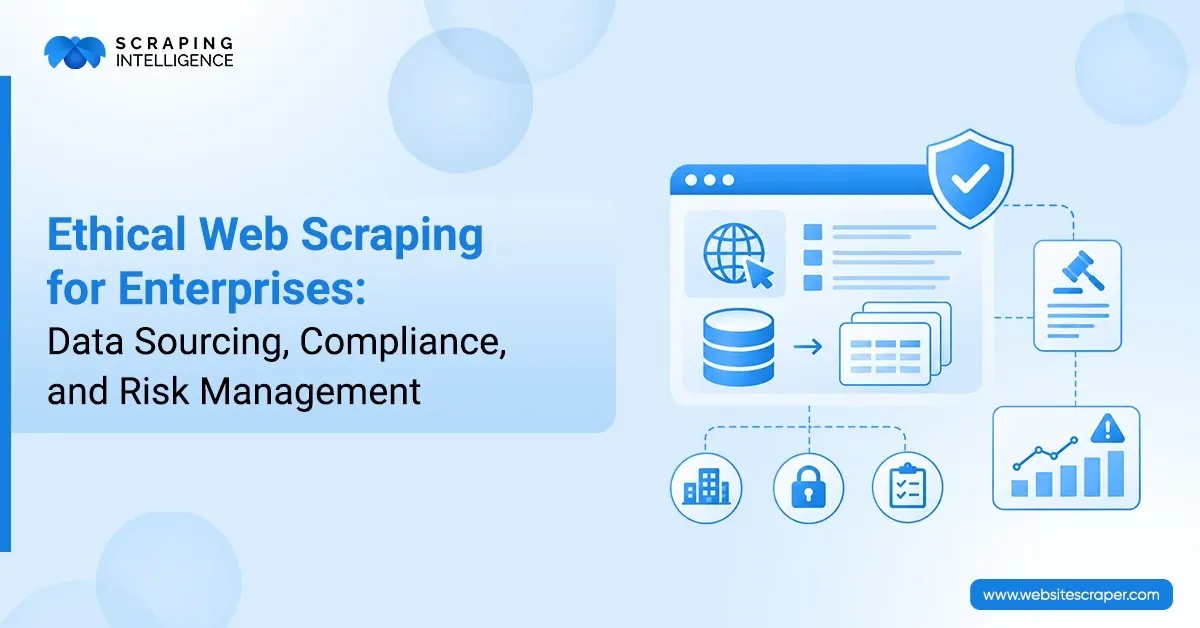
Ethical Web Scraping for Enterprises: Data Sourcing, Compliance, and Risk Management
Category
Services
Publish Date
Nov 16, 2026
Author
Scraping Intelligence
Businesses rely on web data to track competitors, monitor market trends, and make informed decisions. However, collecting information from websites at scale comes with responsibilities that enterprises cannot afford to overlook. Ethical web scraping involves more than extracting publicly available information. It requires organizations to understand website policies, respect data privacy, and follow applicable regulations before using collected data.
For enterprise teams, a responsible approach to web scraping starts with choosing reliable data sources, identifying legal requirements, and establishing clear collection policies. Without these safeguards, even routine data extraction activities can create compliance issues, financial exposure, and reputational damage.
This guide explores ethical web scraping for enterprises, including responsible data sourcing practices, major privacy regulations, common compliance risks, and practical risk management strategies for building a sustainable data collection process.
Publicly Accessible vs. Legally Permissible: What Is the Difference?
This distinction trips up more enterprise teams than any other, so it deserves its own section. Information being visible without a password tells you that it is publicly accessible. It does not tell you that processing it is lawful. Privacy regulations such as the GDPR govern what you do with personal information after collection, and that duty applies whether or not the data sat behind a login. A name, a job title, or a photograph on a public profile remains personal data, and reusing it at scale can still require a lawful basis, a retention limit, and a clear purpose.
The practical takeaway is that "anyone can see it" is a statement about access, while "we are allowed to keep and use it" is a separate statement about compliance. Mature programs keep these two questions apart and answer both before collection begins.
Where Should Enterprises Source Their Data From?
Not every source carries the same weight of risk, so the most reliable programs rank their sources carefully before a single request leaves the server. The pointers below move roughly from the lowest level of exposure toward the highest.
Public pages without authentication: content any visitor can view without signing in usually sits at the lower end of the risk scale, although a website's terms of service still apply to your activity.
First-party and owned channels: your own websites, mobile applications, and existing customer agreements give you the cleanest possible footing for data sourcing.
Licensed APIs and data partners: paid feeds and official interfaces shift much of the legal burden onto a written contract that you can point to later, which is a strong position to hold.
Gated or personal content: anything behind a login screen, a paywall, or a consent banner needs legal sign-off first, since this is where the majority of disputes tend to begin.
The guiding principle is proportionality, where the sensitivity of the information should always match the strength of your legal basis for collecting it.
Ethical Web Scraping vs. Unethical Web Scraping: Key Differences
The difference between ethical and unethical web scraping comes down to how information is accessed, collected, and used. Enterprises need to establish clear operational standards rather than relying solely on whether a scraping tool can retrieve information.
Evaluation factor
Ethical Web Scraping
Unethical Web Scraping
Data sources
Uses appropriately assessed and authorized sources
Targets restricted or inappropriate sources
Website policies
Reviews relevant terms and crawling directives
Deliberately ignores applicable restrictions
Personal information
Applies data minimization and privacy safeguards
Collects unnecessary personal information
Request frequency
Uses controlled request rates
Sends excessive requests that may disrupt services
Access controls
Respects authentication and technical restrictions
Attempts to bypass access controls
Transparency
Uses identifiable crawlers where appropriate
Disguises crawling activity to avoid detection
Documentation
Maintains policies and audit records
Operates without clear documentation
Data retention
Applies defined retention and deletion policies
Retains information without appropriate controls
For enterprise teams, ethical scraping is not simply about avoiding website blocks. It is about creating a documented process that accounts for data privacy, source restrictions, security, and responsible data usage.
These practices also make scraping operations easier to monitor, audit, and manage as data requirements grow.
Which Laws and Regulations Shape Compliance?
The legal picture shifts from one region to the next, yet a small group of frameworks shapes nearly every serious enterprise decision. The table below summarizes what each framework or landmark case governs, with links to the primary sources.
Framework or Case
Region
What It Governs
Why It Matters
GDPR
EU and EEA
Processing of personal data
Penalties run in two tiers: up to €10M or 2% of turnover for lesser breaches, and up to €20M or 4% for the most serious
CCPA / CPRA
California, US
Consumer personal data rights
Applies to businesses above set thresholds, separates "selling" from "sharing," and grants opt-out and deletion rights
hiQ v. LinkedIn
US federal
Unauthorized computer access
At the preliminary injunction stage, the Ninth Circuit found that scraping public profiles likely does not breach the CFAA; this was not blanket permission, and hiQ later lost on contract grounds
EU AI Act, Art. 5(1)(e)
European Union
Prohibited AI practices
Bans the untargeted scraping of facial images from the internet or CCTV to build or expand facial recognition databases
One pattern runs through every entry, which is that the word "public" describes where information sits, and never confirms on its own that you are permitted to process it.
What Are the Financial and Legal Risks of Non-Compliant Web Scraping?
Poor data collection practices can expose enterprises to regulatory investigations, financial penalties, litigation, processing restrictions, and reputational damage. Enforcement actions involving companies that collect personal and biometric information demonstrate why data governance matters.
Real-World Web Scraping Compliance Cases
Clearview AI – Netherlands
In September 2024, the Dutch Data Protection Authority announced a €30.5 million fine against Clearview AI for unlawful collection and processing of personal and biometric information. The case involved a database containing billions of facial images collected from the internet.
Clearview AI – United Kingdom
In May 2022, the UK's Information Commissioner's Office announced a penalty of approximately £7.5 million against Clearview AI for collecting images of UK residents from websites and social media for facial recognition purposes. The subsequent legal proceedings should also be considered when describing the current status of this enforcement action.
Clearview AI – Other European Enforcement Actions
Enforcement actions in other European jurisdictions, including France and Italy, provide further examples of the regulatory scrutiny surrounding the collection and processing of biometric information. Verify the latest legal status of these decisions before citing their original penalty amounts as final or enforceable.
What Do These Cases Mean for Enterprises?
These cases highlight three important lessons:
Publicly accessible information may still be protected by privacy regulations.
Collecting personal or biometric information at scale can create substantial compliance exposure.
Organizations need documented sourcing policies, clear processing purposes, and appropriate retention controls.
The Growing Demand for Web Data Extraction
According to The Business Research Company's 2026 Web Scraping Market Report, the global web scraping market was valued at approximately $0.99 billion in 2025 and is projected to reach $2.28 billion by 2030, representing a projected CAGR of 18.2%.
As enterprise demand for web data increases, responsible collection practices become an important part of building sustainable data operations.
What Does an Enterprise Data Sourcing Workflow Look Like?
A repeatable workflow keeps good practice from living only inside one engineer's head. Most mature teams move through a familiar sequence, even if they describe the stages a little differently. It usually begins with scoping, where the business pins down the exact question and the smallest set of fields that can answer it. Source review comes next, and this is where legal and engineering look together at the target, its terms, and how sensitive the information really is. Only once someone has written down why the collection is permitted, and under which rule, does a crawler get the go-ahead. The collection itself then runs under sensible rate limits and honest identifiers, with a person watching for errors or sudden blocks.
Everything closes with review and retention, where the gathered information is checked, held under a time limit, and cleared out the moment it has served its purpose.
How Can Enterprises Build a Risk Management Framework?
A sound risk management framework turns a tangle of scattered scripts into something leadership can actually govern, and it tends to rest on a few connected habits rather than a single control. Governance usually comes first, because a written policy that names approved sources, sets retention limits, and assigns clear ownership keeps sourcing consistent as more teams get involved. Legal review has to happen early as well, since counsel who sees a new target at the start can flag trouble long before it ever reaches production. On the technical side, respecting robots.txt, holding request rates to a reasonable level, and identifying crawlers honestly eases both the load on the target servers and your own exposure at the same time. Records deserve the same care, as logs of what was gathered, when, and why quietly become your best evidence the day a regulator or a partner comes asking. Any vendor collecting on your behalf, finally, should be held to the standard you set for your own staff, because their shortcuts eventually become your liability.
Enterprise Compliance Checklist:
A written purpose and lawful basis for every source you touch
A quick read of robots.txt and the site terms before anything runs
Only the personal data you genuinely need, with a retention limit attached
Crawlers tuned to reasonable rates and honest identifiers
Legal sign-off on anything gated, paid, or sensitive
Audit logs and vendor contracts that stay current rather than drifting
A specialist partner can carry much of this weight. Teams that focus on compliant collection, such as the group behind enterprise web scraping services, pair the infrastructure with the legal awareness that large programs usually need but rarely staff for on their own.
Conclusion: Building a Responsible Enterprise Web Scraping Strategy
Ethical web scraping is essential for enterprises that depend on external web data for market research, competitive intelligence, and business decisions. However, collecting information at scale requires more than the right tools. Organizations must evaluate data sources, understand applicable privacy regulations, and establish clear governance and risk management practices.
A structured approach helps businesses maintain reliable data pipelines while reducing unnecessary legal, operational, and reputational exposure. As data requirements continue to grow, responsible collection practices should remain part of every enterprise's long-term data strategy.
For businesses looking to scale their data collection activities, Scraping Intelligence offers enterprise web scraping capabilities designed to support structured, reliable, and responsible data extraction.
Let's Talk About Your Data Needs
Tell us what data you need, and we'll help you find the right solution.
Scraping Intelligence Editorial Team is a collective of data specialists, analysts, and researchers with expertise in web scraping, data extraction, and market intelligence. The team produces well-researched guides, actionable insights, and industry-focused resources that help businesses unlock the value of data and make informed, strategic decisions.
Latest Blog
Explore our latest content pieces for every industry and audience seeking information about data scraping and advanced tools.
Explore ethical web scraping for enterprises, covering data sourcing, privacy laws, compliance risks, and strategies for responsible data collection at scale.
Looking for a web scraping company? Compare 10 top providers, from managed data services to APIs and no-code tools, by pricing, features, and scalability.
Explore Property Finder data scraping to collect UAE property prices, listings, locations, and rental trends for smarter market research and investment analysis.