Beauty Price Intelligence: Scrape Sephora and Ulta Data
Category
E-commerce & Retail
Publish Date
Oct 29, 2026
Author
Scraping Intelligence
Beauty retailers regularly adjust product prices, launch limited-time promotions, and update stock across thousands of listings. For beauty brands, ecommerce teams, and market analysts, tracking these changes manually makes it difficult to maintain an accurate view of the competition.
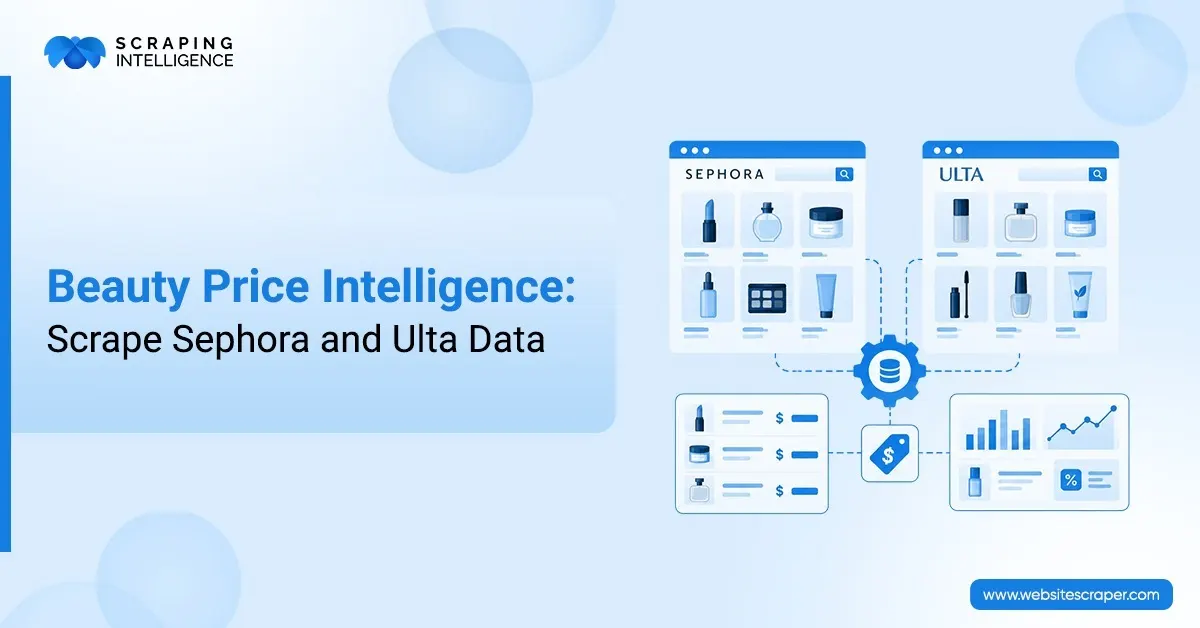
Sephora data scraping helps automate the collection of publicly available product information, including prices, discounts, ratings, product variants, and stock status. When combined with Ulta product data, it allows businesses to compare competing offers, monitor assortment changes, and identify pricing opportunities across both retailers.
This guide explains how beauty price intelligence works, which product fields are worth collecting, how to build a reliable data extraction workflow, and what legal and technical considerations to address. It also explores how structured Sephora and Ulta data can support competitor price monitoring, merchandising decisions, and ecommerce market research.
Why Does Beauty Pricing Change So Often?
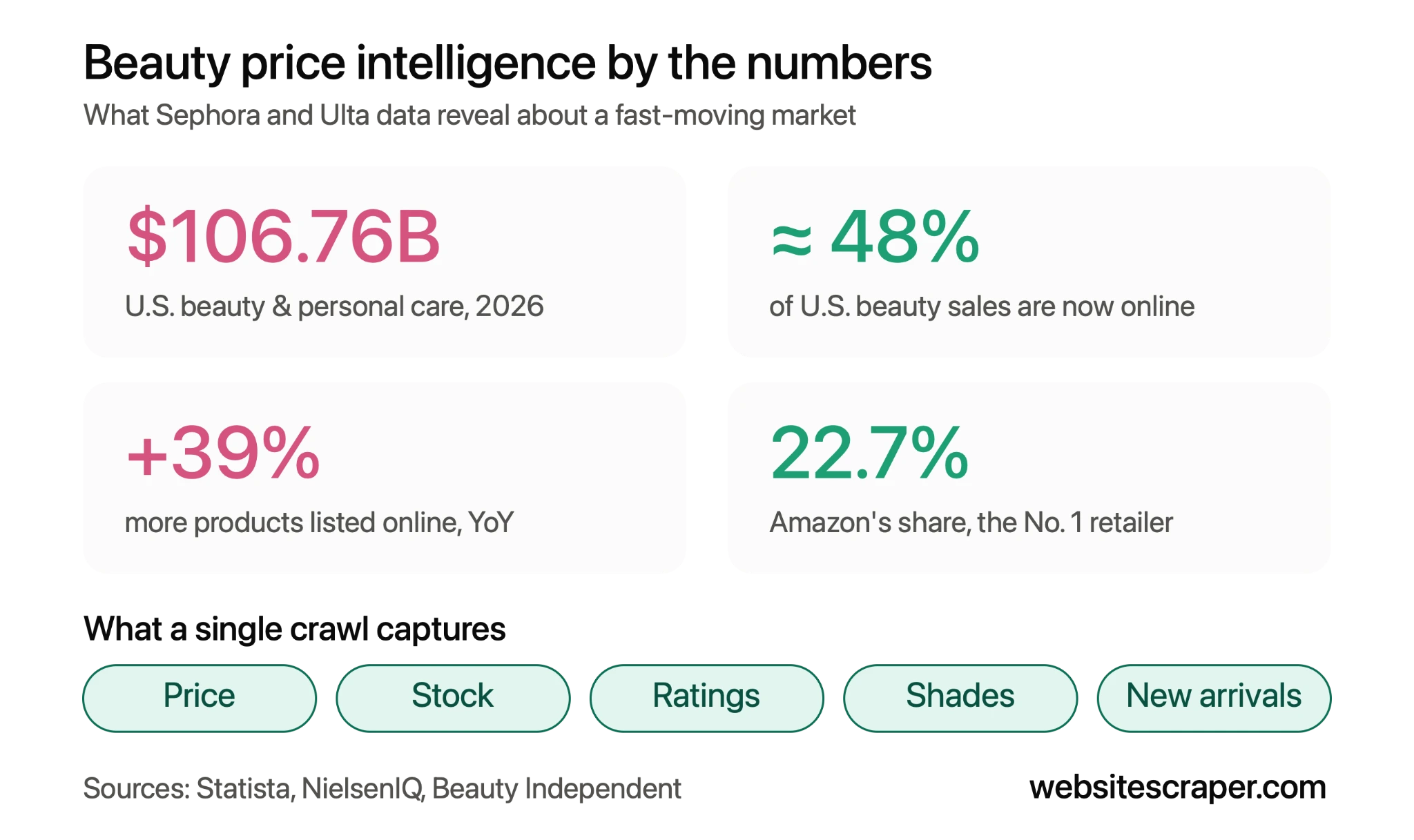
Beauty runs on high purchase frequency, rapid launches, and heavy promotion, so prices and assortments churn constantly. The scale behind that churn is real. US beauty and personal care revenue is projected at about $106.76 billion for full-year 2026, according to Statista Market Insights figures reported in 2026. On the channel side, NielsenIQ estimated in January 2026 that e-commerce now accounts for roughly 48% of US beauty sales, with Amazon holding about 22.7% of the market as the single largest beauty retailer. Assortments are swelling as well: an analysis of 2025 performance found the number of brands and products listed online jumped 39% year over year. Against that backdrop, last week's pricing read is already stale, which is why reliable cosmetics ecommerce data has shifted from a nice-to-have to an operating requirement.
What Is Sephora Data Scraping and How Does It Work?
Sephora data scraping is the automated collection of publicly accessible product information from Sephora's website, subject to applicable access restrictions and site policies. Depending on what the pages expose, the collected fields may include product names, listed prices, discounts, ratings, review counts, shade options, and stock indicators.
The extracted information is organized into a structured format such as CSV, JSON, or a database. Businesses can then compare product listings over time, analyze promotional activity, and combine Sephora records with data from other retailers. For reliable results, the extraction process must account for dynamic page content, product variants, changing page structures, and incomplete records.
Which Data Points Can You Actually Capture?
A single beauty listing is dense with signals, and each field answers a different commercial question. The table below shows the fields most teams prioritize for Sephora data scraping and Ulta product data collection.
Data Field
What It Reveals
Practical Business Use
Price and discounts
Current rate and promo depth
Competitive repricing and margin checks
Stock availability
In-stock versus sold-out status
Demand signals and restock timing
Ratings and review counts
Customer sentiment at scale
Product development and positioning
Shade and variant data
Full assortment per SKU
Range gaps and merchandising calls
Brand and category tags
Catalog structure
Market share and assortment tracking
New arrivals
Fresh launches over time
Trend spotting and early response
Example of a Sephora and Ulta Price Intelligence Dataset
Theory is easier to trust with a concrete example. The table below uses illustrative values, not live figures, to show how a cross-retailer feed reads once it has been cleaned and matched. Prestige brands often enforce the same list price across stores, so the edge rarely comes from the headline number. It comes from stock status and promotion depth, which is where beauty retail analytics earns its keep.
Product (illustrative values)
Sephora
Ulta
Availability
Promotion
The Ordinary Niacinamide 10% + Zinc
$6.50
$6.50
In stock, both
None
Sol de Janeiro Bum Bum Cream, 240 ml
$48.00
$48.00
Low stock at Sephora
Ulta: free mini
Rare Beauty Soft Pinch Blush
$23.00
$23.00
In stock, both
Sephora: bonus points
Fenty Beauty Gloss Bomb
$21.00
$21.00
Out of stock at Ulta
None
A brand reading this feed would spot the Ulta mini-size offer within a day and respond, while a retailer would notice the Fenty stockout at Ulta as a short window to capture demand. That is the difference between a price list and genuine cosmetics pricing intelligence.
How Historical Beauty Product Data Reveals Market Trends?
A single product snapshot shows what a retailer lists at one point in time. Historical records provide a broader view of how that listing changes. By collecting comparable product data at regular intervals, businesses can analyze patterns that are difficult to identify through manual checks.
Price history: Track listed prices and discounts over time to identify recurring promotional periods.
Promotion history: Record changes in visible offers, bundles, and gift-with-purchase campaigns.
Availability trends: Monitor repeated stock changes as one possible indicator of supply or demand pressure.
Product visibility: Record observable listing positions where consistent measurements are available.
Review trends: Compare timestamped ratings and review counts to understand how customer feedback evolves.
These signals become more useful when combined with sales, inventory, or other business data. Website observations alone cannot establish actual sales volume, consumer demand, or the reason behind a pricing change.
How to Build a Reliable Beauty Data Extraction Workflow?
Dependable beauty product price tracking follows a repeatable pipeline. Each stage protects accuracy once collection runs daily or weekly.
Define the scope: Select retailers, product categories, brands, target fields, and the collection schedule.
Collect accessible product data: Retrieve permitted page content using an approach suited to the site's structure.
Parse and structure records: Convert extracted fields into consistent columns and data types.
Match products across retailers: Compare identifiers, brand, product name, size, and variant details.
Validate and deduplicate: Flag missing prices, conflicting values, duplicate records, and unexpected changes.
Store historical snapshots: Preserve timestamps so changes can be measured instead of overwriting earlier observations.
Deliver and monitor: Export the data in the required format and track extraction failures, coverage, and freshness.
Technical Challenges in Sephora and Ulta Data Scraping
Beauty sites are among the trickier targets in ecommerce, which is exactly why the engineering matters. A few of the challenges that separate a reliable feed from a brittle one:
JavaScript rendering: Sephora and Ulta load much of their catalog client-side, so a headless browser or rendered-DOM approach is needed; a plain HTML fetch returns an empty shell.
Variant-level extraction: One product page can hide dozens of shades or sizes, each with its own price, SKU, and stock state, so the parser must walk every variant rather than the default view.
Price normalization: List price, sale price, unit price, and currency need to be standardized into comparable fields before any analysis is trustworthy.
Deduplication and matching: The same product appears under different identifiers across retailers, so fuzzy matching on brand, title, and size keeps comparisons honest.
Crawl scheduling: Incremental crawls, polite rate limits, and rotating sessions keep collection sustainable without hammering the source.
Automated quality control: Schema validation and anomaly detection catch a $0 price or a dropped variant before it ever reaches a decision-maker.
Here is how those pieces fit together on a real product. Take the Sol de Janeiro Bum Bum Cream tracked across both sites. The matcher links Sephora's 240 ml listing to Ulta's 240 ml listing by brand, title, and size, even though each store files it under a different product ID. Normalization then strips the currency symbol, separates the $48.00 list price from any sale price, and adds a unit price of about $0.20 per milliliter so the two listings compare cleanly.
A scheduler runs that same job every morning at 6 a.m., and on the day Ulta's price reads $0.00 from a page error, the quality check holds that row back until a person confirms it. This layer is what makes Ulta product data and Sephora figures usable at scale instead of merely available.
Legal and Compliance Considerations for Beauty Data Scraping
Collecting publicly accessible product information does not automatically resolve every legal or contractual question. Before launching a beauty data extraction project, businesses should review the relevant website terms, access restrictions, applicable copyright rules, privacy obligations, and any other laws that apply to their collection and use of the data.
The US dispute in hiQ Labs v. LinkedIn illustrates why these issues should be considered separately. The litigation addressed whether collecting publicly accessible information could violate the Computer Fraud and Abuse Act, while contractual claims raised distinct questions about compliance with website terms. The outcome should not be treated as blanket permission to scrape any public website.
A responsible approach starts with a defined collection scope, minimizes unnecessary data collection, respects applicable access restrictions, and includes legal review where appropriate. Product prices and stock indicators may not present the same privacy concerns as personal information, but the overall collection process and subsequent use of the data still require assessment.
Where Does Ulta Product Data Fit In?
One retailer tells half the story. Sephora and Ulta share many of the same brands yet price, bundle, and promote them on different rhythms, so pairing Ulta product data with Sephora insight shows the complete competitive picture. Ulta has been scaling its assortment quickly; its fragrance category alone grew brands by 37% and products by 30% across 2025. Run both feeds together and you can line up identical SKUs across stores, flag a pricing or promo gap the same day it opens, and act before the window shuts. That side-by-side view is what elevates raw numbers into real beauty market intelligence.
Beauty Price Intelligence at a Glance
Who Benefits Most from This Kind of Data?
The same dataset serves very different goals depending on the reader:
Retailers and marketplaces: pricing stays competitive when every rival move is visible within hours, not weeks.
Beauty brands: distribution and MAP monitoring become simple, since unauthorized sellers and price violations surface fast.
Market analysts: forecasting rests on firmer ground, because historical beauty retail analytics expose patterns ahead of mainstream reports.
Ecommerce startups: assortment planning sharpens early, as market gaps only become obvious once the full catalog is mapped.
Conclusion
Beauty price intelligence helps retailers and brands understand how product prices, promotions, and availability change across competing stores. By combining Sephora data scraping with Ulta product data, businesses can build a structured view of product listings, compare equivalent items, and track changes over time.
Reliable results depend on accurate product matching, consistent data fields, appropriate refresh schedules, and quality checks. These foundations make the dataset more useful for competitive pricing, assortment planning, and ecommerce market research.
Scraping Intelligence can introduce its beauty data extraction capabilities through a sample dataset covering available product prices, variants, stock indicators, and promotional fields. Request a sample Sephora–Ulta dataset to evaluate the available fields and data quality for your use case, or explore our ecommerce data scraping services to discuss your requirements.
Frequently Asked Questions
What is Sephora data scraping used for? +
Sephora data scraping can collect publicly accessible product information, such as listed prices, discounts, ratings, product variants, and availability. Businesses can use these records for competitor price monitoring, assortment analysis, and beauty retail market research.
Can Sephora and Ulta product prices be compared directly?+
Yes, provided that the products and variants match. Businesses should compare the same size, shade, and product version, normalize prices to a common unit where appropriate, and account for differences in promotional terms.
How often should beauty product data be collected?+
The appropriate frequency depends on the category, business requirements, and observed rate of change. Daily collection may suit frequently changing prices or promotions, while weekly collection may be sufficient for slower-moving assortment analysis. Collection schedules should also respect applicable access restrictions and request limits.
What data fields matter most for beauty price intelligence?+
Common fields include product name, brand, product identifier, size, listed price, discount, availability, variant details, ratings, and observation timestamp. Historical snapshots help businesses measure changes over time.
How can businesses improve the accuracy of scraped beauty data? +
Use consistent field definitions, validate prices and availability, deduplicate records, match equivalent products carefully, and monitor missing fields. Unexpected changes should be flagged for review instead of automatically treated as genuine market movements.
Is scraping Sephora or Ulta product data legally permitted?+
Permission depends on the collection method, applicable website terms, access restrictions, jurisdiction, and intended use. Review the relevant legal and contractual requirements before starting a project, and seek legal advice when necessary.
Let's Talk About Your Data Needs
Tell us what data you need, and we'll help you find the right solution.
Scraping Intelligence Editorial Team is a collective of data specialists, analysts, and researchers with expertise in web scraping, data extraction, and market intelligence. The team produces well-researched guides, actionable insights, and industry-focused resources that help businesses unlock the value of data and make informed, strategic decisions.
Latest Blog
Explore our latest content pieces for every industry and audience seeking information about data scraping and advanced tools.
Compare real estate data APIs vs. web scraping costs, including setup, infrastructure, maintenance, and data quality, to find the right solution for your needs.