How to Find Job Postings from Multiple Websites Automatically
Category
Recruitment
Publish Date
Aug 18, 2026
Author
Scraping Intelligence
Introduction
Job postings are spread across company career pages, major job boards, niche platforms, regional websites, and staffing portals. For recruiters, job seekers, and job board owners, checking each source manually can mean opening multiple tabs, copying listings, comparing information, and repeatedly searching for new opportunities. As the number of sources grows, this process becomes increasingly time-consuming and makes it easier to miss relevant or newly published roles.
Automating job posting collection provides a more efficient way to monitor multiple websites within a single workflow. Instead of manually visiting each source, automated tools can collect job titles, company names, locations, salary ranges, descriptions, required skills, posting dates, and source URLs and organize them into structured data.
In this blog, you will learn how to find job postings across multiple websites automatically, explore four common approaches to job data collection, and understand how to set up an automated workflow. You will also learn how to manage duplicate listings, keep job data up to date, and choose the right approach for your needs and budget.
Why Manual Job Searching No Longer Works
The modern job market is scattered. Job postings live on company career pages, niche boards, regional sites, staffing agency portals, and giant aggregators all at once. Trying to track them all by hand is not just slow. It is nearly impossible to do well at any real scale.
Here is the part that surprises most people. A large share of the listings you see are not even real. Research in 2026 estimates that between 20% and 33% of active online listings are ghost jobs, meaning roles the employer never plans to fill. On top of that, an estimated 27.4% of active U.S. LinkedIn listings are likely ghost jobs, and 81% of recruiters admit their employer has posted them. When you search manually, you waste energy on postings that were dead before you clicked.
Automated job scraping solves this scattered mess. Instead of reading listings one by one, you let software collect them for you, filter out the noise, and hand you a clean list. This is where a job posting scraper earns its keep.
What Does "Automatically Finding Job Postings" Actually Mean?
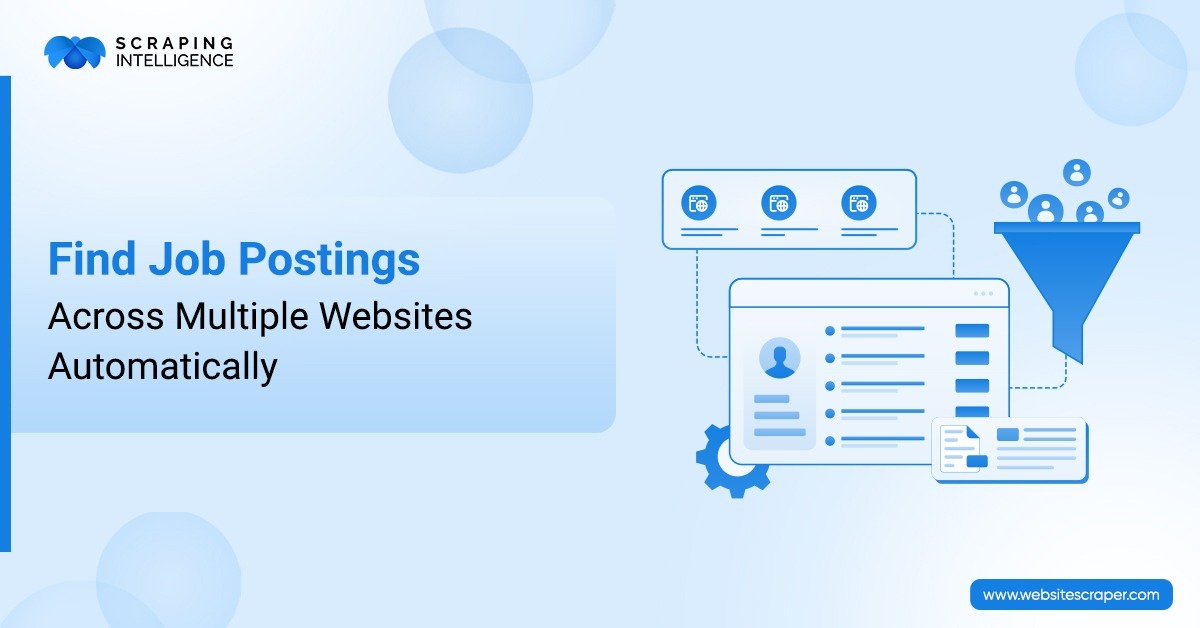
Automated job posting collection is the process of gathering job listings from multiple websites using APIs, scraping tools or automated data services and organizing the results into a structured format such as a spreadsheet, database or dashboard.
A good automated job aggregator typically captures the following fields:
Job title and role level
Company name and location
Salary range, when listed
Job description and required skills
Posting date and the source URL
These structured job listings then flow into a spreadsheet, a database, or a dashboard. From there, you can sort, compare, and act fast. The core idea is simple: turn scattered public listings into usable web data you fully control.
Main Methods to Find Job Postings Across Multiple Websites
No single method works for everyone. What suits you best really comes down to how comfortable you are with technology, what your budget allows, and how much data you need to pull. In practice, most teams end up choosing between four approaches, and it helps to understand where each one shines before you commit.
The simplest place to begin is with an aggregator API. These services already gather listings from thousands of sources into one searchable place, so most of the heavy lifting is done for you. Send over a query with your keywords, a location, and maybe a date range, and you get back structured job data ready to use. If you mainly want wide coverage or a fast read on the market, this approach can work well when broad coverage and fast access to structured listings are the primary requirements.
If you need a bit more control but would rather not write code, pre-built job scraping tools sit right in the middle. Many of them ship with ready-made templates for popular job boards, and useful extras like cloud scheduling and one-click exports come standard. The trade you are making is a fair one: you get a repeatable web scraping workflow without paying a developer to create it from scratch. That balance is exactly why so many growing teams settle here.
For teams that want total control, a custom in-house scraper is the answer. You choose which sites to target, decide how often the scraper runs, and clean the output however you like. The catch is maintenance. Sites change their layouts often, and when they do, your scraper usually breaks within a few weeks. Running one well takes a skilled team and a steady commitment to upkeep, so it is rarely the right fit for a small operation.
At the other end of the spectrum, a managed data service hands the whole process to a specialized partner. They run the scraping, clean the results, and deliver finished job posting data straight to you. When a source changes its structure, the provider quietly patches it, and your feed keeps running without interruption. For anyone who cares more about reliable data than about tinkering under the hood, this is the lowest-maintenance route available.
Comparison Table: Which Method Fits You Best?
The table below lays out the four approaches side by side so you can pick with confidence.
Method
Best For
Setup Effort
Maintenance
Cost Level
Aggregator API
Broad market discovery
Low
Low
Low to Medium
Pre-Built Scraping Tool
Repeatable workflows
Medium
Medium
Medium
Custom In-House Scraper
Full control and tailoring
High
High
High
Managed Data Service
Reliable, hands-off data
Low
Very Low
Medium to High
As you can see, the automated job scraper you choose should match your resources. Beginners often start with an API. A managed service is typically the choice for companies that rely on data quality.
How to Set Up Automated Job Data Collection?
Building your own pipeline is more straightforward than it first appears. Work through these points in order and you will move from scattered searching to reliable automation without much friction.
Get clear on the roles you actually care about before you open any software. The job titles, locations, and industries you pick here will quietly shape every choice that follows.
Make a short list of the job boards, company career pages, and niche sites worth watching. A handful of high-value sources almost always beats a long, unfocused pile.
Look back at the comparison table above and choose the lane that fits your situation, whether that is an API, a pre-built tool, a custom build, or a managed service.
Confirm exactly which fields you need, such as title, company, salary, and posting date. Narrowing this down early keeps your results useful instead of cluttered with detail you will never open.
Put the collection on a schedule so it runs daily or weekly. From that point on, your job listings stay current without any manual effort on your part.
Clean the data before you rely on it. Raw output is rarely tidy, so strip out duplicate postings and filter the likely ghost jobs that would otherwise skew your view.
Send the finished results to a dashboard or spreadsheet where you already work, then move quickly on the openings that turn out to be real.
Once this job search automation loop is running, it saves hours every single week. Rather than copying and pasting listings by hand, you get to spend that time on the decisions that actually matter.
Key Benefits of Automating Your Job Search
Why bother switching from manual work to an automated job aggregator? The payoffs stack up fast.
Massive time savings. You reclaim hours once lost to tab hopping.
Wider coverage. Managed aggregation can pull in far more listings than any manual effort.
Fresh results. Scheduled runs give you near real-time visibility into new openings.
Cleaner data. Deduplication and filtering cut through ghost jobs and repeats.
Better decisions. Structured data lets you compare salaries, track competitors, and spot trends.
For recruiters and job board owners, these gains translate into a stronger product and happier users. Job seekers who encounter stale or duplicate listings simply leave and do not come back, so clean data protects trust directly.
How to Avoid Duplicate Job Listings?
Collecting job postings from multiple websites can quickly create duplicate records. The same position may appear on a company's career page, a general job board, a niche recruitment site, and several aggregators. Without deduplication, these repeated listings can inflate job counts and make it harder to identify genuinely new opportunities.
A reliable automated workflow should include a deduplication step before the data is stored or analyzed.
Match Key Job Details
Compare fields such as the job title, company name, location, and posting date to identify listings that may represent the same position. Normalizing differences in capitalization, spacing, and formatting can make these matches more accurate.
Use Source URLs or Job IDs
When available, the source URL or unique job ID can help distinguish individual postings. These identifiers are particularly useful when the same website publishes multiple positions with similar titles.
Normalize Company and Job Titles
Companies and job titles may appear in slightly different formats across websites. For example, variations such as "Software Engineer," "Software Engineer – Backend," or different capitalization can make identical or related listings difficult to compare. Standardizing these fields before matching can improve data quality.
Track Existing Listings
Instead of treating every collected record as new, compare incoming data with previously stored listings. This allows the system to identify whether a posting is new, already collected, updated, or no longer available.
Effective deduplication ensures that the final dataset contains cleaner job posting data, making it easier for recruiters, job boards, and businesses to analyze opportunities without repeatedly reviewing the same listing.
How to Keep Automated Job Data Up to Date?
Collecting job postings once is not enough for businesses that need a reliable view of the job market. Listings can be added, updated, closed, or removed as hiring requirements change. An automated workflow therefore needs a process for regularly checking source websites and updating stored records.
Set an Appropriate Collection Schedule
Choose a collection frequency based on how quickly the job data changes. Daily collection may be sufficient for some use cases, while high-volume job boards or recruitment platforms may require more frequent updates.
Check for New Listings
Each scheduled run should identify newly published positions and add them to the existing dataset. Tracking posting dates can help prioritize recent opportunities and reduce the chance of overlooking new roles.
Detect Updated or Removed Jobs
A job listing may change after it is initially collected. Salary information, descriptions, locations, or required skills can be updated. Some positions may also be closed or removed. Comparing new results with previously collected records helps identify these changes.
Remove Stale or Expired Listings
Keeping old listings in the dataset can reduce its usefulness. Build rules to identify postings that are no longer available or have remained inactive beyond the required period.
Monitor Data Quality
Regular checks can identify missing fields, duplicate records, broken source URLs, and unexpected changes in website structures. Monitoring these issues helps maintain consistent structured job data over time.
With scheduled collection, change detection, cleaning, and monitoring in place, automated job search automation can provide a more current and reliable view of listings across multiple websites.
How Scraping Intelligence Helps You Automate Job Data Collection
At Scraping Intelligence, we make it easy to find job postings across multiple websites automatically without the headaches of building and fixing scrapers yourself. Our team delivers clean, structured, and ready-to-use job posting data from the sources that matter to your business.
Whether you run a job board, lead a recruiting team, or track hiring trends, our automated job scraping service scales with your needs. We handle the anti-bot challenges, the cleaning, and the delivery, so you receive reliable data on schedule.
Explore our full range of solutions at Scraping Intelligence and see how simple job search automation can be.
To go deeper, you can also read our related guide on web scraping services to understand how the same approach powers many industries beyond hiring.
Conclusion
Finding jobs the old way is broken. With ghost jobs clogging boards and listings scattered across countless sites, manual searching burns your hours and hides the real opportunities. Automation flips the script. By using the right job scraping tool, you collect structured job listings from many websites at once, filter out the noise, and act on real openings faster than everyone else.
Start small with an API if you are testing the idea, scale to pre-built tools as you grow, or hand the whole job to a managed partner when data quality matters most. Whichever path you pick, the goal stays the same: turn scattered listings into clean, usable web data you can trust. When you are ready to automate your job posting data the smart way, Scraping Intelligence is here to help you get there.
Share this article:
About the Author
Scraping Intelligence
Scraping Intelligence Editorial Team is a collective of data specialists, analysts, and researchers with expertise in web scraping, data extraction, and market intelligence. The team produces well-researched guides, actionable insights, and industry-focused resources that help businesses unlock the value of data and make informed, strategic decisions.
Latest Blog
Explore our latest content pieces for every industry and audience seeking information about data scraping and advanced tools.
Discover how real estate web scraping helps agents, investors & brokers extract listings, prices & market trends. See 7 key benefits of real estate data scraping.
Discover how AI-powered web scraping is transforming data extraction with LLMs, machine learning, automation, real-time data, and intelligent web crawling.