How Grocery Retailers Track Competitor Prices Across Thousands of Products
Category
Grocery
Publish Date
Nov 24, 2026
Author
Scraping Intelligence
When a competitor changes the price of milk, eggs, or cooking oil, grocery retailers need to know before that difference affects customer buying decisions. But monitoring prices across thousands of products and multiple store locations is difficult to manage manually. This is where grocery competitor price tracking becomes essential.
Retailers use automated price monitoring to collect competitor prices, compare identical products, track promotional offers, and identify changes in product availability. Web scraping and price intelligence tools help turn this information into structured data that pricing teams can use to make informed decisions. In this guide, we explore how grocery retailers monitor competitor prices at scale, the challenges involved, and how automated data collection helps protect margins while maintaining competitive pricing.
Why Do Grocery Retailers Watch Competitor Prices So Closely?
Grocery retailers operate on tight profit margins, which makes pricing decisions particularly important. A small difference in the price of frequently purchased products can influence where customers shop, especially when competing stores offer similar brands and product categories.
Competitor price tracking helps retailers understand how their prices compare with nearby supermarkets, online grocery stores, and delivery platforms. Instead of matching every competitor price, pricing teams can identify which products need attention and where they can maintain their existing margins.
For example, if two supermarkets sell the same 1-liter milk brand, a retailer can monitor the competitor's price and decide whether a price adjustment is necessary. The same approach applies to eggs, bread, cooking oil, packaged foods, and other frequently purchased products.
By consistently monitoring competitor prices, grocery businesses can:
Maintain competitive prices on high-visibility products.
Identify promotional campaigns launched by rival retailers.
Avoid unnecessary discounts that reduce profit margins.
Understand pricing differences across locations.
Make informed pricing decisions using current market data.
What Exactly Do Retailers Track Across Thousands of Products?
Price is only the headline. The real work sits in the details that surround each item, and the sharpest teams collect far more than a shelf number. Here is the kind of price data they pull for every tracked SKU:
Everyday shelf prices on comparable items, from milk and bread to pantry staples and household goods.
Promotional discounts, coupons, and limited-time offers that shift weekly, and sometimes within the same day.
Price per unit and pack-size differences, which show whether a "deal" is genuinely cheaper once you do the math.
Stock availability and out-of-stock flags, because an item a rival cannot deliver is a sale waiting to be won.
Private-label and store-brand pricing, where a large share of today's margin battle is actually fought.
Key Value Items (KVIs) — the familiar products shoppers rely on to decide whether a store feels cheap or expensive.
How Does Competitor Price Tracking Actually Work?
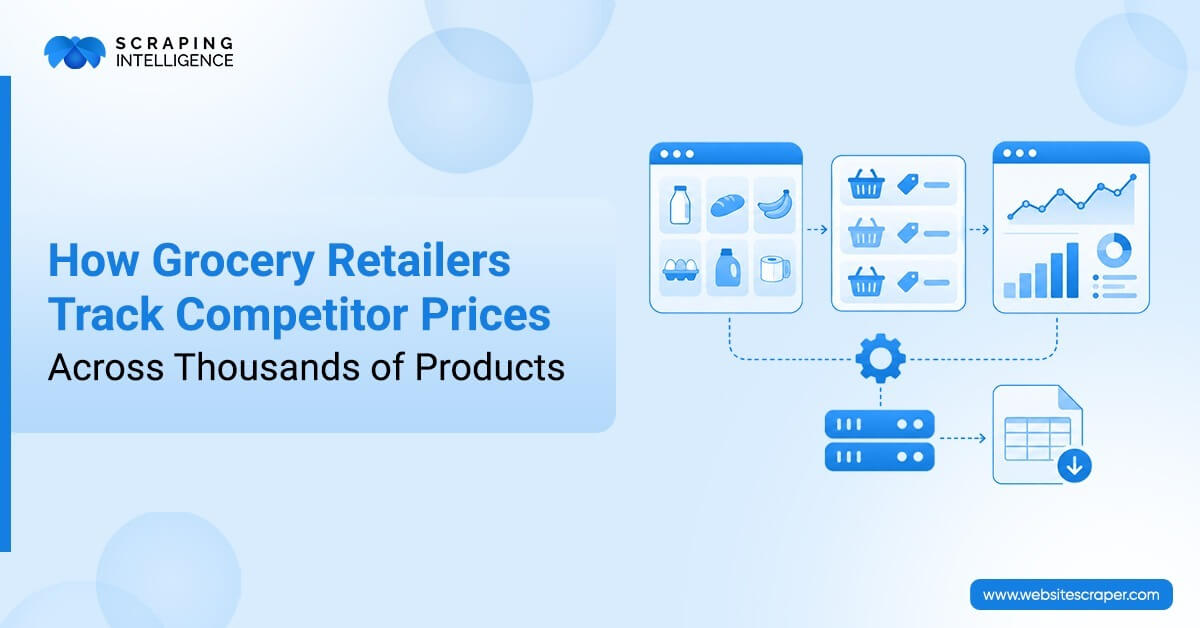
Every price change on the shelf starts long before a shopper ever notices it. The work begins with sourcing, where analysts decide which rival websites, apps, and weekly flyers are worth watching for a given region and category. Not every competitor carries the same weight, so this early step quietly sets the boundaries for everything that follows.
After that, collection runs mostly on autopilot. Automated web scraping, usually paired with price tracking APIs, pulls thousands of grocery prices from those sources on a fixed schedule. Then comes the part that trips most teams up: matching. A gallon of 2% milk has to line up against the exact same product at a rival store, never against whole milk or a different pack size, or the comparison means nothing.
Once the records are matched, they get cleaned and sorted into tidy tables, with units, currencies, and promotions all formatted the same way. Pricing engines study those numbers, flag the price gaps that genuinely matter, and weigh each one against real demand before suggesting whether to hold a price, match it, or leave it alone. Approved moves flow to the point-of-sale system and, more and more often, straight to electronic shelf labels that refresh in near real time.
The scale is hard to picture from the outside. One national grocery chain tracked more than 50,000 competitor prices a day to steer its calls on milk, eggs, and other everyday essentials.
Manual Price Checks or Automated Price Tracking: What Is the Real Difference?
Plenty of smaller grocers still send staff to walk rival aisles with a clipboard or a phone. That approach works for a handful of items, yet it falls apart the moment you need to cover thousands of products across many locations. The table below lays out where automated price tracking pulls ahead.
Factor
Manual price checks
Automated price tracking
Coverage
A few hundred items at most
Tens of thousands of SKUs
Update speed
Weekly or slower
Daily, hourly, or near real-time
Accuracy
Open to human error
Consistent and rules-based
Labor cost
High and never-ending
Low after the initial setup
Scalability
Capped by available staff hours
Scales across stores and regions
The takeaway is simple enough. Manual methods survive at a tiny scale, while anything serious depends on real-time grocery price monitoring built on automation.
Which Challenges Come with Large-Scale Price Monitoring?
Monitoring competitor prices across thousands of grocery products is not simply a matter of collecting more data. Retailers must ensure that the information is accurate, current, and consistent across different sources.
Some common challenges include:
Incorrect Product Matching
Similar product names can create inaccurate comparisons. Two products may share a brand name but differ in flavor, package size, weight, or formulation.
How to address it: Use product identifiers, brand information, pack sizes, and product attributes to improve matching accuracy. Flag uncertain matches for manual review.
Frequent Price and Promotion Changes
Grocery prices and promotional offers can change frequently. Infrequent collection may cause retailers to work with outdated information.
How to address it: Establish collection schedules based on product categories and pricing volatility. High-priority products may require more frequent monitoring than slower-moving items.
Website Changes and Anti-Bot Restrictions
Competitor websites may change their page structures, introduce dynamic content, or implement automated traffic protections. These changes can interrupt data collection.
How to address it: Use maintainable scraping workflows, monitor extraction errors, and update data collection logic when source websites change. Follow applicable website terms and access restrictions.
Inconsistent and Incomplete Data
Different retailers may display prices, units, promotions, and availability information in different formats. Missing fields and duplicate records can affect analysis.
How to address it: Apply data validation, normalization, duplicate detection, and regular quality checks before using the information for pricing decisions.
Managing Large Data Volumes
Collecting information across thousands of products and multiple locations creates substantial data processing and storage requirements.
How to address it: Use scalable collection infrastructure, structured databases, and automated processing pipelines to manage growing data volumes.
Identifying Meaningful Price Changes
Not every competitor price adjustment requires an immediate response. Reacting to every discount can lead to unnecessary price reductions.
How to address it: Establish pricing thresholds and prioritize changes involving important products, high-volume categories, and direct competitors.
Addressing these challenges helps grocery retailers build a more reliable competitor price monitoring process and make decisions based on consistent market information.
How Does Web Scraping Power Grocery Price Intelligence?
At the heart of modern price intelligence sits structured data collection. Web scraping gathers prices, promotions, and stock status from competitor sites and marketplaces, then hands that information to pricing engines in a clean, usable form. Without a steady and reliable feed, even the smartest dynamic pricing model is guessing.
This is where a dedicated data partner earns its keep. A specialized provider handles the heavy lifting — rotating sources, repairing broken scrapers, matching products correctly, and delivering results on a schedule your team can trust. If you want a closer look at how managed collection works end to end, the web scraping services at Scraping Intelligence walk through the full process. Reliable input is the difference between a pricing strategy you can defend and one you simply hope is right.
The payoff shows up on the shelf. Clean competitor data lets grocers protect margins on profit drivers, stay sharp on Key Value Items, and cut the wasteful discounting that eats into an already thin bottom line.
What Do Retailers Actually Gain from All This Tracking?
Gathering millions of prices only matters if it changes something on the shelf, and for grocers that return tends to show up in a few concrete ways. The clearest one is margin protection. When a team can see a true price gap instead of guessing at it, it stops slashing prices on items that never needed a cut, which quietly adds up across thousands of SKUs. One national chain found that sharper visibility protected the margin on more than half the products it had been over-matching before.
The benefit goes past the numbers, though. Shoppers form their whole opinion of a store from a small handful of familiar items, so staying competitive on those Key Value Items keeps a store’s cheap-or-expensive reputation intact. Dependable price intelligence also speeds up decisions, since teams can react to real moves rather than wait on a weekly flyer check. Then there’s the defensive edge. A grocer that catches a rival’s promotion early gets to respond on its own terms, instead of scrambling after customers have already spotted the deal. In a 2% margin business, that head start is rarely small.
Conclusion
Tracking competitor prices across thousands of grocery products requires more than occasional price checks. Retailers need consistent product data, accurate comparisons, and regular visibility into competitor pricing changes. Automated web scraping helps simplify this process by collecting product prices, promotions, and availability information from multiple online sources.
When combined with reliable data processing and price intelligence tools, this information helps grocery businesses evaluate pricing strategies, protect profit margins, and respond to changing market conditions. For retailers looking to scale their monitoring efforts, investing in a dependable data collection solution can make competitor price tracking more efficient and manageable.
Let's Talk About Your Data Needs
Tell us what data you need, and we'll help you find the right solution.
Scraping Intelligence Editorial Team is a collective of data specialists, analysts, and researchers with expertise in web scraping, data extraction, and market intelligence. The team produces well-researched guides, actionable insights, and industry-focused resources that help businesses unlock the value of data and make informed, strategic decisions.
Latest Blog
Explore our latest content pieces for every industry and audience seeking information about data scraping and advanced tools.
Discover how grocery retailers track competitor prices across thousands of products using web scraping and automated price monitoring to protect margins.
Explore ethical web scraping for enterprises, covering data sourcing, privacy laws, compliance risks, and strategies for responsible data collection at scale.
Looking for a web scraping company? Compare 10 top providers, from managed data services to APIs and no-code tools, by pricing, features, and scalability.