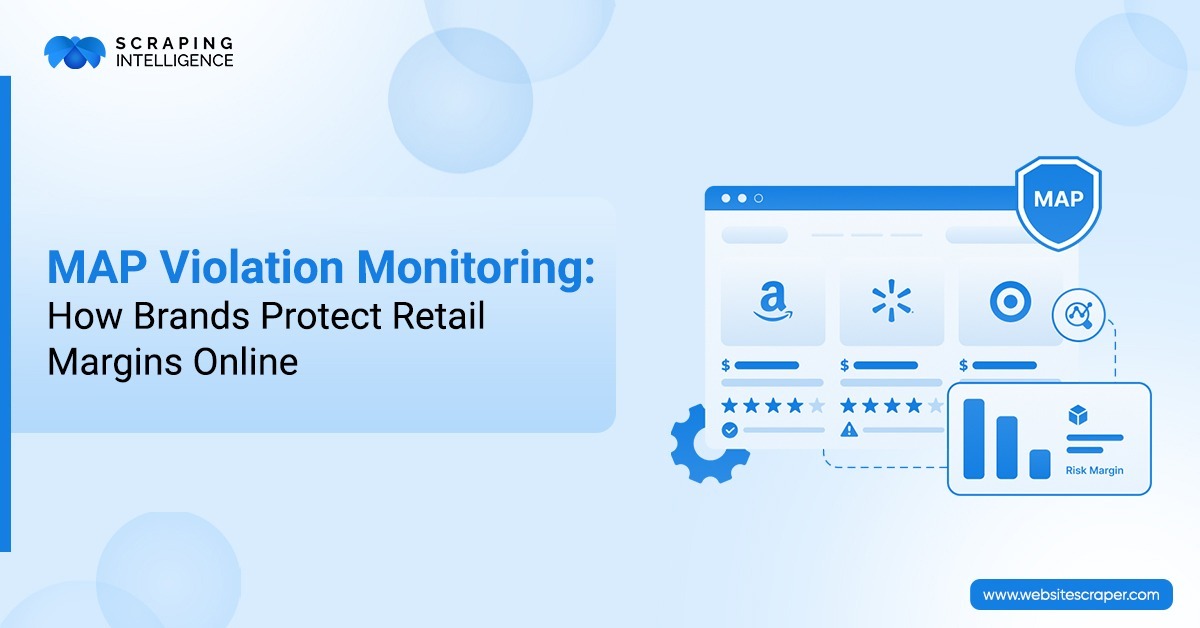
MAP Violation Monitoring: How Brands Protect Retail Margins Online
Category
E-Commerce & Retail
Publish Date
Sep 07, 2026
Author
Scraping Intelligence
Introduction
What happens when a product that should sell at a premium suddenly appears online at 30% below its advertised price? Lower margins, channel conflict, and inconsistent pricing can quickly follow. This is where MAP violation monitoring helps brands identify retailers and sellers advertising products below their Minimum Advertised Price (MAP).
A MAP policy sets the lowest price at which an authorized retailer can advertise a product. However, creating the policy is only the first step. Brands selling across Amazon, Walmart, eBay, and other marketplaces need a reliable way to monitor prices, identify potential violations, and respond consistently.
This guide explains what MAP monitoring is, why MAP violations can affect retail margins, how automated monitoring works, and which best practices can improve price compliance. It also examines how product matching, e-commerce data collection, alerts, and enforcement workflows can help brands maintain greater visibility across online sales channels.
What Is MAP Violation Monitoring?
A Minimum Advertised Price (MAP) is the lowest price a retailer is allowed to advertise a product for. When a retailer advertises a product below the price specified in a brand’s MAP policy, it may constitute a MAP violation, depending on the policy terms and applicable rules. Monitoring is the ongoing process of scanning online listings to catch those violations early, before the discount spreads to other sellers.
The chain reaction is what makes this urgent. When one seller drops the price, competing sellers feel pressure to match it, and a full price war takes hold across the network. Unauthorized sellers can be a significant source of MAP violations, making seller-level monitoring particularly important for brands. That gap tells you where most of the trouble originates.
The practice sits at the crossroads of price monitoring and brand protection, two disciplines that together shape how a product is priced and perceived online. Steady tracking keeps your pricing structure stable and your legitimate partners loyal.
Why Do MAP Violations Hurt Retail Margins So Badly?
Price is never just a number on a page. It signals value and determines how much profit actually reaches your account. When violations appear, the damage runs far deeper than one discounted listing.
Here is where the real losses pile up:
Margin compression across channels, since authorized sellers demand matching discounts to stay in the game. Pattern's Amazon marketplace analysis notes that a drop in Average Selling Price is often the first warning sign.
Brand perception: Repeated below-MAP advertising can make it harder for brands to maintain consistent premium positioning and perceived value.
Channel conflict between loyal partners and gray-market sellers. According to a 2025 Jungle Scout survey, more than 70% of Amazon brands rank MAP violations as a top concern.
Marketplace visibility: Pricing differences can affect seller competitiveness and marketplace visibility, particularly on platforms where multiple sellers compete for the same product listing.
One outdoor apparel brand reportedly lost 12% of quarterly revenue after a major retailer slashed prices to match a third-party Amazon seller. Conversely, Trade Vitality’s 2025 findings show that brands that have consistently enforced MAP have seen as much as a 20% increase in profit margins. Enforcement is the deciding factor, and brands that treat it seriously tend to hold their pricing far better than those that don't.
How Does Automated MAP Monitoring Work?
Manual price checking collapses the moment your catalog scales. Thousands of listings shift daily across Amazon, Walmart, eBay, and a long tail of smaller platforms, and no spreadsheet can keep pace. That reality is why price monitoring services and automated MAP monitoring have become standard practice.
The pipeline runs through a handful of connected stages, and it helps to walk them one at a time.
Monitoring frequency can range from daily checks to more frequent refreshes for high-risk or high-volume SKUs, depending on the brand’s requirements.
Next comes product matching, which is trickier than it sounds. Sellers rarely use the same product titles you do, so the system leans on fuzzy title matching, UPC and GTIN lookups, and sometimes image comparison to tie each listing back to the right item in your catalog.
Once listings are matched, violation detection takes over. A rules engine checks every live price against your MAP threshold and flags whatever falls below. Depending on the MAP policy, monitoring systems may also account for shipping, coupons, promotions, or other pricing conditions when evaluating potential violations.
Then there is alert generation, and speed is everything at this stage. The system pings your team the moment a price slips under the line. Earlier detection gives brands more time to investigate the seller, validate the violation, and take the appropriate enforcement action.
The last piece is enforcement action. Depending on the brand’s policy and seller relationship, enforcement may range from a warning or request for correction to stronger contractual actions for repeated violations.
There is a sobering benchmark worth remembering. Most brands currently detect fewer than 30% of the MAP violations actually happening across marketplaces. A monitoring system built on solid e-commerce data scraping is what closes that visibility gap.
Comparison Table: Manual vs Automated MAP Monitoring
Set the two approaches against each other, and the difference in coverage and speed becomes hard to ignore.
Factor
Manual MAP Monitoring
Automated MAP Monitoring
Speed
Periodic checks
Scheduled or near-real-time monitoring
Coverage
Limited by team capacity
Scales across large seller and marketplace networks
Product Matching
Manual or spreadsheet-based
Automated SKU, UPC, GTIN, and catalog matching
Data Processing
Time-consuming
Automated data collection and processing
Violation Alerts
Manual review
Automated alerts and notifications
Scalability
Difficult at large catalog sizes
Designed for high-volume monitoring
Automation stopped being a nice-to-have some time ago. For any brand selling across multiple channels, it is now the floor for credible retail margin protection.
Which Channels Deserve the Most Attention?
Risk is not spread evenly. MAP risk can vary by marketplace, seller type, product category, and distribution model. Brands should prioritize channels where they have high sales volume, multiple third-party sellers, or a history of pricing inconsistencies.
These are the channels that tend to reward close watching:
Large marketplaces: Amazon, Walmart Marketplace, and similar platforms with many third-party sellers.
Resale marketplaces: Channels where diverted or gray-market inventory may appear.
Price comparison platforms: Sites that aggregate prices from multiple retailers.
Social commerce: Emerging channels where seller visibility can be less consistent.
Broad brand monitoring services let you cover all these fronts at once rather than chasing one platform while violations bloom on another. Wider coverage simply means fewer blind spots.
What Are the Best Practices for MAP Enforcement?
Catching a violation is only half the battle. Enforcement is where margins actually get defended, and where a lot of brands quietly fumble. Harvard Business Review research found that only 41% of MAP policies clearly spell out consequences, which leaves the majority effectively toothless.
A few habits separate brands that enforce well from those that only intend to:
Clear policies written in plain language, with penalties stated up front and shared with every authorized seller.
Uniform enforcement matters more than most brands expect. Penalize one seller and let another slide, and your whole policy weakens. Consistent enforcement can help brands apply their policies more predictably and avoid disputes with authorized sellers. Brands should also have their MAP policies and enforcement procedures reviewed by qualified legal counsel.
Graduated responses work better than heavy-handed ones. A first violation usually warrants a simple reminder, with tougher steps held in reserve for sellers who ignore it. A moderate penalty applied every single time beats a harsh one that lands only now and then.
Accurate matching so a legitimate listing never gets flagged by mistake and no seller relationship is strained over a false alarm.
The payoff is well documented. Clear consequences and consistent follow-through can make MAP policies easier to administer and give authorized sellers a clearer understanding of the brand’s expectations. Pairing enforcement with product matching services keeps those alerts precise, which is what makes consistent action possible in the first place.
How Much Does Data Quality Really Matter?
Enormously, as it turns out. Feed a monitoring system stale or mismatched prices and its enforcement crumbles from the inside. Fresh, accurate, complete data is the quiet foundation under every effective MAP program.
Freshness
Pricing data needs to be collected frequently enough to identify changes before they affect broader channel pricing.
Accuracy
Incorrect product matches or outdated prices can create false MAP violation alerts.
Completeness
Monitoring more marketplaces, sellers, and product listings reduces blind spots in the monitoring process.
This is where e-commerce data scraping and product matching become important components of an automated MAP monitoring workflow.
Fresh data reflects prices as they stand right now, not last Tuesday. Accurate data prevents the false alarms that erode trust with good sellers. Complete data leaves no channel where a violator can hide. When all three hold, your team acts with confidence instead of second-guessing every flag.
Layering in digital shelf analytics stretches that value further. Beyond price alone, you gain a read on stock levels, Buy Box ownership, and listing quality, which is the fuller picture that turns raw alerts into smart decisions.
Conclusion
Guarding your margins online is not about scrambling after the damage lands. It is about spotting every price drop, every rogue seller, and every threat to brand value while there is still time to act. MAP violation monitoring gives brands greater visibility into pricing across digital marketplaces, helping them identify potential violations earlier and respond according to their enforcement policies.
Combine a clear MAP policy with automated tracking, precise product matching, and genuinely fresh data. Hold that discipline over time, and your retail margins stay intact while your brand keeps its premium standing rather than sliding toward commodity status.
At Scraping Intelligence, we help brands build precisely this kind of defense through accurate, scalable data solutions. Consistent pricing keeps profits healthy and retail partners loyal, and that steady control is the real return on smart price monitoring.
Let's Talk About Your Data Needs
Tell us what data you need, and we'll help you find the right solution.
Scraping Intelligence Editorial Team is a collective of data specialists, analysts, and researchers with expertise in web scraping, data extraction, and market intelligence. The team produces well-researched guides, actionable insights, and industry-focused resources that help businesses unlock the value of data and make informed, strategic decisions.
Latest Blog
Explore our latest content pieces for every industry and audience seeking information about data scraping and advanced tools.
Compare real estate data APIs vs. web scraping costs, including setup, infrastructure, maintenance, and data quality, to find the right solution for your needs.
See how the travel industry uses web scraping to track fares, room rates, availability, and reviews, plus how to choose the right data extraction solution.