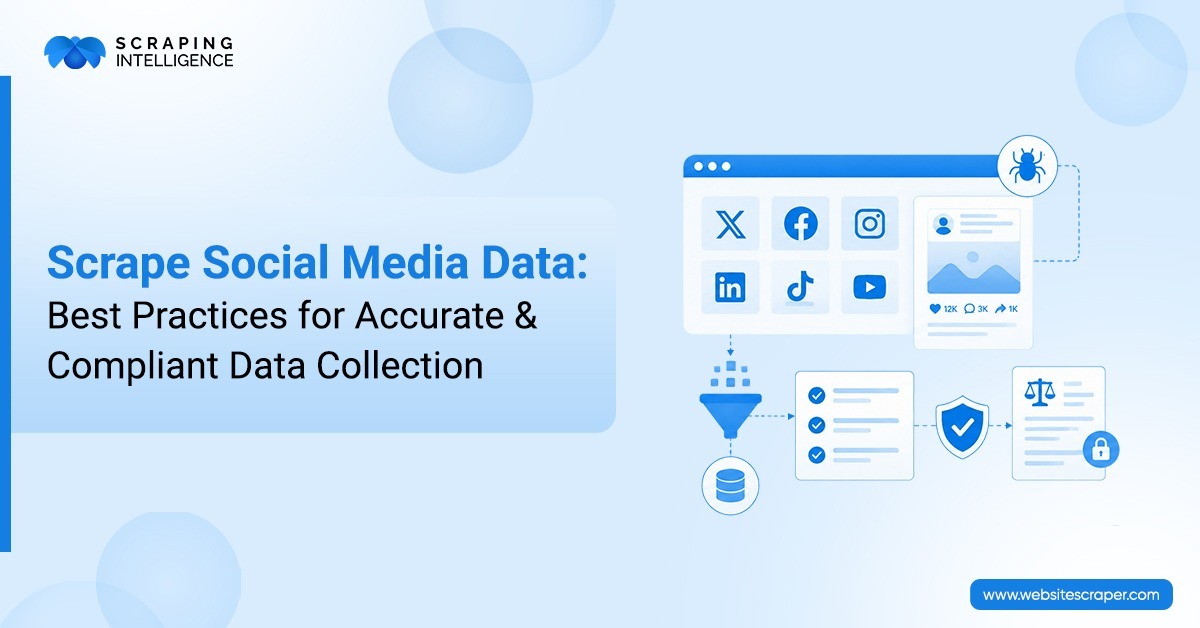
How to Scrape Social Media Data Ethically: Best Practices for Accurate and Compliant Data Collection
Category
Social Media
Publish Date
Aug 24, 2026
Author
Scraping Intelligence
Introduction
Marketing teams, research groups, and product managers all share a common need right now: a dependable view into public conversations across social platforms. That need is precisely what has pushed ethical social media scraping from a niche technical concern into a core competency for data teams. The difficulty lies in the balance. Organizations want current insight from platforms such as Instagram, LinkedIn, and X, yet they remain bound by privacy expectations, platform terms, and a patchwork of regional laws. Where those pressures meet, careless collection tends to backfire — producing banned accounts, unexpected legal exposure, and data the team itself no longer trusts.
This guide covers the subject in practical terms. It explains what compliant data collection entails, which methods keep a project within the rules, and how to preserve data quality without introducing unnecessary risk.
What Is Ethical Social Media Scraping?
Ethical social media scraping refers to gathering publicly available data that respects users’ reasonable privacy expectations, platform terms of service, and applicable laws. The emphasis falls on restraint rather than reach. A well-run project pulls only the fields it can justify, draws from sources where access is permitted, and ties each collection effort to a defined purpose. The goal is to create a dataset with a clear source, defined purpose, and documented collection process that your team can confidently use.
Scraping and hacking are not the same. Scraping generally involves collecting information that a website makes accessible, while hacking involves gaining unauthorized access to systems or data. Not every publicly visible page is automatically permissible to scrape or reuse in the same way an analyst might review a public profile. Hacking, by contrast, involves reaching into private systems that were never meant for outside eyes. Working within those limits protects more than compliance records. Your brand reputation depends on it, as does the reliability of the data you hand to decision-makers and the privacy of the people whose information moves through your systems. Responsible data collection is, in the end, the practical test of whether an organization can be trusted with sensitive material at all.
Is Social Media Scraping Legal?
Scrutiny of data practices has intensified from every direction regulator, platforms, and the public are all paying closer attention to how information gets gathered. One serious lapse can erase months of effort and leave a mark on a company's reputation that lingers. The points below explain why a disciplined approach repays the effort, and each ties back to the underlying health of the business.
Regulatory penalties are substantial: Under GDPR, fines can reach €20 million or 4% of global annual revenue, and Regulatory penalties can be substantial. Under the GDPR, certain infringements can result in fines of up to €20 million or 4% of an organization's total worldwide annual turnover, whichever is higher.
Sourcing affects credibility: When clients can see that findings rest on legitimate, well-documented data, they tend to act on those findings with more confidence.
Quality improves at the source: Disciplined collection removes the duplicates and spam entries that quietly skew an analysis.
Access tends to last: Responsible request rates can reduce the likelihood of unnecessary throttling or access restrictions, although platforms may still change their access policies at any time.
None of these advantages depends on aggressive tactics. If anything, a measured and rule-aware method tends to yield the stronger result. That equilibrium sits at the center of compliant data collection.
Which Laws and Rules Shape Compliant Social Media Scraping?
The rules that govern a project deserve attention well before any code is written. They originate from three separate sources, and a gap in any one of them can compromise the whole dataset.
Key Legal and Platform Considerations:
Data protection statutes: GDPR across Europe and CCPA in California place firm limits on how personal data may be stored, processed, and reused.
Platform terms of service: Every network defines the automated access it permits, and those definitions are revised more often than most teams expect.
Content ownership: Some material is still copyrighted by its creators. So, if you reuse it without permission, you may be infringing copyright.
Purpose and lawful basis: Public visibility does not automatically mean that data can be collected, stored, profiled, or reused without restrictions. Depending on the jurisdiction and use case, organizations may need to establish an appropriate lawful basis and meet transparency and data-minimization requirements.
Recording the legal basis behind each project. Being able to explain why a given field was collected converts an ambiguous situation into a documented one. For any serious data collection operation, that record quietly becomes one of its most valuable assets.
Ethical vs. Risky Social Media Scraping
Placing good practice next to poor practice is often the quickest way to see the distinction. The table below sets common habits against one another, giving you a reference point for auditing your own workflow.
Factor
Ethical Approach
Risky Approach
Data Source
Publicly accessible sources where collection and use are permitted
Private, restricted, or unauthorized sources
Request Pacing
Measured intervals that mimic normal traffic
Bursts of requests that strain the host server
Personal Data
Reduced to essentials, then anonymized
Harvested in bulk regardless of relevance
Platform Terms
Reviewed and followed before collection begins
Treated as optional to move faster
Lawful Basis and Purpose
Documented for the processing activity
Assumed or left undocumented
Outcome Over Time
Reliable access with data you can defend
Account bans, IP blocks, and exposure to legal claims
6 Best Practices for Ethical Social Media Data Collection
This brings us to the methods themselves. The habits below are what keep social media data scraping both accurate and defensible. Each is straightforward to adopt on its own, and in combination they form a system that holds up as your needs expand.
Honor robots.txt and rate limits: Sites publish access rules for a reason, and a crawler that respects them stays welcome rather than blocked.
Narrow your scope to what matters: Collecting less lowers storage costs, reduces privacy exposure, and keeps irrelevant noise out of your analysis.
Minimize and pseudonymize personal identifiers: Collect only identifiers that are necessary for the stated purpose. Where individual-level analysis is required, consider pseudonymizing identifiers and storing any mapping information separately with appropriate access controls.
Run regular deduplication checks: Compare stable post IDs, URLs, timestamps, or other available identifiers to identify duplicate and malformed records before they reach downstream analysis.
Prefer official APIs where they exist: Sanctioned endpoints tend to return cleaner data and spare you the instability of raw page scraping.
Maintain a consent record: Document the lawful basis and purpose. Record why the data is being collected, what fields are required, how the data will be used, and how long it will be retained. Where consent is the applicable basis, maintain appropriate consent records.
These practices function best as a shared checklist the whole team can consult. Once the process lives in writing, quality no longer rests on any one person's memory and instead becomes part of how the group operates. Sustained over time, that consistency is what accurate data collection looks like in practice.
How Can the Right Tools and Partners Improve Your Results?
Strong habits still depend on capable tooling. Reliable scraping infrastructure can help teams manage request rates, scheduling, data formatting, validation, and monitoring. The right solution should prioritize stable collection and compliance rather than simply maximizing the volume of requests. An experienced partner contributes something further a working knowledge of the rules that vary from one platform and jurisdiction to the next.
This is where dedicated tooling and outside expertise prove their worth. For teams that would prefer to bypass the trial-and-error phase and begin with a compliant pipeline already in place, a specialized data collection service can build a workflow matched to your objectives and your tolerance for risk. Teams refining an in-house approach can lean on published guides and vendor documentation to sharpen their process. The end goal remains constant in either case: a dependable flow of accurate and compliant data the wider organization can rely on.
Most scraping failures come down to a handful of avoidable errors. Reviewing them in advance can spare you hours of remediation, so treat the list as a short pre-flight check before a project begins.
A crawler that fires requests in rapid succession draws bans quickly, and the data it manages to pull back is often skewed anyway.
Terms of service are easy to skip past, but violating them can convert a useful dataset into a legal problem with little warning.
Personal data kept without a clear reason offers no analytical upside while steadily increasing your privacy exposure.
Skip the validation step and duplicate or junk records slip through, quietly degrading the analysis before anyone notices.
An operation resting on one account or a single IP address is fragile by design, and a platform can shut it down in one move.
Final Thoughts
Sound data work is not measured by how much you gather in the shortest time. It is measured by whether the right information was gathered soundly, so that every conclusion drawn from it rests on firm ground. Following ethical social media scraping practices protects your users, your brand, and your commercial standing at the same time — an uncommon alignment, and one well within reach for any disciplined team.
Begin modestly, keep your process documented, and bring in proven tools and partners as your requirements grow. Ethical social media scraping starts with a clear purpose, limited data collection, documented processes, and respect for platform rules and applicable privacy requirements. When teams combine responsible collection practices with strong data validation and governance, they can build datasets that are both useful and defensible.
Share this article:
About the Author
Scraping Intelligence
Scraping Intelligence Editorial Team is a collective of data specialists, analysts, and researchers with expertise in web scraping, data extraction, and market intelligence. The team produces well-researched guides, actionable insights, and industry-focused resources that help businesses unlock the value of data and make informed, strategic decisions.
Latest Blog
Explore our latest content pieces for every industry and audience seeking information about data scraping and advanced tools.
See how the travel industry uses web scraping to track fares, room rates, availability, and reviews, plus how to choose the right data extraction solution.
Discover how real estate web scraping helps agents, investors & brokers extract listings, prices & market trends. See 7 key benefits of real estate data scraping.