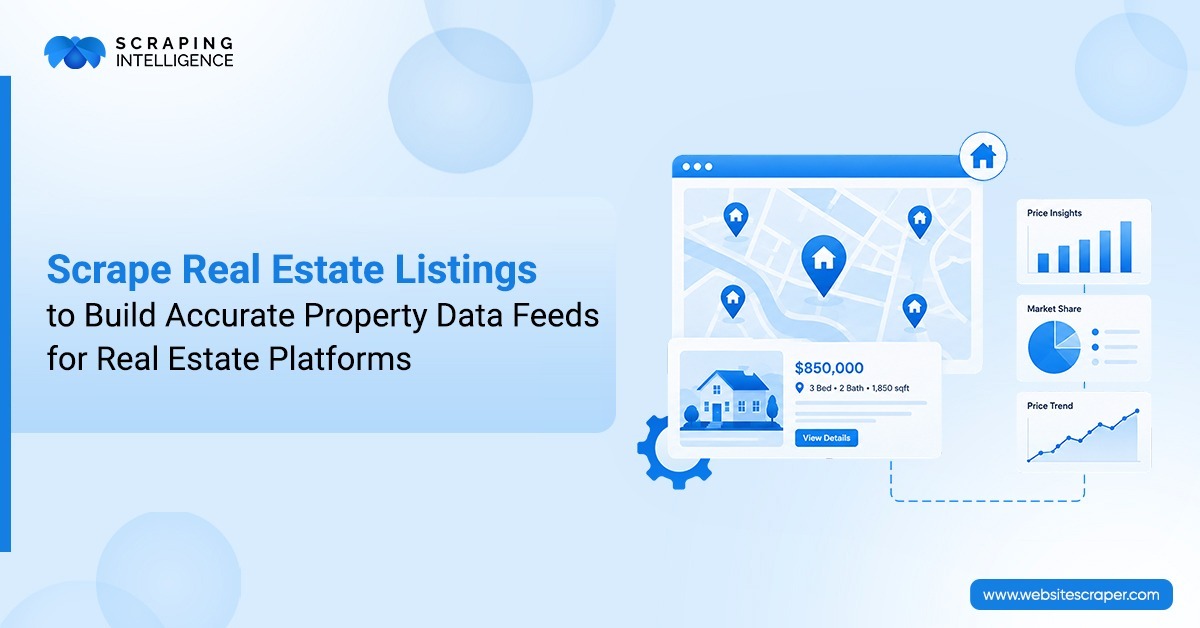
Scrape Real Estate Listings to Build Reliable Property Data Feeds
Category
Real Estate
Publish Date
Sep 01, 2026
Author
Scraping Intelligence
Global real estate investment is soon going to reach a staggering $1.2 trillion by the end of 2026, with around $500 billion already deployed in the first half of the year. (Source: Savills Impact) As capital flows back into the market, access to accurate and timely property information is becoming increasingly important.
Every listing, price change, property feature, and availability update can influence valuation models, investment decisions, property discovery, and competitive analysis. Yet this information remains fragmented across thousands of real estate websites and constantly changes.
That’s where real estate listing scraping and real estate web scraping come in. By automating property listing and real estate data scraping, businesses can extract property data at scale, standardize real estate listing data, and continuously deliver fresh real estate data feeds.
These property data feeds help real estate platforms turn scattered property listing data into reliable, structured, actionable intelligence, giving businesses the data foundation they need to make faster, smarter decisions.
What is Real Estate Listing Scraping?
Real estate data scraping is the automated extraction of property listing data, such as the address, price, beds and baths, area, agent, open house dates, and listing status, from web pages into structured records. The goal is not raw HTML. It is a typed listing object that a database, a comps model, or a search index can consume without manual cleaning.
Why Extract Real Estate Data?
In this fierce real estate market, extracting data is important for gaining valuable information and making informed decisions. Real estate data forms the foundation for several business strategies and analytical processes.
Here’s why extracting this data is critical:
Market Analysis and Trends
Real estate data scraping services enable the collection of extensive data from sites such as Zillow, Realtor.com, Redfin, etc. This data helps you understand market dynamics, track changes in property prices, and identify emerging trends.
Informed Decision-Making
Extracted data provides access to a complete real estate property dataset, enabling investors, developers, and analysts to make analytics-based decisions. By analyzing property prices, market patterns, and location specifics, stakeholders can identify lucrative investment opportunities and create effective strategies.
Price Comparison and Monitoring
Web scraping property prices on different platforms enables precise price comparisons. This information is important for setting competitive pricing and tracking market fluctuations. Scrapers that provide a housing price dataset help monitor changes over time and predict future trends.
Competitive Advantage
Having the latest data gives you an upper hand in the market. By utilizing real estate data API services, businesses can stay ahead of competitors through real-time updates and accurate information. This is especially useful for developing pricing policies and comprehending market positioning.
Advanced Research and Analytics
Real estate research analytics involves analyzing large volumes of data to generate actionable insights. Scraping data helps in compiling robust datasets for research, which can be used to forecast market patterns, assess property values, and evaluate investment potential.
A well planned extraction process is necessary to turn scattered property listings into accurate, structured, and usable real estate data. The following steps can help you build an efficient and scalable data extraction workflow.
Step 1: Extracting Core Property Listing Details
The process begins by collecting essential listing data such as property prices, square footage, number of rooms, amenities, images, and location details. These data points form the foundation for market analysis and property comparisons.
Step 2: Maintaining Consistency Across Multiple Property Platforms
Different property websites display data in different formats. This step standardizes listing fields so information is scraped consistently across platforms.
Step 3: Validating and Structuring the Collected Data
Once extracted, the data is cleaned and validated to remove duplicates and outdated listings. Structured formatting ensures the data is ready for analytics, reporting, and internal systems.
Step 4: Supporting Analytics and Reporting Workflows
The final step ensures the structured data fits seamlessly into analytics and reporting workflows. Businesses can then track market movements, analyze pricing patterns, and make smarter, data-backed decisions.
What are the Challenges Faced While Extracting Real Estate Listings?
When businesses try to scrape real estate listings, they often face challenges that affect data quality and consistency. Property websites are designed for users, not for large-scale data collection, which creates roadblocks for reliable access.
Here’s a list of challenges that real estate data scraping service providers face:
Anti-Bot Systems and Data Access Restrictions
Property websites now use multiple security measures to control automated access. These security measures can block requests, limit data visibility, or restrict access to important listing fields. This makes it difficult to collect data at scale without interruptions.
Data Structure Variability
Another challenge real estate scraping faces is data structure variability. Data from different websites comes in different formats. To address this, property data extraction providers use data cleaning and normalization techniques to standardize the data for analysis.
Ensuring Accuracy and Compliance During Data Collection
Maintaining accurate and up-to-date property data is another major challenge. Duplicate listings, outdated prices, and incomplete records can affect analysis. At the same time, data must be collected responsibly to follow website policies and reduce compliance risks.
IP Blocking
IP blocking is another challenge that real estate listing scraping providers face. Frequent requests from the same IP address can lead to blocking. To avoid this, most scrapers use rotating proxies or VPNs to distribute requests across multiple IP addresses.
Use Cases of Real Estate Data Collection Service
Real estate data collection services support a wide range of business use cases by providing structured and reliable property data. These services help organizations turn raw listings into insights that guide planning and decision-making.
Investment Research and Portfolio Evaluation
Investors use structured property data to compare locations, evaluate asset performance, and assess risk. Consistent listing data makes it easier to review portfolios, identify high-performing properties, and plan future investments.
Market Trend Analysis and Forecasting
Businesses analyze historical and current property data to track price movements, demand shifts, and regional trends. This data supports forecasting models that help predict future market behavior and identify growth areas.
Business Intelligence and Internal Reporting
Clean and organized datasets feed directly into internal reports and dashboards. Teams can monitor key metrics, measure performance, and support strategic decisions with accurate, up-to-date real estate insights.
How Does Scraping Intelligence Make a Difference?
Scraping Intelligence helps businesses turn fragmented data into reliable, structured, and continuously updated property data feeds. By automating real estate listing scraping, unifying data across multiple property platforms, and validating records for accuracy, Scraping Intelligence enables investors, real estate platforms, and analysts to access fresh property data for market analysis, price monitoring, investment research, forecasting, and competitive intelligence, without the difficulty of managing large-scale data collection themselves.
Final Thoughts
Professional real estate data scraping services have become essential for businesses that need accurate and structured property data. Manual data collection is time consuming, prone to errors, and difficult to scale, while managed services ensure consistency, quality, and compliance with data usage policies.
These services allow businesses to track prices, analyze market trends, monitor competition, and make informed decisions with confidence. With scalable delivery and validated datasets, companies can focus on insights instead of struggling with raw listings.
If you are looking for trusted property data for research, analytics, or strategy planning, get in touch with Scraping Intelligence today. As a leading real estate data scraping service provider, we deliver clean and structured datasets tailored to your business needs. Get in touch with Scraping Intelligence to streamline your data workflows and gain a competitive advantage in the market.
Share this article:
About the Author
Scraping Intelligence
Scraping Intelligence Editorial Team is a collective of data specialists, analysts, and researchers with expertise in web scraping, data extraction, and market intelligence. The team produces well-researched guides, actionable insights, and industry-focused resources that help businesses unlock the value of data and make informed, strategic decisions.
Latest Blog
Explore our latest content pieces for every industry and audience seeking information about data scraping and advanced tools.
See how the travel industry uses web scraping to track fares, room rates, availability, and reviews, plus how to choose the right data extraction solution.