Scrape Multi-Retailer Reviews to Fix Product Issues Faster
Category
E-commerce & Retail
Publish Date
Oct 09, 2026
Author
Scraping Intelligence
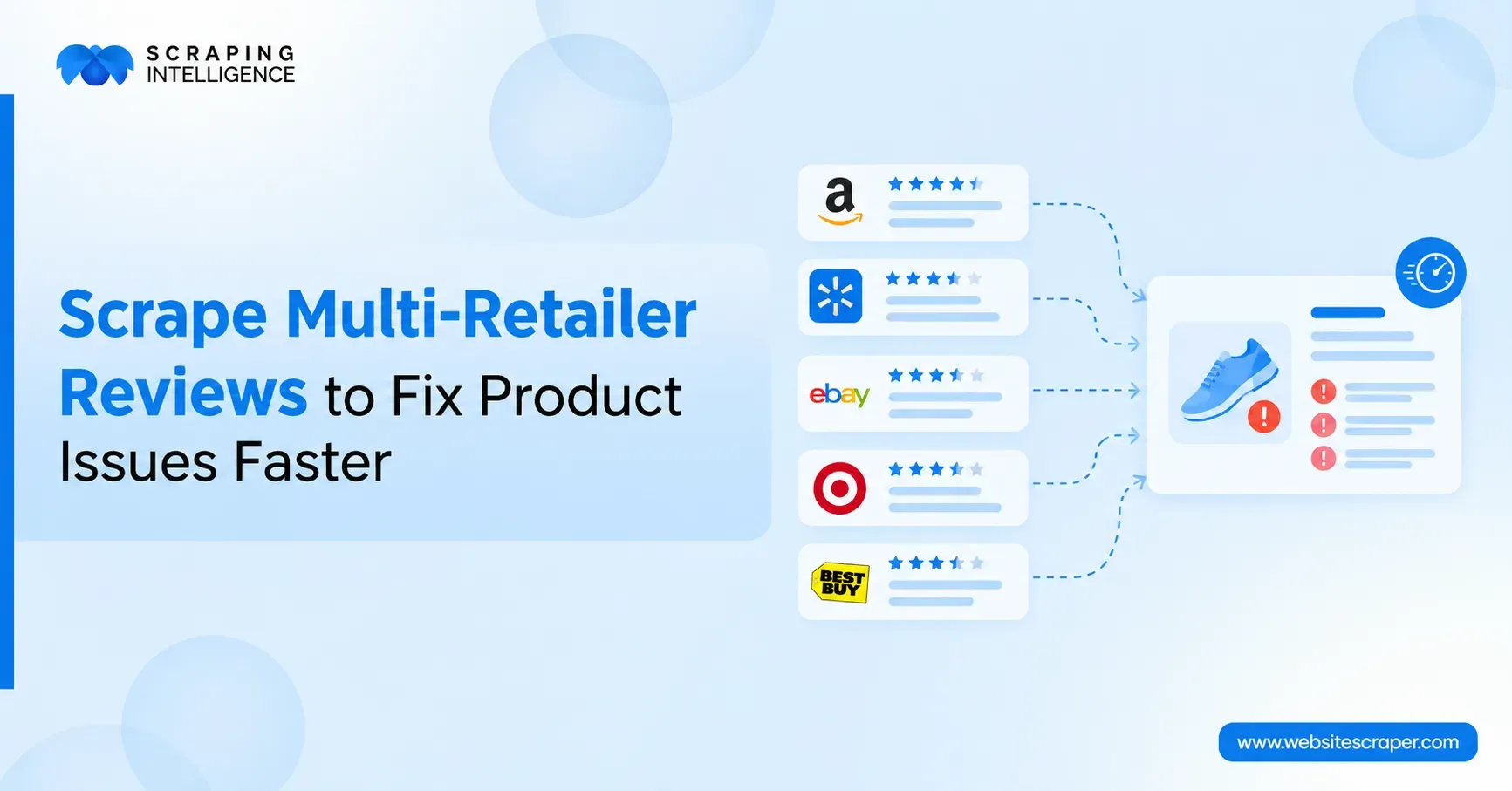
Customer reviews across Amazon, Walmart, Target, and other retailers can reveal product defects, sizing issues, packaging problems, and recurring complaints. The challenge is that this feedback is scattered across different websites, making it difficult to analyze at scale. Product review scraping brings reviews, ratings, dates, and other relevant fields into a structured dataset that teams can analyze together.
By combining feedback from multiple retailers, brands can identify recurring product issues, compare customer sentiment, and prioritize improvements based on real customer experiences. This guide explains how multi-retailer review scraping works, what product problems review data can uncover, how often to refresh the data, and how voice of customer data can turn customer feedback into actionable product and quality improvements.
What Is Product Review Scraping, and Why Does It Matter Now?
Product review scraping is the automated collection of customer reviews, star ratings, and related feedback from retail websites. Rather than copying comments by hand, a scraper visits each product page, reads the review section, and exports the details into a structured file. The output usually captures the review text, rating, date, verified-purchase flag, and source retailer.
Review data is increasingly important as shoppers use customer feedback to evaluate products before purchasing. When reviews are spread across multiple retailers, analyzing them together gives brands a broader view of recurring customer concerns and product performance. When your feedback lives on ten different sites, none of it is useful until it sits together. That is the real point of review data extraction: it turns thousands of separate comments into one searchable record your product and support teams can actually trust.
Why Should You Pull Feedback from More Than One Retailer?
A single retailer provides only part of a product's customer feedback. Different marketplaces attract different customer groups and may surface different problems, so combining reviews can provide a broader view of product performance. Shoppers spread their opinions widely, and about 59% check several review platforms before deciding. The case for multi-retailer review scraping comes down to a handful of clear advantages:
Different audiences shop on different sites, so a fit complaint that floods Walmart may barely register on your own store.
Retailer-specific problems, such as damaged packaging from one fulfillment center, only stand out when sources sit side by side.
Verified-purchase indicators can provide additional context when evaluating recurring complaints, helping teams distinguish broader product patterns from isolated feedback.
Broader coverage lowers the risk that a few fake or planted reviews quietly skew your read on quality.
Trend signals get sharper when the same complaint repeats across three or four independent retailers instead of one.
Which Product Issues Do Reviews Reveal First?
The table below maps frequent complaints to the review signals that expose them, the retailer where each tends to appear first, and the fix it points toward. Patterns like these are why disciplined product review scraping pays off so quickly.
Product Issue
Typical Review Signal
Commonly Reported On
Potential Action
Defective units
"Stopped working after a week"
Amazon, Best Buy
Review QC procedures
Sizing problems
"Runs small, order a size up"
Walmart, Target
Review size chart
Packaging damage
"Arrived crushed in the box"
Amazon
Evaluate packaging
Misleading listing
"Not as described online"
Marketplaces
Update images and copy
Missing parts
"No screws in the kit"
Home improvement retailers
Audit package contents
Is It Legal to Scrape Product Reviews from Retailers?
This question comes up early, and the honest answer has nuance. Legal and contractual considerations around review scraping depend on the website, jurisdiction, data collected, and intended use. Public availability does not automatically remove a site's terms of service or other legal considerations. Before starting a scraping project, review the applicable website policies, access restrictions, privacy requirements, and local laws.
Several practices can help reduce legal, privacy, and operational risks:
Collect only public-facing review text and star ratings, not login-gated or personal information.
Respect rate limits so your requests don’t strain a retailer’s servers.
Check robots.txt files and posted usage rules for each site.
When in doubt, a brief chat with your legal team settles most concerns. Clear boundaries protect both your brand and the quality of your voice-of-customer data.
How Does Review Data Extraction Work, Step by Step?
Good review data extraction follows a repeatable sequence. The process can look technical from the outside, yet the logic is straightforward once you break it into stages.
Source selection. First, list every retailer that sells your product. Include the big marketplaces, but don't skip smaller niche stores.
Page discovery. From there, the scraper finds each product URL and locates where the reviews live on the page.
Field mapping. Now you decide what to pull from each review: the text, rating, date, and whether the purchase was verified.
Extraction at scale. With the fields set, the scraper collects thousands of reviews at once, so no one has to copy and paste anything.
Cleaning and structuring. The raw page code is messy, so this stage tidies it into clean rows you can open in a spreadsheet or a database.
Delivery. Finally, the finished dataset goes to your team, ready for ratings and reviews analytics.
Every stage builds on the last, and a strong pipeline can repeat the whole run on a schedule.
How Often Should You Refresh Your Review Data?
Timing shapes how useful your dataset stays. A one-time pull gives you a snapshot, which is fine for a quick audit. Ongoing fixes, though, need a steady feed, since complaints shift as new batches ship and seasons change.
Most brands settle into a rhythm based on how fast their products move:
Fast-moving products, recent launches, or products under investigation may benefit from weekly monitoring, while stable products may require only monthly or quarterly refreshes.
A monthly refresh covers steady catalog products, where volume is moderate and trends move slowly.
Mature lines that rarely change only need a quarterly look, which works as a routine check rather than an alarm.
Scheduled review data extraction means a packaging problem surfaces in days, not after a thousand returns. Pairing a regular cadence with ratings and reviews analytics keeps your team ahead of issues instead of reacting after the damage is done.
Which Metrics Belong in Your Ratings and Reviews Analytics?
Once the data lands, ratings and reviews analytics tells you what to fix and in what order. A few measures carry far more weight than a single average score:
Average rating trend: Direction over time, since a slow slide signals quality drift long before the raw number looks alarming.
Complaint frequency: How often a specific issue appears, separating a one-off gripe from a real pattern.
Sentiment by feature: Feeling attached to zippers, battery life, or fit, rather than the product as a whole.
Return-linked keywords: Words such as broken, leaked, or wrong that tend to appear right before a refund request.
Tracked together, these numbers turn review data from a wall of text into a short, ranked list of things worth fixing this quarter.
How Do You Turn Voice of Customer Data into Real Fixes?
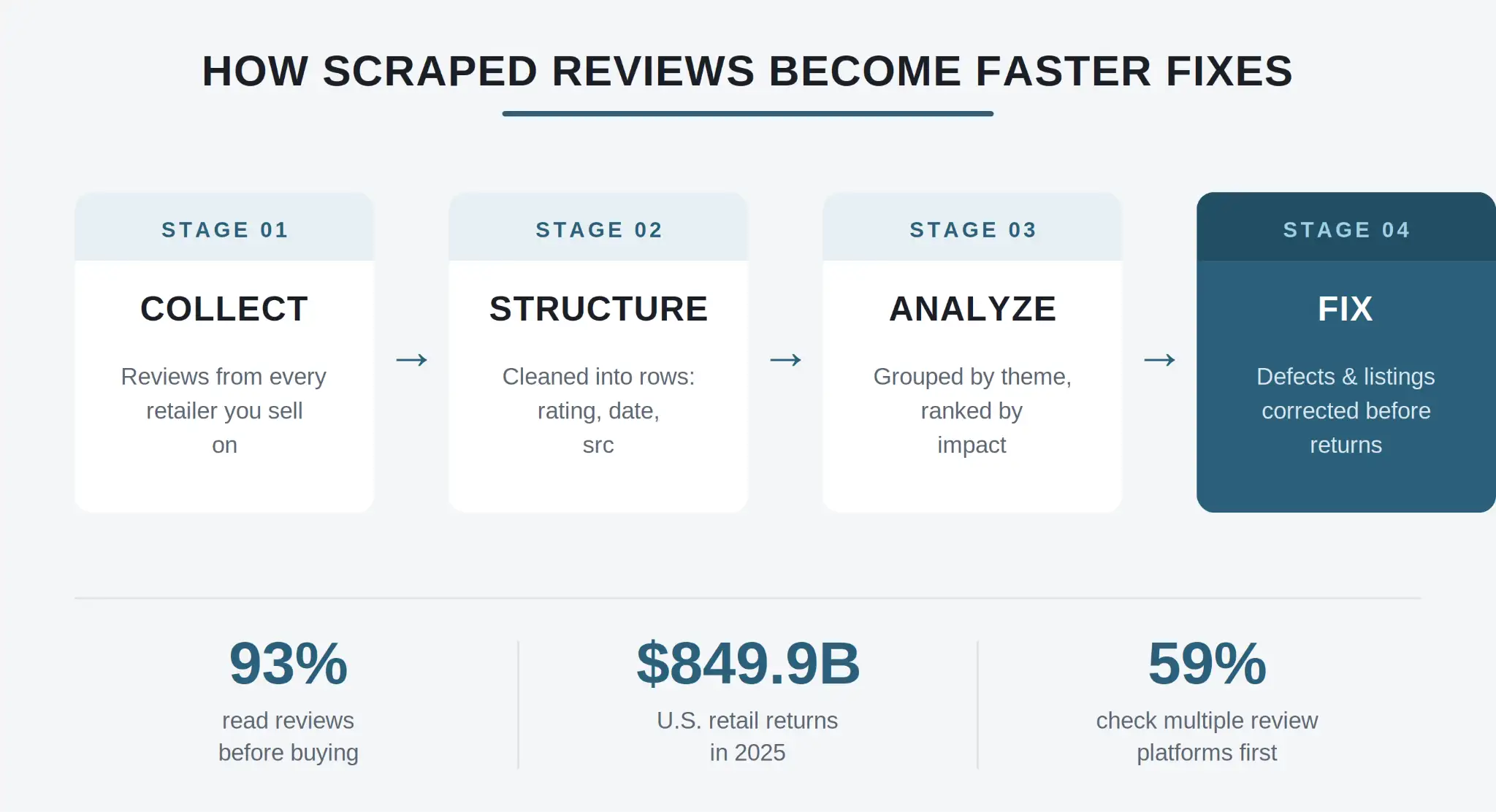
Collecting feedback is only half the job. The real payoff comes when voice of customer data drives decisions on the factory floor or in the listing. Returns are expensive: U.S. retail returns reached $849.9 billion in 2025, and each processed return can cost a retailer between $10 and $65. Reviews can signal emerging product problems before they show up in return or support data.
Group recurring complaints: Combine similar comments into themes so repeated issues become easier to quantify.
Prioritize by impact: Rank issues using review frequency, rating impact, product importance, and related business metrics.
Share evidence with suppliers: Use representative review excerpts and aggregated findings to support quality discussions.
When your voice of customer data feeds product, quality control, and support at the same time, you fix product issues faster and protect the ratings that keep sales moving.
The Payoff at a Glance
Review Data
Business Insight
Potential Action
Repeated defect complaints
Possible quality issue
Investigate manufacturing
Negative fit comments
Sizing concern
Update size guidance
Packaging complaints
Fulfillment/packaging issue
Review packaging
Rating decline
Product satisfaction falling
Investigate recent changes
Recurring feature complaints
Feature-level weakness
Prioritize product improvement
What Separates a Good Scraping Partner from a Weak One?
Not every provider delivers the same quality, and the gap shows up fast once real volume hits. The difference usually comes down to reliability, clean output, and support, not just headline price. A scraping solution's total cost depends on more than its initial price. Reliability, retailer coverage, data quality, maintenance, delivery format, and support all affect how much effort it takes to keep review data usable.
Signs of a partner worth keeping tend to look like this:
Consistent uptime, so your multi-retailer review scraping does not stall mid-project.
Structured, deduplicated files that drop straight into your analytics, with no messy cleanup.
Coverage across the retailers you actually sell on, not just the easy one or two.
Clear communication when a site changes its layout, and the scraper needs a quick fix.
The right choice turns scraping Amazon reviews and other sites into a dependable habit. At websitescraper.com, that reliability is the whole point.
Conclusion: Let Your Reviews Point the Way
Customer reviews can reveal product problems long before sales, support tickets, or return data make them obvious. By collecting feedback from multiple retailers, brands can identify recurring complaints, compare product sentiment across marketplaces, and prioritize improvements using a broader set of customer signals.
The key is not simply collecting more reviews. It is building a reliable process to extract, clean, analyze, and refresh the data. With the right workflow, multi-retailer review data can support product development, quality control, customer experience, and marketplace strategy.
If your team needs to monitor product feedback across multiple retail websites, a structured review data extraction workflow can turn scattered customer opinions into actionable insights.
Share this article:
About the Author
Scraping Intelligence
Scraping Intelligence Editorial Team is a collective of data specialists, analysts, and researchers with expertise in web scraping, data extraction, and market intelligence. The team produces well-researched guides, actionable insights, and industry-focused resources that help businesses unlock the value of data and make informed, strategic decisions.
Latest Blog
Explore our latest content pieces for every industry and audience seeking information about data scraping and advanced tools.
See how the travel industry uses web scraping to track fares, room rates, availability, and reviews, plus how to choose the right data extraction solution.