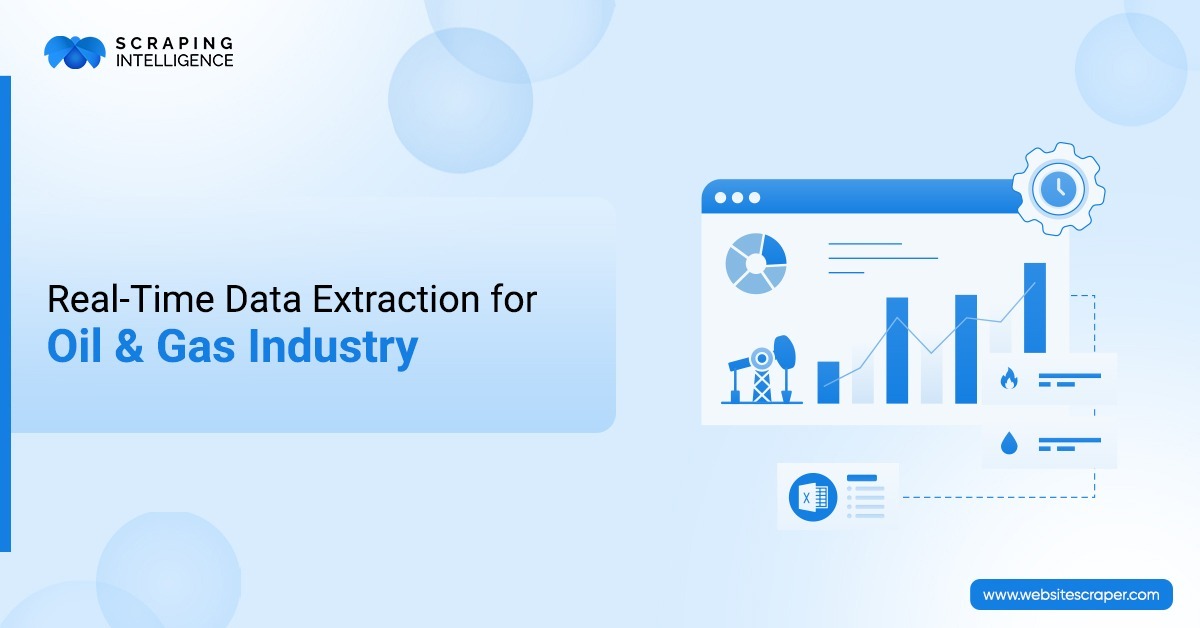
Real-Time Data Extraction for Oil & Gas Industry: A Complete Guide
Category
Services
Publish Date
May 28, 2026
Author
Scraping Intelligence
Energy markets do not slow down for anyone. Crude oil prices shift within minutes. Supply routes get disrupted overnight. Demand signals across global markets change faster than any analyst can track manually. For companies operating in the oil and gas industry, waiting on end-of-day reports or weekly spreadsheets is no longer a viable strategy.
Real-time data extraction enables energy companies to capture live market intelligence at scale. It pulls structured information directly from pricing platforms, government energy portals, refinery databases, and commodity trading sites. It provides a constant, accurate feed of the data that drives decisions across trading, logistics, procurement, and planning.
his guide covers the practical mechanics of extracting real-time oil and gas data. These sources matter most: the business benefits companies are seeing in 2026, and the use cases that deliver the highest return on investment.
What Is Real-Time Data Extraction?
Real-time data extraction is the process of collecting structured information from online sources as soon as that information is published or updated. The fundamental difference from batch processing is latency. Batch systems collect data at a defined schedule, such as hourly, nightly, or weekly pulls. Real-time systems are always up and running, and can provide you with information in seconds or minutes.
For energy sector applications, this means a procurement analyst can access current WTI spot prices, the most recent EIA storage report, and regional retail fuel prices simultaneously, without manually checking each source. All of that data flows into a single structured output. Scraping Intelligence designs these extraction pipelines to handle the specific update patterns, data structures, and access requirements of energy sector sources, so clients receive clean, consistent feeds they can actually use.
Why Does the Oil & Gas Industry Need Real-Time Data?
Energy is arguably the most event-driven commodity market. OPEC quota decisions, refinery shutdowns, pipeline incidents, and currency fluctuations all affect crude oil pricing within hours of becoming public. Companies running on delayed data are, in effect, making decisions based on conditions that no longer exist.
Rapid Changes in Fuel and Crude Oil Prices
Procurement teams and traders who access live crude oil price data can time contracts, hedge positions, and manage inventory costs with considerably more precision. A two-dollar movement in WTI on a 500,000-barrel contract is a million dollars. Getting that data 12 hours late is not a minor inconvenience; it is a quantifiable loss
Supply Chain and Logistics Monitoring
Tanker schedules, pipeline throughput reports, and port congestion data are all generated and updated continuously. Real-time supply chain data extraction lets logistics managers see disruptions forming and reroute shipments before problems compound. Waiting for a morning report to surface an issue that happened the previous afternoon is a structural inefficiency most operators can no longer afford.
Market Volatility and Global Demand Tracking
Demand signals from industrial output data, shipping activity, and regional consumption figures tell a more complete story when they arrive in real time. Energy demand forecasting that uses live inputs produces tighter projections than models that rely on last month's government releases.
Competitive Intelligence Requirements
Competitor pricing changes, capacity expansions, and strategic announcements happen at irregular intervals. Catching them quickly requires automated, continuous monitoring across relevant sources. Manual tracking on a daily schedule almost guarantees that your team is always one step behind on competitor intelligence in oil and gas.
Key Data Sources in the Oil & Gas Industry
Not every data source delivers equal value. The six categories below account for the majority of high-priority inputs in oil and gas data extraction programs.
Data Source
Type of Data Captured
Update Frequency
Crude Oil Pricing Platforms
Spot prices, futures, WTI, and Brent benchmarks
Every few minutes
Energy Market Websites
Market news, trading activity, analyst reports
Hourly to Daily
Refinery & Production Databases
Output volumes, utilization rates, and outage notices
Daily to Weekly
Government Energy Reports
EIA, IEA, OPEC statistical releases
Weekly to Monthly
Fuel Station & Retail Pricing Platforms
Regional and brand-level pump prices
Daily
Commodity Trading Websites
Options, derivatives, spread, and basis data
Real-time
Each of these source types requires a different extraction configuration. Some updates every few minutes and need persistent monitoring. Others publish structured reports on a known schedule and can be pulled on a timed trigger. Scraping Intelligence handles these configurations for clients, updating layouts and access as they become available.
What Are the Benefits of Real-Time Data Extraction for Oil & Gas Companies?
Faster Decision-Making
When analysts receive structured data feeds automatically rather than manually assembling them, response times compress. Teams using automated oil and gas data collection move from event to decision faster because the data is already organized and up to date when they need it. The research bottleneck that used to precede every major call gets removed.
Real-Time Fuel Price Monitoring
Fleet operators, fuel distributors, and retail pricing managers all benefit from knowing what competitors charge in their specific markets right now, not yesterday. Fuel price monitoring built on live extraction enables pricing teams to make adjustments within the same trading session rather than waiting until the following morning.
Improved Supply Chain Visibility
Production output levels, vessel tracking, and pipeline status combine to give a clearer picture of operations. When that information flows continuously rather than in batches, oil and gas supply chain managers catch exceptions earlier and with more context, leading to better-informed escalation decisions.
Better Market and Competitor Analysis
Continuous monitoring of energy market data through scraping gives strategy teams a real-time view of competitors' pricing, capacity, and positioning. Small teams with well-configured extraction pipelines can track more sources more consistently than large manual research teams ever could.
Reduced Manual Research Efforts
Manual data gathering introduces three problems that compound over time: it is slow, it creates inconsistencies between analysts, and it pulls skilled people away from analytical work. Automated energy data collection removes all three. The team's time goes toward interpreting and acting on data, not locating it.
Accurate Demand Forecasting
Forecasting outputs are constrained by input quality. When live consumption data from industrial, commercial, and residential sectors is directly fed into planning models, energy demand forecasting accuracy improves. Production scheduling, procurement planning, and inventory management all benefit from tighter projections.
Top Use Cases of Oil & Gas Data Extraction
Fuel Price Monitoring
Retail and wholesale fuel price tracking at scale requires automation. Pricing teams that monitor hundreds of locations across multiple states cannot do that work manually with any consistency. Automated data extraction delivers current prices across all target locations on a defined schedule, surfacing regional trends and competitor moves as they develop.
Oil Market Trend Analysis
Identifying directional movements in crude oil pricing before they become widely reported requires early access to production data, inventory levels, and refinery activity. Analysts who receive these inputs in real time build views ahead of consensus, which is where actionable market positions come from.
Competitor Intelligence
Pricing changes, contract announcements, and capacity updates from competitors carry strategic value only when captured quickly. Competitor intelligence data extraction automates this monitoring across public sources, giving strategy teams a Pipeline and Logistics Tracking. Throughput figures, maintenance windows, and capacity constraints in pipeline networks directly impact procurement and delivery planning. Automated extraction of oil and gas supply chain data from operator reports and regulatory filings keeps logistics teams working with current information rather than estimates.
Energy Demand Forecasting
Live data from consumption reporting platforms, industrial output indicators, and weather services all sharpen the inputs to energy demand forecasting models. The improvement in forecast accuracy when switching from periodic to real-time inputs is measurable in most operational contexts.
Refinery Performance Monitoring
Utilization rates, unplanned outages, and scheduled maintenance windows at refineries affect downstream supply availability and pricing. Refinery data extraction from operator disclosures and industry databases gives buyers and planners early visibility into supply shifts before they reach the spot market.
The capability set around energy data intelligence is expanding. Several developments underway in 2026 are extending the capabilities of real-time extraction for oil and gas operations.
AI-Driven Energy Intelligence: Machine Learning models embedded in live extraction pipelines can now find patterns across large datasets that manual analysis would miss, and they do so in real time.
Predictive Market Analytics: Using real-time inputs, predictive systems can identify likely price trends and supply disruptions before they appear in published data.
Automation in Industrial Data Collection: Full pipeline automation, from data capture through classification and delivery, is replacing hybrid models where humans still handle intermediate steps.
Growth of Data-Driven Energy Operations: Organizations that establish strong real-time data infrastructure now are building a compounding operational advantage as market complexity and data volumes continue to increase.
Scraping Intelligence is actively developing pipeline capabilities that combine live extraction with AI-powered classification and automated anomaly flagging, specifically tailored to the data requirements of energy sector clients.
Conclusion
The volume of publicly accessible oil and gas market data continues to grow each year. Pricing platforms, government agencies, commodity exchanges, and industry databases all publish information that carries real operational value. The companies capturing that information automatically and continuously are in a structurally better position than those still relying on periodic manual collection.
Getting a real-time data extraction program running is not a long-term project. With the right technical infrastructure and source-specific configuration, teams can move from manual processes to automated feeds within weeks. The performance improvements in fuel price monitoring, competitive intelligence, and demand forecasting begin as soon as live data starts flowing.
Scraping Intelligence builds and maintains these extraction programs for energy companies that want reliable, structured oil and gas data without managing the technical complexity themselves. The infrastructure is already built. The question is simply when to start using it.
Frequently Asked Questions
What is real-time data extraction in the oil and gas industry?+
Collecting live data such as crude oil prices, fuel costs, and market activity from online sources with minimum lag, so that operational decisions are faster and more informed.
Why do oil and gas companies need real-time data?+
Energy markets move in response to news and events continuously. Real-time access allows pricing, logistics, and procurement teams to act on current conditions rather than data reflecting a situation that has already changed.
What types of data can be extracted from oil and gas sources?+
Extraction programs typically cover crude oil spot prices, futures contracts, retail fuel prices, refinery output figures, pipeline status, and government energy statistics, all in near real time.
What is the difference between real-time and batch data extraction?+
Real-time extraction delivers data within minutes of publication. Batch processing runs on a schedule, introducing lag that can stretch to hours in some configurations, which is a meaningful limitation in volatile energy markets.
Is web scraping legal for oil and gas market data?+
Scraping publicly available data is generally lawful, subject to each source's terms of service. Scraping Intelligence evaluates compliance requirements for every data source included in a client program before extraction begins.
Let's Talk About Your Data Needs
Tell us what data you need, and we'll help you find the right solution.
Scraping Intelligence Editorial Team is a collective of data specialists, analysts, and researchers with expertise in web scraping, data extraction, and market intelligence. The team produces well-researched guides, actionable insights, and industry-focused resources that help businesses unlock the value of data and make informed, strategic decisions.
Latest Blog
Explore our latest content pieces for every industry and audience seeking information about data scraping and advanced tools.
Compare real estate data APIs vs. web scraping costs, including setup, infrastructure, maintenance, and data quality, to find the right solution for your needs.
See how the travel industry uses web scraping to track fares, room rates, availability, and reviews, plus how to choose the right data extraction solution.