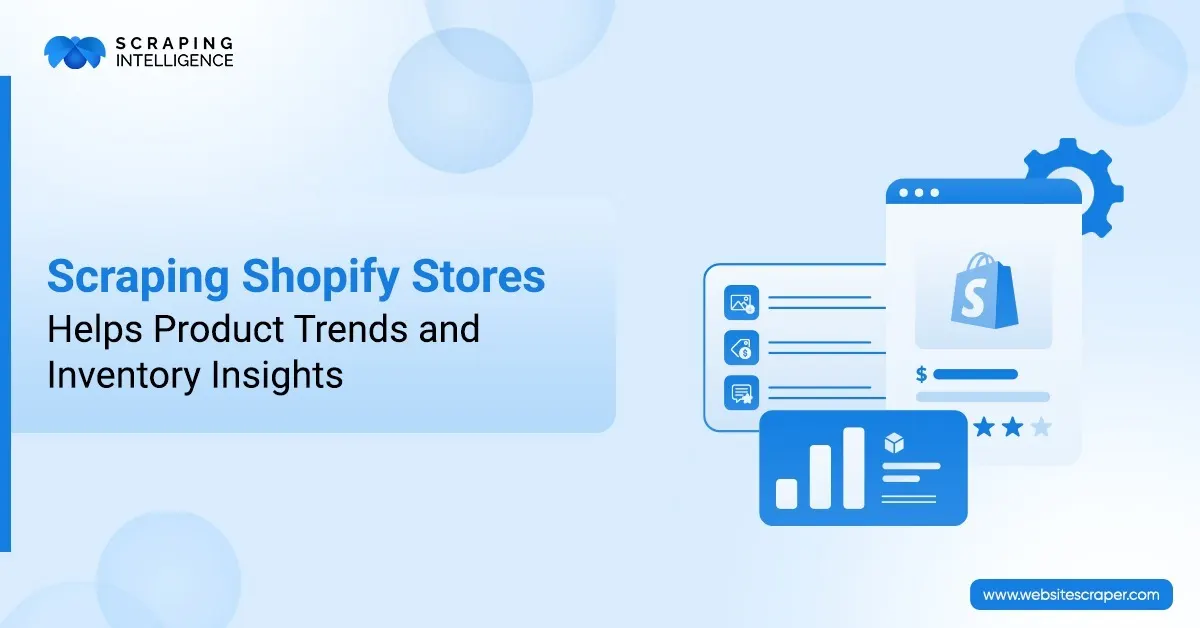
How Scraping Shopify Stores Helps Product Trends and Inventory Insights
Category
E-commerce & Retail
Publish Date
July 07, 2026
Author
Scraping Intelligence
Introduction
Are you still relying on guesswork to predict which products will sell next season, or are you using real-time market data to stay ahead? With more than 6.9 million Shopify stores operating across over 175 countries, thousands of merchants update their product catalogs, prices, collections, and stock availability every day. Each of these changes provides valuable signals about customer demand and shifting market trends. Scraping Shopify stores allows businesses to convert this publicly available Shopify product data into structured insights that support smarter decisions.
By leveraging Shopify data scraping, retailers, brands, analysts, and e-commerce businesses can monitor product trends, track inventory changes, analyze competitor pricing, and identify emerging opportunities before they become mainstream. Instead of manually reviewing hundreds of online stores, automated e-commerce data scraping collects and organizes the information needed for faster analysis and better retail intelligence.
In this blog, you will learn what scraping Shopify stores involves, how it supports product trend analysis and inventory insights, and why it has become an essential strategy for competitor analysis, pricing optimization, and data-driven business planning.
What Does Scraping Shopify Stores Actually Mean?
Shopify web scraping is the automated process of collecting publicly available data from Shopify-powered online stores, such as product names, prices, descriptions, images, stock status, and customer reviews. Instead of manually going through hundreds of individual stores, a scraping tool will visit each page, extract the relevant fields, and put them in a spreadsheet or database. This is not about accessing private admin panels or customer accounts. It is strictly about gathering the same information any shopper can see on a live storefront, just done at scale and on a schedule.
With over 6.9 million active Shopify stores currently running worldwide across more than 175 countries, the platform has become one of the largest sources of retail data on the internet. That scale is exactly why scraping product trends from Shopify has become so valuable for anyone trying to understand where the market is heading.
Why Product Trend Insights Matter for Modern Retail?
Retail moves fast, and a trend that looks strong in January can fade completely by March. Businesses that rely only on gut feeling or quarterly reports are usually reacting too late. Tracking Shopify product trends through scraped data gives a much earlier and more accurate signal because it reflects what real merchants are actually stocking, pricing, and promoting right now.
Here is what trend data pulled from Shopify stores typically reveals:
Which product categories are gaining new listings month over month?
How pricing shifts across competitors in the same niche?
Which keywords and product titles are being used most often?
Seasonal spikes in specific product types before they show up in mainstream reports.
New entrants in a niche and how quickly they scale their catalog.
This kind of visibility helps brand owners plan inventory purchases, helps marketers time campaigns, and helps investors evaluate which niches are heating up before the crowd notices.
How Inventory Insights Improve Business Decisions?
Stock visibility is one of the most practical benefits of Shopify inventory scraping. When a business can see how competitor stock levels change over time, it becomes much easier to plan purchasing, pricing, and marketing around real supply patterns rather than assumptions.
Consider a few common scenarios:
A competitor's best-selling product is unavailable for a week or two. That’s an opportunity, not merely an oddity, and a retailer monitoring it carefully can jump in with a similar product while demand remains high.
A particular product type keeps selling out across several unrelated stores. That pattern is a demand signal worth acting on before the next buying cycle, not a coincidence.
A retailer walks into a supplier negotiation with real numbers on how many stores carry a product and at what price. That tends to land better than walking in with a guess.
A dropshipper checks whether a promising product has stayed in stock and kept selling across multiple stores over several weeks, rather than gambling on a single fast spike.
A merchandiser compares their product range with competitors' and spots an entire category they have missed.
Comparison Table
It helps to see this laid out plainly, so here is a quick breakdown of what each type of scraped data actually tells you and where it gets used in practice.
What You're Tracking
Why It Matters
Who Uses It, and How
When products get listed
Shows whether a store is expanding fast or staying flat
Buyers use this to catch a trend early, before it peaks
Stock going in and out
Tells you how fast something sells and how quickly it comes back
Planners lean on this to time purchase orders and avoid stockouts
Price changes over weeks or months
Reveals discount habits and how aggressive competitors get during sales
Pricing teams use it to stay competitive without racing to the bottom
Review volume and star ratings
A rough proxy for how happy buyers actually are with a product
Product scouts use it to filter out items that look good but perform poorly
Tags, categories, and collections
Highlights which niches are crowded and which still have room
Merchandisers use it to decide what to add next to their own catalog
Changes to collection or landing pages
Often lines up with seasonal pushes or promotions
Marketers use it to time their own campaigns around the same windows
Nothing here is exotic. It is the same information a shopper could technically dig up by browsing manually, just collected consistently enough that patterns actually show up.
Before deciding whether e-commerce data scraping is right for your business, it helps to understand the scale and context behind it.
Shopify currently powers well over 6.9 million live stores across more than 175 countries, making it one of the largest retail ecosystems on the web.
Shopify merchants collectively process well over $100 billion in gross merchandise volume every quarter, showing the sheer size of the transactional data flowing through the platform.
The average Shopify store carries a fairly small catalog, with a large share of stores selling under fifty distinct products, which means trend signals from many small stores combined can be more revealing than watching one large retailer alone.
Fashion and apparel remain the single largest category on Shopify, followed by beauty, personal care, home goods, and food products.
A large proportion of Shopify stores actively update their catalogs and collection pages on a regular basis, which is exactly why scheduled scraping produces far more useful trend data than a single one-time pull.
These figures highlight why scraping Shopify stores for product and inventory intelligence has become a standard practice for retail analysts, marketing agencies, and product research teams rather than a niche technique.
Best Practices for Ethical and Effective Shopify Scraping
Doing this well requires more than just writing a script. A few practices separate reliable data projects from messy, unusable ones.
Respect public data boundaries. Only collect information that is visible on public storefront pages, and always review a site's terms of service and robots.txt file before starting.
Scrape on a consistent schedule. Trend and inventory data are only useful when it is tracked over time, so daily or weekly collection tends to produce far more actionable insight than a single snapshot.
Clean and structure the data properly. Raw scraped data are hardly ever ready for analysis, so normalizing product names, currencies, and categories is a necessary step before you can conclude.
Focus on relevant niches. Rather than scraping every store on Shopify, focusing on a defined set of competitors or a specific category produces sharper and more usable insights.
Use a professional service when the scale grows. Managing proxies, handling site changes, and maintaining data pipelines becomes difficult in-house once the number of tracked stores grows into the hundreds.
Conclusion
At the end of the day, Shopify's catalog is too big and too active to track by hand, and that is exactly why so many retailers, dropshippers, and analysts have started leaning on scraped data instead of gut instinct. It will not tell you everything about a market, but it will tell you what is actually happening on the shelf right now, which is more than most quarterly reports can offer. If you are weighing whether to build this in-house or bring in outside help, the honest answer is that it comes down to scale. A handful of competitors is manageable on your own. A few hundred stores across multiple niches are a different story, and that is where Scraping Intelligence comes in, handling the scraping, cleaning, and delivery so your team can focus on what to do with the numbers rather than how to collect them. You can also check out our e-commerce web scraping services if you want to see how this fits into a broader data strategy.
Share this article:
About the Author
Scraping Intelligence
Scraping Intelligence Editorial Team is a collective of data specialists, analysts, and researchers with expertise in web scraping, data extraction, and market intelligence. The team produces well-researched guides, actionable insights, and industry-focused resources that help businesses unlock the value of data and make informed, strategic decisions.
Latest Blog
Explore our latest content pieces for every industry and audience seeking information about data scraping and advanced tools.
Discover how real estate web scraping helps agents, investors & brokers extract listings, prices & market trends. See 7 key benefits of real estate data scraping.
Discover how AI-powered web scraping is transforming data extraction with LLMs, machine learning, automation, real-time data, and intelligent web crawling.