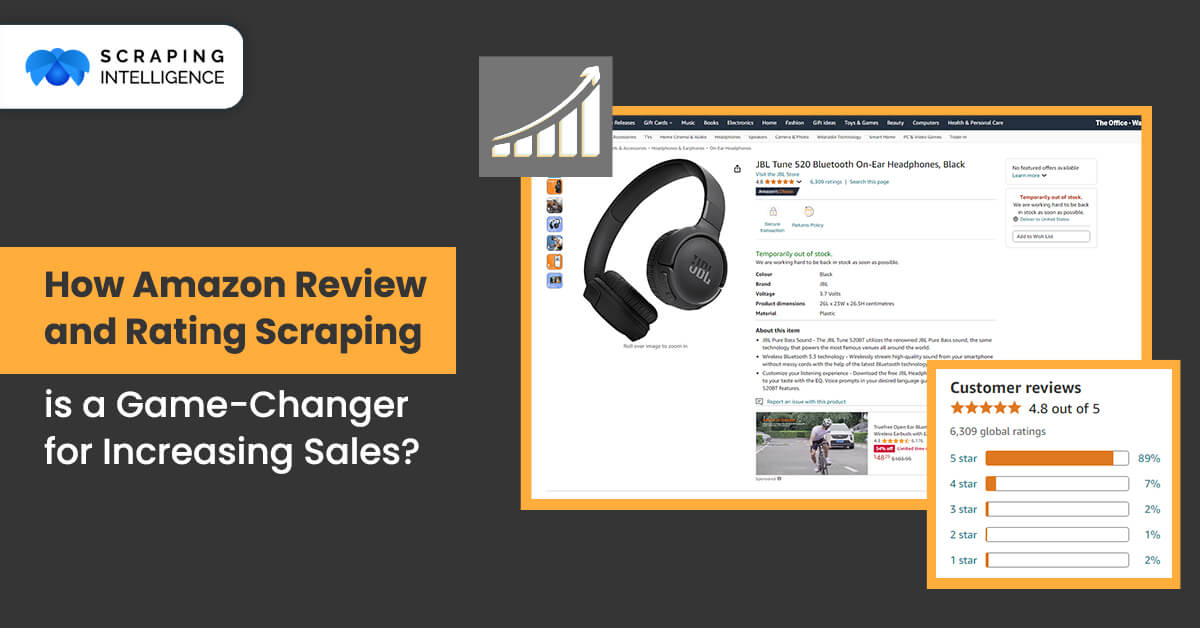
How Amazon Review and Rating Scraping is a Game-Changer for Increasing Sales?
Category
E-commerce & Retail
Publish Date
October 23, 2024
Author
Scraping Intelligence
Amazon, the world’s largest online store, has revolutionized how people sell
and shop online. The financial year ended on December 31, 2023, with the company recording net sales
of nearly $575 Billion on Amazon. The majority of it is generated from its vast array of products.
However, it also sells services and products of third-party merchants, from subscriptions to its
other offers, such as Amazon Prime and cloud storage and computing (AWS). Indeed, nearly 60% of all
Amazon sales are conducted by third-party sellers using Amazon Marketplace. These sellers rely on
Amazon’s Fulfillment by Amazon or FBA, which means Amazon will take care of packing, shipping, and
fulfillment of orders. The best-known and commonly used payment method at Amazon is the purchase
through this service; it accounts for 50% of all transactions.
Therefore, by 2024, it will be very important for businesses and individuals
to collect data from Amazon if they want to sell online. With the help of special tools and APIs,
users can collect a lot of relevant data regarding Amazon products. Scraping Intelligence's advanced
data scraping services assist businesses in knowing what is trending and creating achievable
strategies to stay ahead of competitors.
What is Amazon Review Scraping?
Amazon Review and Rating Scraping is a process of mining customers’ reviews
and ratings from Amazon's product page. This data is of great worth as it captures customer
feedback, how a product is faring, or what customers feel/dislike about certain products. People
interested in business or marketing, researchers, and analysts frequently use web scraping to gather
Amazon review and rating data.
Highlighting Statistics
According to Amazon Stats, Amazon visitors finish 28% of all purchases within 3 minutes and 50%
within 15 minutes.
By 2023, the average annual total sales of sellers whose base was located in the United States
were more than $250000.
The net sales revenue online of Amazon itaped nearly 575 billion U.S. dollars by the year 2023.
With a worldwide reach and popularity, Amazon is regarded as one of the most valuable brand
assets.
According to the Statista report, most of Amazon’s revenue comes from its e-retail sales of
various product categories, followed by third-party revenues from various sellers' products,
retail and media subscriptions, and AWS cloud services.
Amazon is a marketplace where third-party sellers (3P) are vendors. Sellers use Amazon as an
e-commerce site to present their products; 3P sales represent around 60% of total paid ASMs.
According to Statista reports, e-sales of service and Amazon's e-commerce business boosted the
company's net revenue from 2004 to 2023.
The multinational e-commerce company's total net revenue in the last reported year was about 576
billion USD, compared to 514 billion USD in 2022.
Why Scrape Amazon Product Reviews?
Amazon reviews and ratings can be a transformational aspect for businesses,
which helps them in creating achievable strategies and staying competitive in the evolving market.
Here’s why Amazon product review data scraping can be done:
Market Analysis and Product Information
Scrapping reviews provides businesses with information on what customers say
about a product. They have information on what customers like and dislike about products. Through
the analysis of lots of feedback, enterprises can determine the trends of customers' requirements,
new features they wish to be added, and areas they feel the products or services are lacking.
Scrapping reviews for competitor products help businesses compare them with other products, identify
weak areas, and find ways to beat the competitor.
Sentiment Analysis
A sentimental analysis of such posts is essential to determining customers'
general satisfaction with
the business. Businesses can monitor fluctuating customer attitudes following the launch of a new
product, a general update or promotion, or marketing practices.
New Product Development & Enhancement
Scrapped reviews can also reveal concepts such as additional features or the
need for functional
enhancements. Businesses can use this information to improve their products' creation by including
customers' demonstrated features. The regular reports of commercially available products regarding
certain aspects (for instance, durability, performance, etc.) directly indicate areas of concern for
quality control.
Personalized Marketing and Targeting
By using reviewer information like location or preference, businesses can
identify their potential
audience clearly and market to them accordingly. Ad managers can design better advertisement
messages because the recurrent features customers mention emphasize the features valued by the
latter.
Competitor Benchmarking
Website scraping of competitors can help to get an idea of what customers
think of other similar
products and services, including aspects such as price range or specifics of the offering. Reviewing
competitors' product reviews helps business organizations determine the image of rival brands and
opportunities for their brands.
Controlling Product Position and Growth
Scraping reviews is vital in profiling a business because it shows whether the
product is thriving or
has failed. Customer and market surveys and ratings give business organizations an idea of how long
a product will take in the market and the future demands for that particular product. Additionally,
customer reviews can sometimes highlight specific markets that are different and new that companies
can take advantage of, hence being an advantage.
Steps to Scrape Amazon Review Data?
Following a certain procedure can help you get the specialized expertise
needed for Amazon data scraping.
Step 1: Choose the right tool or API for Amazon scraping.
Step 2: Set up the environment to be scraped.
Step 3: Decide which Amazon data needs to be scrapped.
Step 4: Configure the chosen data scraper to extract the required data.
Step 5: Start your scraper and collect the data.
Step 6: Analyze and process the scraped data.
bs4: Python package called Beautiful Soup (bs4) extracts data from XML and HTML
files. This module is not automatically included in Python. Enter the following command in the
terminal to install this.
pip install requests
Before we start web scraping, we need to finish a few preparatory procedures.
Bring in all the necessary modules. Obtain the cookies ' information before submitting a request to
Amazon; without it, you couldn't scrape. Add your requested cookies to the header; if you don't have
cookies, you won't be able to scrape Amazon data and will constantly get an error.
The getdata() function (User Defined Function) will request a URL and return a
response if you pass it in. We are utilizing the get function to retrieve data from a particular
server via a provided URL.
Syntax: requests.get(url, args)
Transform the data into HTML code so that bs4 can parse it.
Now, filter the required data using soup. The function Find_All.
Program
# import module
import requests
from bs4 import BeautifulSoup

HEADERS = ({'User-Agent':
			'Mozilla/5.0 (Windows NT 10.0; Win64; x64) \
			AppleWebKit/537.36 (KHTML, like Gecko) \
			Chrome/90.0.4430.212 Safari/537.36',
			'Accept-Language': 'en-US, en;q=0.5'})

# user define function
# Scrape the data
def getdata(url):
	r = requests.get(url, headers=HEADERS)
	return r.text


def html_code(url):

	# pass the url
	# into getdata function
	htmldata = getdata(url)
	soup = BeautifulSoup(htmldata, 'html.parser')

	# display html code
	return (soup)


url = "https://www.amazon.in/Columbia-Mens-wind-\
resistant-Glove/dp/B0772WVHPS/?_encoding=UTF8&pd_rd\
_w=d9RS9&pf_rd_p=3d2ae0df-d986-4d1d-8c95-aa25d2ade606&pf\
_rd_r=7MP3ZDYBBV88PYJ7KEMJ&pd_rd_r=550bec4d-5268-41d5-\
87cb-8af40554a01e&pd_rd_wg=oy8v8&ref_=pd_gw_cr_cartx&th=1"

soup = html_code(url)
print(soup)
Output
Note: This just includes HTML code or raw data.
Now that the fundamental setup is finished, let's examine how scraping for a
particular purpose can be accomplished.
Scrape the name of the client
Use class_ = a-profile-name and the span tag to locate the customer list. As
seen in the image, visit the webpage in the browser and perform a right-click to verify the relevant
element.
To utilize the find_all () method, you need to supply the tag name, attribute,
and corresponding values.
Code
def cus_data(soup):
	# find the Html tag
	# with find()
	# and convert into string
	data_str = ""
	cus_list = []

	for item in soup.find_all("span", class_="a-profile-name"):
		data_str = data_str + item.get_text()
		cus_list.append(data_str)
		data_str = ""
	return cus_list


cus_res = cus_data(soup)
print(cus_res)
To find the customer reviews, use the same steps as before. Use a given
tag—div in this case—to find a unique class name.
def cus_rev(soup):
	# find the Html tag
	# with find()
	# and convert into string
	data_str = ""

	for item in soup.find_all("div", class_="a-expander-content \
	reviewText review-text-content a-expander-partial-collapse-content"):
		data_str = data_str + item.get_text()

	result = data_str.split("\n")
	return (result)


rev_data = cus_rev(soup)
rev_result = []
for i in rev_data:
	if i is "":
		pass
	else:
		rev_result.append(i)
rev_result
Scraping Review Image
To obtain photo links from product reviews, follow the same steps. As seen
above, findAll() receives the tag name and attribute.
def rev_img(soup):

# find the Html tag
# with find()
# and convert into string
data_str = ""
cus_list = []
images = []
for img in soup.findAll('img', class_="cr-lightbox-image-thumbnail"):
    images.append(img.get('src'))
return images


img_result = rev_img(soup)
img_result
Saving data into CSV file
In this instance, the data will be saved as a CSV file. Prior to being
exported as a CSV file, the data will first be converted into a data frame. We will examine the
process of exporting a Pandas DataFrame to a CSV file and save a DataFrame as a CSV file using the
to_csv() method.
import pandas as pd

# initialise data of lists.
data = {'Name': cus_res,
		'review': rev_result}

# Create DataFrame
df = pd.DataFrame(data)

# Save the output.
df.to_csv('amazon_review.csv')
How to Avoid Getting Blocked by Amazon?
It is necessary to carefully follow Amazon's standards and employ ethical
tactics in order to avoid getting barred for review and rating scraping. Here are a few tips to
assist you stay protected from blocking:
Respect Amazon's Robots.txt
Check Robots.txt: It is crucial to always include a stop in Amazon's
robots.txt file to determine
which pages are allowed or disallowed for crawling. Accessing several prohibited pages is prohibited
in Amazon OS and can cause an account to be banned almost immediately.
Use Proxies
To notice this, Amazon will look at the number of requests you make, and if
all the requests
originate from the same IP address, then you, Amazon, will. Switching the proxy server after some
time and using the proxy servers to change the IP address is recommended, which is quite like the
act of pretending to have arrived from two different places every time.
Residential Proxies: This is also more viable than using data
center ones since it emanates IP addresses of actual homes,
the residential proxies, which Amazon cannot easily detect.
Rotate User Agents
A "user agent" informs Amazon which browser you employ like Chrome, Firefox,
or another. It should be
changed often to give the impression of completely different people using different browsers.
Respect Amazon's Rules
The robots.txt file exists in Amazon's root directory and informs you which
parts of the site you are
allowed to scrape. Be sure to obey the following rules so you do not become banned. Requesting many
pages at once may slow the Amazon servers, which is not good and may lead to your being blocked. Do
not send too many requests; better yet, spread them over different time intervals.
Solve Captchas
If Amazon considers you a bot, they might offer you a CAPTCHA—the distorted,
silly illustrations that
test. Apply for services that can do these for you instantly or pause the process if one is seen.
Use Headless Browsers
It's possible to scrape data using Selenium or Puppeteer while the webpage is
rendered in the second
plane so the user does not see the browser. Nevertheless, some sites, such as Amazon, may recognize
headless browsers. You can play with settings to decrease the likelihood of detection but use them
carefully.
Make Use Of APIs Instead Of Scraping
If feasible, do not scrape the page and try first to use any bugs, like
Amazon's Product Advertising
API, to get product details and reviews. This is an official method of getting data while avoiding
the risk of being blocked. The data that one can request is controlled, and the frequency with which
the requests can be made is also regulated.
Conclusion
Outsourcing to Scraping Intelligence helps businesses fine-tune their products
and strategies with the right data set. We assist clients in overcoming general scraping issues,
such as blocking IPs and CAPTCHAs, to get around the problem and continue scraping. Collecting data
from Amazon can be very helpful for businesses because it contains information on customer
experiences, ratings, and trends. This data assists firms in making better decisions about which
products to develop and put into the market. It also assists in conducting sentiment analysis.
Share this article:
About the Author
Scraping Intelligence
Scraping Intelligence Editorial Team is a collective of data specialists, analysts, and researchers with expertise in web scraping, data extraction, and market intelligence. The team produces well-researched guides, actionable insights, and industry-focused resources that help businesses unlock the value of data and make informed, strategic decisions.
Latest Blog
Explore our latest content pieces for every industry and audience seeking information about data scraping and advanced tools.
Discover how real estate web scraping helps agents, investors & brokers extract listings, prices & market trends. See 7 key benefits of real estate data scraping.
Discover how AI-powered web scraping is transforming data extraction with LLMs, machine learning, automation, real-time data, and intelligent web crawling.