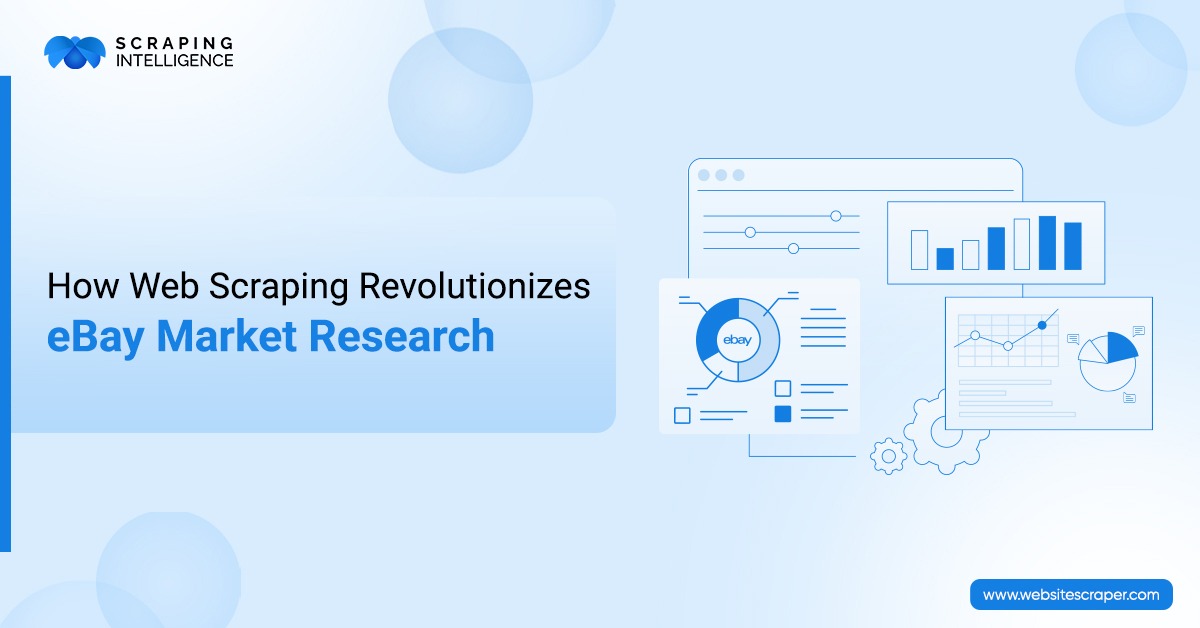
How Web Scraping Revolutionizes eBay Market Research?
Category
E-commerce & Retail
Publish Date
January 07, 2026
Author
Scraping Intelligence
eBay has one of the most volatile marketplaces in the entire world. Products move from listing to listing rapidly, pricing fluctuates daily, and sellers regularly try to optimize their titles, photos, and shipping options. If you are relying on a manual process of searching for product(s), taking screenshots, and maintaining spreadsheets, then you will always be behind the curve. By the time you complete your data collection, the market has already shifted.
That is where web scraping enters. Web scraping allows you to collect structured data from many different web pages at once. Instead of looking through fifty individual listings to see how they compare, you'll have access to thousands of listings across multiple categories, brands, and keywords, and you will be able to repeat your collection. Hence, you have a historical record of how the marketplace has changed over time. Instead of guessing at prices, features, etc., you can measure them.
With the data obtained from scraping eBay, you can answer critical questions that help you to conduct a comprehensive analysis of the eBay marketplace. For example, you can see how much an item is worth today, identify the features that drive higher prices, and gain insight into how shipping and returns affect conversion rates. You can also determine who your biggest competitors are for a particular keyword, and you can quickly and easily find out what items are trending this week versus last month.
Web scraping will allow you to turn eBay from a "browse and guess" model into a monetizable, measurable data set. By accurately evaluating the market(s), you can improve your sourcing, pricing, and inventory decisions with much greater confidence.
What Does Web Scraping Mean for eBay Research?
Web scraping effectively makes eBay a "measurable dataset" instead of a "browse and estimate". With accurate measurements of your eBay marketplace, you can optimize your sourcing, pricing, and listings. Data collected through web scraping includes titles, prices, shipping, condition, seller ratings, location, returns, etc. You can also see how these items' listings have evolved, including when they were first listed, their selling price, and when their stock was sold out.
The significant advantage of web scraping for market research is that it removes a bias introduced by manual research. Manual research looks at the first page of search results, which might include a limited selection of the available sellers on eBay, and will vary based on the researcher's opinion or preference on that day. With web scraping, you can collect the same data in the same manner every time you research virtually all keywords and categories, and you can compare all those results fairly across whatever parameters you use.
A second significant benefit of web scraping is scale. If you sell in multiple niches, web scraping will enable you to assign multiple people to work simultaneously, allowing you to effectively monitor various markets without hiring an entire army of employees.
Additionally, historical market analysis is possible if you regularly conduct scraping. When you conduct web scraping regularly, you can build a record of how markets have behaved historically. You will be able to measure when a price goes up or down, when demand is at its peak, and when a competitor becomes aggressive towards you.
The central premise of web scraping is not to get as much data as possible, but rather to collect and review structured data. Once you have structured your data, you will be able to filter and sort it into groupings, enabling you to use eBay as a viable source of market intelligence.
How Does eBay Market Intelligence Help Improve Pricing Decisions?
eBay pricing will fluctuate wildly. Sellers will adjust their pricing to stay competitive, respond to sales promotions, and adjust to changes in shipping costs. On eBay, if you price your product too high, you will lose sales; if you price it too low, you will lose margins. With web scraping, you can set your product's price based on market data.
From web scraping, you will see the actual average market pricing of a particular product. It includes the product price plus its shipping cost. When determining pricing, most buyers consider both the item and shipping costs; therefore, it is also helpful to segment prices by condition (new, open box, used), brand, and variations of the same item. One can take a condition, a small step, like "with original box", which is like comparing the average selling price of those items.
Web scraping enables analysts to monitor pricing trends. You might learn from your web scraping analyses that top sellers are pricing their products slightly higher but offering faster shipping times and strong customer ratings. Alternatively, some of the lowest-priced items have hidden costs, such as high shipping or limited return policies. You can consider these insights when deciding how to position your offer.
Finally, you can use web scraping to monitor your competitors' price movements. When you do web scraping regularly, you can spot when your competitor announces price drops, bundles items, or changes its shipping strategy. These early warning signals allow you to respond accordingly and operationally before your sales result negatively.
The bottom line is that pricing will become more analytical and less emotional than in the past, due to the collection of real market data through web scraping.
How Does Web Scraping Reveal Real Buyer Demand?
Market research is not based solely on pricing but also on demand. Demand for items on eBay can be quantified using many different indicators: The total number of listings for your keyword, the turnover of listings, the frequency of words in your title, and the conditions of the items that comprise the overall category. By scraping these signals, you can capture this type of demand information in many ways as a buyer. One measure of demand is called "Listing Density"; if a keyword has thousands of listings, that is an indicator of high competition for that keyword.
However, knowing a keyword's density does not give you the complete picture of what sells quickly. Regular scraping helps identify which listings are removed (most likely sold) and which remain on-site for weeks (most likely overpriced or unattractive). Scraping helps identify the features buyers prefer. Product titles and item specifics reveal what buyers care about as it relates to: Model Number; Size; Colour; Compatibility; Accessories included. Over time, keywords become more common as trends emerge.
A critical geographic aspect to understand is how consumers' preferences change based on seller location and shipping options. A web scraper can show you where certain products may be based, as this may impact shipping speed, competition, and demand in that area.
This demand insight will allow you to source (select) the best products to sell by focusing on items people buy regularly, price them adequately based on buyer demand or preferences, and maintain a competitive edge when selling.
How Can You Use Web Scraping for Competitor Research on eBay?
When buying on eBay, your competitors are not only other sellers but also a valuable resource (a benchmark) to help you identify ways to grow your sales. The most successful eBay sellers are often those who deliver superior customer service by evaluating listing quality, establishing a pricing strategy that results in a purchase that satisfies both parties, utilizing delivery or shipping options to get their products to customers quickly, and managing customer expectations. Web scraping provides an unbiased, objective way for you to study your competitors' patterns rather than guessing.
For example, by combining your competitor dataset with your listings (e.g., seller name, feedback score, positive rating percentage, item location, handling time, return policy, listing format), you can determine what factors are associated with higher prices and faster turnover. You may discover that listings with "free returns" sell more quickly in specific categories than others, or that listings with "1-day handling" improve buyer confidence.
You can also analyze the title-writing patterns of your competitors and identify their formatting. Many listings with high turnover and low prices follow a similar format when writing their titles (e.g., brand + model + top features + condition + compatible products). With bulk scraping on eBay, you will notice similarities across many item titles and item specifics, which will also give buyers more confidence in purchasing from those sellers compared to a seller with no item specifics.
By monitoring your competitors' eBay listings, you can identify gaps or opportunities to improve your own strategy. You may have noticed many listings featuring low-quality images or unclear item descriptions, as well as sellers who take longer to ship than their competitors. These issues represent opportunities for you to differentiate yourself and stand out in the marketplace.
Scraping eBay gives you more than just the ability to see other listings; you can utilize the information you collect to identify competitors that are already participating in your market and respond to them with a competitive strategy.
How Does Web Scraping Help You Monitor eBay Market Trends?
The pace at which trends on eBay move is mind-boggling; a product can go from "unsold" to "hot seller" overnight, driven by viral videos, seasonality, new models, and/or stock shortages. Without using a tool like an eBay Web Scraper, you are likely to miss out on opportunities and/or end up paying inflated prices for products that are already declining in popularity.
Using the eBay Web Scraper will allow you to track fluctuations in the overall eBay Marketplace continuously. Each time you scrape eBay, you can see how average prices, listing quantities, and keyword quantities have changed daily. By looking at the increase in eBay listings, you can determine whether there is increased competition from other sellers selling the same product and/or whether there is an excess of inventory available for sale.
Conversely, by looking at a decrease in eBay listings, you can determine that demand has risen for that product (as new competition may have entered the market, causing sellers to increase sales price) and/or that stock levels have decreased.
Using eBay Scraper also helps you identify related categories and opportunities to expand (i.e., when there is demand for a given product, there will also be demand for its accessories and replacement parts). You can also validate these assumptions before investing.
Finally, eBay Scraper can help. If sales fall sharply, the cause may be oversupply due to overproduction or reduced market demand. As a seller, being aware of this allows you an opportunity to reduce your market exposure and minimize excess or non-moving inventory. Trends are not just chance occurrences; they are measurable indicators derived from the analysis of structured or organized data.
How Can Web Scraping Optimize Your eBay Listings and Conversions?
Good research and data collection provide the basis for the successful execution of sales strategies, and for eBay execution, which means optimizing the appearance of your product listings on the platform to convert shoppers into paying customers.
The market research conducted through web scraping collects data on the details of other sellers' successful product listings, allowing you to analyze which title keywords are consistently used by the highest-selling eBay merchants, as well as which title keywords are missing from the product titles of lower-quality eBay sellers.
Additionally, you can determine which words are commonly associated with high-priced listings compared with the words widely used in low-priced listings, enabling you to develop a better title that matches the intent of the buyer rather than simply a title for your item.
The ability to web-scrape the item-specific fields for the product(s) is equally valuable. Specifics are one of the main factors eBay uses to determine search results for items a buyer is looking for. Specifics of the product include Brand, Model, Size, Material, and Compatibility.
If you fail to include all the necessary specifics that your competitors include in their item specifics fields, your items may never be shown or may be categorized in the wrong category.
By analyzing competitor-specific field input patterns, you can create a template for all similar product categories that you sell on eBay based on the most common specifications in those categories.
Lastly, web scraping can help you determine which shipping and return policies influence your competitors' ability to convert buyers successfully. Do the majority of your competitors offer free shipping or a standard 30-day return period? If so, you need to determine whether matching the shipping/return policy will still be worth the cost, given your profit margin. For some items, speed is more important than condition; for others, buyers care a lot more about condition accuracy than speed of handling.
Web scraping provides eBay sellers with market data from which they can build an accurate representation of the item sold on eBay, based on genuine buyers' behaviour; this results in better ranking on search engine results pages (SERP), greater levels of trust in eBay sellers, and higher levels of eBay sales.
How Does Web Scraping Reduce Risk and Improve Sourcing Decisions?
One of the highest hidden costs of eBay selling is the acquisition of inventory based on a lack of validated demand/pricing. A deal on paper may look great, but if the average selling price of the item sold is lower than expected or the market is oversaturated, the profit will disappear. Scraping eBay provides an opportunity to validate an item's demand and pricing before deciding to source it.
By scraping eBay and viewing the entire market for a specific item before sourcing, sellers can get a more accurate estimate of prices and how many people are selling it, as well as segment the data by condition (used or new). It is a critical step in the sourcing process, as different sourcing channels may yield items of varying quality or condition.
Scraping eBay can also help sellers identify hidden shipping costs. For example, if an eBay seller appears to be making money selling an item, this may not be the case when looking at how that seller ships items domestically and/or internationally. If you have items that are heavier than average and you need to ship them internationally, your profit margin may not be able to compete with leading sellers in that category who use lightweight packaging and/or ship only domestically.
Another risk associated with sourcing and selling items on eBay is compliance with policies and maintaining a good reputation. By scraping data about sellers, sellers can see if the top-rated sellers in the category offer a generous return policy or an extended warranty. If consumers expect that to be the case and you do not provide a return policy or an extended warranty, your conversion rate may suffer. By using scraping, the "market standard" can be calculated and used when establishing a seller's policies.
More innovative sourcing is not about sourcing cheaply. Smarter sourcing is about sourcing based on proven demand, price stability, and the level of competition, supported by real data.
Conclusion
The results of eBay market research are maximized when it is systematic, measurable, and repeatable through web scraping. By scraping eBay, a large volume of real listing data is captured and structured, allowing analysis of price, demand, competition, and trends. It will enable sellers to base their decisions on what the market is doing now and how it is changing. By scraping eBay, sellers can keep an eye on competitors and respond quickly to market changes.
In a fast-moving marketplace like eBay, speed and accuracy give sellers an advantage. When combined with good data management, cleaning, and validation, along with user-friendly dashboards, sellers can achieve great results. Professional partners and platforms are valuable resources in this area.
If you want to create valuable market intelligence from data pulled from eBay and develop reliable and scalable data processes to support your growth strategies on the platform, Scraping Intelligence can help.
Frequently Asked Questions
What is eBay web scraping?+
eBay web scraping is the automated process of collecting public data from eBay listings, such as prices, titles, item conditions, seller details, and sold history. This data is used for market research, pricing analysis, and competitor tracking.
Is web scraping eBay legal?+
Web scraping legality depends on how it is done. Using eBay’s official APIs is the safest option. If scraping is used, it should respect eBay’s terms of service, avoid personal data, and follow ethical data collection practices.
What data can be scraped from eBay for market research?+
You can scrape listing prices, sold prices, product titles, item specifics, seller ratings, shipping costs, listing duration, and demand indicators like bids and watchers.
How does web scraping help eBay sellers?+
Web scraping helps sellers optimize pricing, identify profitable products, monitor competitors, track demand trends, and improve listing performance based on real market data.
Can beginners use web scraping for eBay research?+
Yes. Beginners can start with eBay APIs, no-code scraping tools, or simple software solutions. Advanced users can build custom scrapers for deeper analysis.
How often should eBay data be scraped?+
This depends on your goal. Pricing and competitor monitoring may require daily scraping, while trend analysis can be done weekly or monthly.
Share this article:
About the Author
Scraping Intelligence
Scraping Intelligence Editorial Team is a collective of data specialists, analysts, and researchers with expertise in web scraping, data extraction, and market intelligence. The team produces well-researched guides, actionable insights, and industry-focused resources that help businesses unlock the value of data and make informed, strategic decisions.
Latest Blog
Explore our latest content pieces for every industry and audience seeking information about data scraping and advanced tools.
See how the travel industry uses web scraping to track fares, room rates, availability, and reviews, plus how to choose the right data extraction solution.
Discover how real estate web scraping helps agents, investors & brokers extract listings, prices & market trends. See 7 key benefits of real estate data scraping.