Web Scraping vs Web Crawling: Key Differences, Uses & Which Is Best for Your Business
Category
Services
Publish Date
Aug 11, 2026
Author
Scraping Intelligence
Introduction
Every business today depends on accurate web data to make smarter decisions. Whether you want to monitor competitor pricing, generate qualified leads, or understand market trends, having access to reliable, up-to-date information is essential to staying competitive.
This is where web scraping and web crawling come into play. Although these terms are often used interchangeably, they serve different purposes. Confusing one with the other can lead to inefficient data collection, unnecessary costs, and missed business opportunities.
In this blog, you will learn the key differences between web scraping vs web crawling, how each solution works, and when to use one or both. By the end, you'll be able to choose the right approach based on your business goals and data requirements.
What Is Web Crawling?
Web crawling is the method used to find and map the pages that exist across a website. The tool that performs this task is known as a web crawler, though it is also referred to as a spider or a bot. Its role is straightforward. A web crawler starts from a known webpage, follows internal and external links, and systematically discovers additional pages until it maps the site's structure and has a complete list of URLs. A good way to think about it is a surveyor, who surveys a city block by block, listing every street and building along the way.
Examples of web crawlers
Googlebot
Bingbot
AhrefsBot
Screaming Frog SEO Spider
Rather than extracting content, web crawling focuses on discovering URLs and understanding how webpages are connected on each page. Instead, it answers one core question, and that question is simple: where does the data live? Search engines like Google use crawling every single day to find and index new pages across the internet. According to industry sources, crawling is all about breadth, which means covering as much ground as possible.
Here is what web crawling does well:
It finds fresh pages and hidden URLs without any manual effort on your part.
It lays out the complete structure of large websites, even the ones with thousands of pages.
It flags new competitors, product listings, and category changes before they get a chance to slip past you.
It strengthens your SEO research by revealing how a website is actually organized.
What Is Web Scraping?
Web scraping, also known as web data extraction, is the process of pulling specific information out of pages you already know about. A web scraper goes to a page you already know about and pulls out the exact details you want, whether that is prices, product names, reviews, stock levels, or contact information. Once it has those details, it saves them in a tidy, structured format such as JSON or CSV.
If crawling answers where the data lives, then scraping answers a different and equally important question, and that question is: what is the data actually? Scraping is about depth, which means precision and detail rather than wide coverage. This is usually the layer that delivers real business value, because dashboards, analytics tools, and AI models all need structured fields to work properly.
Common business uses of web scraping include:
Businesses commonly use web scraping for competitor price monitoring, allowing them to react quickly to market changes.
Sales teams use it to build lead lists worth actually calling.
It surfaces market trends early, plus the shifts in demand that follow.
AI models, recommendation engines, and business intelligence platforms rely on structured datasets extracted through web scraping.
One point that many people overlook is data normalization. Raw scraped data often contains messy currency symbols, uneven decimal formats, and region-based differences. Without proper cleaning, this data cannot be compared reliably over time. Good web scraping services always include this cleaning step.
Web Scraping vs Web Crawling: Key Differences at a Glance
The table below gives you a quick and clear comparison so you can understand both solutions in one glance.
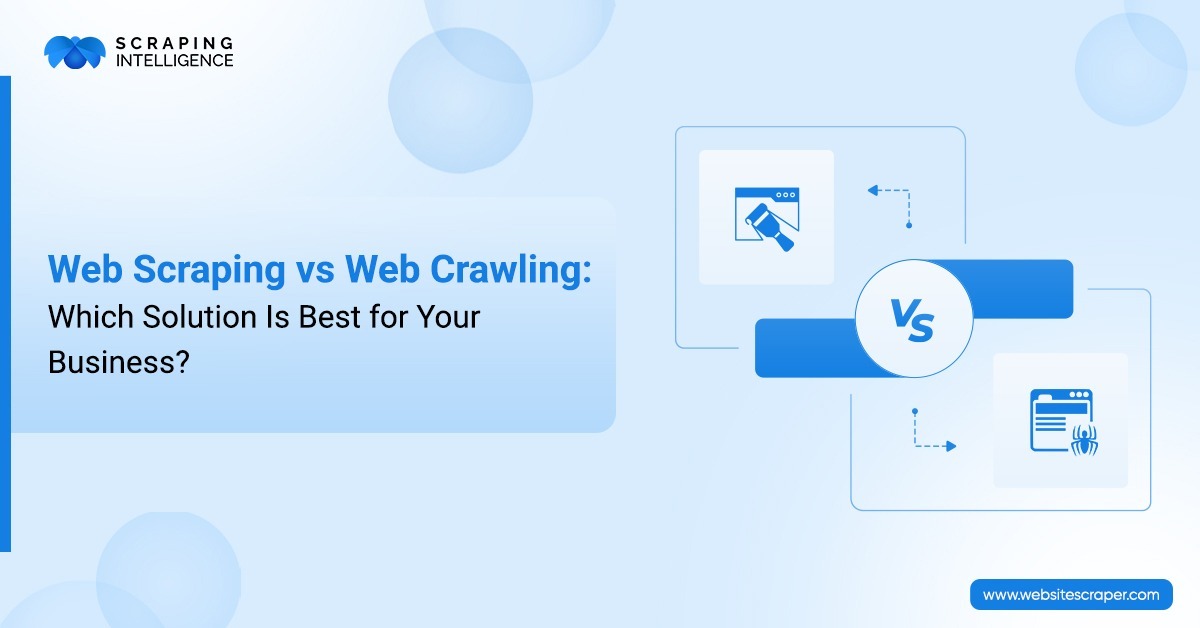
Here is a truth that surprises many people, and it is worth saying clearly. Web scraping and web crawling are not rivals at all. They are two stages of the same job. One finds the pages worth visiting, and the other pulls the useful data off those pages. When you treat them as competitors, you build broken systems.
For example, a project might discover thousands of URLs but never extract a single clean record, which is a crawling-only mistake. On the other side, a pipeline might scrape a few known pages while missing most of the website, which is a scraping-only mistake. Serious data programs use a hybrid pipeline, where crawling handles discovery and scraping handles extraction. This combination gives you both coverage and accuracy.
Which Solution Is Best for Your Business?
The right choice depends on your size, goals, and how fast your market changes. Let us look at it by business type.
Business Type
Recommended Solution
Startup
Scraping
Ecommerce
Scraping + Crawling
Marketplace
Both
Enterprise
Hybrid Pipeline
Ask yourself these three questions before you decide:
Do I already have a complete list of target URLs, or do new pages appear often?
Do my decisions depend on precise fields like price, stock, or reviews?
How often does my target data change?
If new pages appear frequently, you need crawling. If your decisions depend on exact data, you need scraping. If both are true, you need a combined solution.
Why Does 2026 Make This Decision More Important Than Ever?
In 2026, websites update content more frequently, anti-bot technologies have become increasingly sophisticated, and AI-powered applications require continuously refreshed structured data. As a result, selecting the right web data collection strategy has become a critical business decision. At the same time, anti-bot systems have grown sharper, and AI systems consume structured web data at a huge scale that seemed impossible only a few years ago.
Because of this, real commercial websites now fight back with rate limits, CAPTCHAs, and browser fingerprinting. Solving these problems yourself means building proxy rotation, headless browsers, and retry logic, which has nothing to do with your actual data goal. This is why many companies now prefer managed web scraping and crawling solutions instead of fragile in-house scripts.
Legality also deserves a brief mention. In many regions, scraping data that is already public may be permissible depending on applicable laws, website terms, and the nature of the data being collected. Courts in the United States have drawn a clear distinction between public data and protected systems that sit behind a login. That said, this is not a free pass. You are still expected to honor a website's terms of service, avoid personal data you have no lawful basis to process under GDPR and CCPA, and refrain from bypassing any login screen to access restricted content.
Conclusion
So, which solution is best for your business? The honest answer is that it depends on what you are trying to achieve. If you need to discover pages across a large site, choose web crawling. If you need to extract precise, structured data, choose web scraping. And if you want a data operation that truly holds up in 2026, you will most likely need a smart combination of both.
Web crawling helps businesses discover webpages, while web scraping transforms those pages into structured, actionable data. Most modern organizations benefit from using both together to build scalable, reliable data pipelines. When you understand the difference, respect the rules, and plan for ongoing maintenance, your data pipeline keeps working even as the web keeps changing.
Share this article:
About the Author
Scraping Intelligence
Scraping Intelligence Editorial Team is a collective of data specialists, analysts, and researchers with expertise in web scraping, data extraction, and market intelligence. The team produces well-researched guides, actionable insights, and industry-focused resources that help businesses unlock the value of data and make informed, strategic decisions.
Latest Blog
Explore our latest content pieces for every industry and audience seeking information about data scraping and advanced tools.
Discover how real estate web scraping helps agents, investors & brokers extract listings, prices & market trends. See 7 key benefits of real estate data scraping.
Discover how AI-powered web scraping is transforming data extraction with LLMs, machine learning, automation, real-time data, and intelligent web crawling.