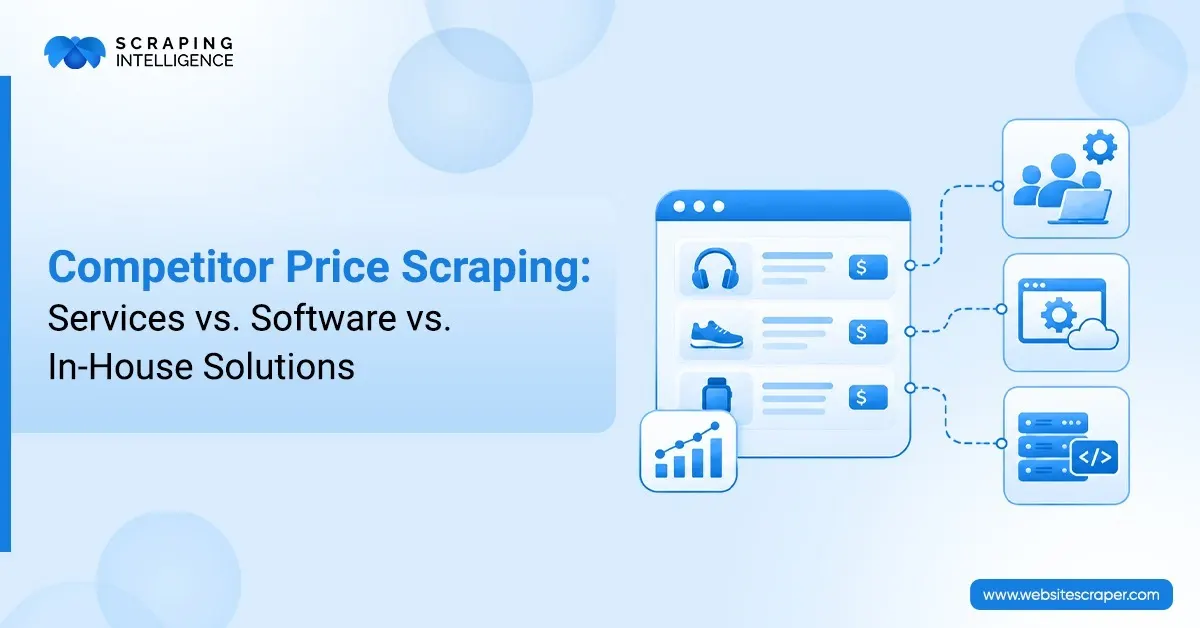
Competitor Price Scraping: Services vs. Software vs. In-House Solutions
Category
Services
Publish Date
Nov 26, 2026
Author
Scraping Intelligence
A competitor changes a product price overnight, but your team discovers it several days later. By then, you may have already lost sales or missed an opportunity to adjust your pricing strategy. This is where competitor price scraping becomes valuable. It helps businesses collect product prices, availability, and other pricing details from competitor websites without relying on manual checks.
However, collecting competitor pricing data is only part of the challenge. Businesses must also decide how to manage the scraping process. Should you hire a managed price scraping service, subscribe to price monitoring software, or build an in-house solution? Each approach comes with different costs, technical requirements, scalability, and maintenance responsibilities.
This guide compares all three options, examines their actual cost considerations, and explains how to choose the right competitor price monitoring solution for your business.
What Is Competitor Price Scraping, and Why Does It Matter?
Competitor price scraping is the process of automatically collecting product pricing information from competitor websites and online marketplaces. It allows retailers to monitor product prices, discounts, stock availability, shipping charges, and promotional changes across multiple sources.
Instead of checking competitor websites manually, businesses use automated scraping systems to collect this information at scheduled intervals. The extracted data is then organized into structured formats such as CSV files, spreadsheets, or API feeds for further analysis.
Retailers use competitor price scraping to identify pricing gaps, track promotional activity, evaluate market positioning, and make informed pricing decisions. It is particularly useful for businesses managing large product catalogs or monitoring multiple competitors across different marketplaces.
Services vs. Software vs. In-House: How Do the Three Compare?
Choosing between a managed price scraping service, price monitoring software, and an in-house solution depends on your data requirements, technical resources, budget, and target website complexity. While all three approaches help businesses collect competitor pricing information, they differ in setup time, customization, scalability, and ongoing maintenance. The following comparison highlights the key differences.
Factor
Price Scraping Service
Price Monitoring Software
In-House Solution
Time to first data
Days to a couple of weeks
Hours to a few days
Weeks to a few months
Cost model
Monthly retainer or per-project
Fixed subscription
Salaries plus infrastructure
Technical skill on your side
None required
Minimal
Experienced engineers
Difficult or protected sites
Handled by the provider
Often out of reach
Possible, but you own the problem
Maintenance when sites change
Provider's responsibility
Vendor's responsibility
Entirely yours
Best suited for
Complex, large, or shifting targets
Standard catalogs, lean teams
Data-as-a-product businesses
Price Scraping Services: What Should You Expect?
With a price scraping service, a specialist provider owns the entire pipeline on your behalf, from the crawlers and proxies to data cleaning and delivery. You hand over a list of target sites and products, and structured price data arrives on the cadence you choose. For brands without a data engineering team, this is usually the shortest route to dependable numbers. A managed partner like Scraping Intelligence works in exactly this lane. The provider runs the crawlers, keeps them alive when a target site changes its layout, and sends over data that is ready to use. Your people spend their hours on pricing calls instead of chasing a scraper that broke overnight.
Hands-off from day one: the provider handles collection and clean-up end to end, so what reaches your team is already sorted into a file or API feed you can plug straight into your own systems.
Resilience when sites fight back: layout changes and anti-bot defenses become the provider's problem, which keeps your data flowing without internal firefighting.
Coverage for awkward sources: large catalogs, JavaScript-heavy pages, and frequently changing listings are far more manageable here than with most self-serve tools.
A premium for convenience: the trade-off is cost, and for a handful of simple competitors a full service can be more than the situation calls for.
A practical example of when a service wins: picture a home-goods retailer tracking 8,000 SKUs across twelve competitors, three of which use aggressive bot protection and rotate their page layouts monthly. Off-the-shelf software keeps dropping those three sources, and matching variant sizes across sites is eating a junior analyst's entire week. This is the exact scenario where a managed provider earns its fee, because the hardest 20% of sources is precisely what a tool struggles with and a service is built to handle.
Price Monitoring Software: Where Does It Fit Best?
Price monitoring software hands you a ready-made platform with dashboards, alerts, and reports. You load your products, select the competitors worth watching, and the tool tracks them within the limits of its design. For lean teams that want more control than a service yet none of the engineering overhead of a build, this middle path is often the sweet spot.
A short setup window, typically measured in hours rather than weeks, which suits teams that need numbers quickly.
Monthly costs you can plan around: SmapraTracker runs roughly $39 a month, while Pricemind sits at about $69 if your product list is on the smaller side.
Mid-tier and enterprise plans for heavier use, where PricingHunter opens at $129 per month and platforms such as Competera begin around €599 per month.
Real limits on unusual targets, since heavily protected or oddly structured sites frequently sit beyond what a packaged tool can reliably reach.
In-House Price Scraping Solutions: Is Building Your Own Worth It?
An in-house solution puts your own developers in charge of the scrapers behind your pricing intelligence. Control is the headline benefit, because every source, field, and refresh rule is yours to shape. Responsibility is the headline cost, which is why this route generally makes sense only when pricing data is central to the product rather than a supporting function. The four points below capture what owning the stack really involves.
Complete control of the pipeline, from the sites you crawl to how the output connects with your internal pricing and inventory systems.
Continuous engineering time, because scrapers break the moment a target site changes, and a developer must patch them fast to avoid gaps in coverage.
Infrastructure and proxy spend, since reliable large-scale scraping needs servers, rotating proxies, and monitoring, none of which are free at volume.
Legal and compliance ownership, which now rests entirely with your business and demands attention to each site's terms and the relevant regional rules.
What Does Each Option Really Cost? (A Total Cost of Ownership View)
Sticker price alone hides the real picture, so the illustrative table below weighs the total cost of price monitoring across a mid-sized scenario of roughly 5,000 to 10,000 SKUs. Software figures reflect publicly listed 2026 plans; service and in-house columns are industry-representative estimates rather than fixed quotes.
Cost component
Price Scraping Service
Price Monitoring Software
In-House Solution
Monthly platform or fee
~$2,000 retainer
~$1,000 subscription
~$0 (you own the code)
Engineering / staff time
Included
Light configuration
1+ developer, often $6,000+/mo loaded
Proxies & infrastructure
Included
Included
~$1,500/mo
Maintenance when sites break
Included
Vendor-handled
Your team, ongoing
Realistic time to launch
1–2 weeks
1–3 days
1–3 months
The pattern is clear enough: software looks cheapest on paper, in-house looks cheapest in licensing yet rarely is once salaries and upkeep are counted, and a service bundles the hidden costs into one predictable line.
How Does Price Scraping Actually Work? (The Technical Side)
A competitor price scraping system involves more than collecting product prices from different websites. It must also retrieve data at the right intervals, handle website variations, validate extracted information, and match competitor listings with the correct products. These steps determine whether the final dataset is reliable enough to support pricing decisions.
The following technical components play an important role in maintaining an effective price monitoring pipeline.
Crawl Frequency and Scheduling
Crawl frequency determines how often competitor websites are checked for price changes. Fast-moving categories such as electronics and consumer goods may require more frequent updates, while products with relatively stable pricing may only need daily monitoring. The appropriate frequency depends on market volatility, business requirements, and the target website's permitted access conditions.
Proxy Management and Request Handling
Websites may restrict repeated automated requests through rate limits, IP restrictions, or other access controls. Scraping systems need appropriate request management, including rate limiting, retry mechanisms, and authorized proxy infrastructure where applicable. These measures help maintain reliable data collection while respecting website restrictions.
Data Extraction and Validation
Extracted information may contain missing prices, incorrect currencies, promotional pricing, or inconsistent product attributes. Validation processes help identify these issues before the data reaches pricing dashboards or analytical systems.
Product Matching and Deduplication
A competitor may list the same product using a different title, SKU, image, or product identifier. Matching systems must compare attributes such as brand, model, size, color, and product specifications to avoid comparing unrelated items. Deduplication also helps prevent repeated listings from distorting pricing analysis.
Data Storage and Integration
Once validated, the collected information needs to be stored and delivered in a format that business teams can use. CSV, JSON, database connections, and APIs are common delivery options. Integrating the data with pricing engines, inventory systems, and analytics platforms makes it easier to turn collected information into business insights.
Final Thoughts: Choosing the Right Competitor Price Scraping Solution
Competitor price scraping helps retailers understand market pricing, monitor competitor activity, and make informed pricing decisions. However, the right way to collect this data depends on the scale and complexity of your requirements.
Price monitoring software works well for businesses with standard tracking needs and limited technical resources. In-house solutions offer greater customization but require ongoing development and infrastructure management. Managed web scraping services are worth considering when businesses need extensive website coverage, structured data delivery, and continuous technical maintenance.
If managing complex websites and maintaining scraping infrastructure is becoming a challenge, a managed competitor price scraping service can simplify the process. Scraping Intelligence helps businesses collect competitor pricing information through tailored extraction workflows, scheduled data delivery, and ongoing maintenance.
Let's Talk About Your Data Needs
Tell us what data you need, and we'll help you find the right solution.
Scraping Intelligence Editorial Team is a collective of data specialists, analysts, and researchers with expertise in web scraping, data extraction, and market intelligence. The team produces well-researched guides, actionable insights, and industry-focused resources that help businesses unlock the value of data and make informed, strategic decisions.
Latest Blog
Explore our latest content pieces for every industry and audience seeking information about data scraping and advanced tools.
Discover how grocery retailers track competitor prices across thousands of products using web scraping and automated price monitoring to protect margins.
Explore ethical web scraping for enterprises, covering data sourcing, privacy laws, compliance risks, and strategies for responsible data collection at scale.