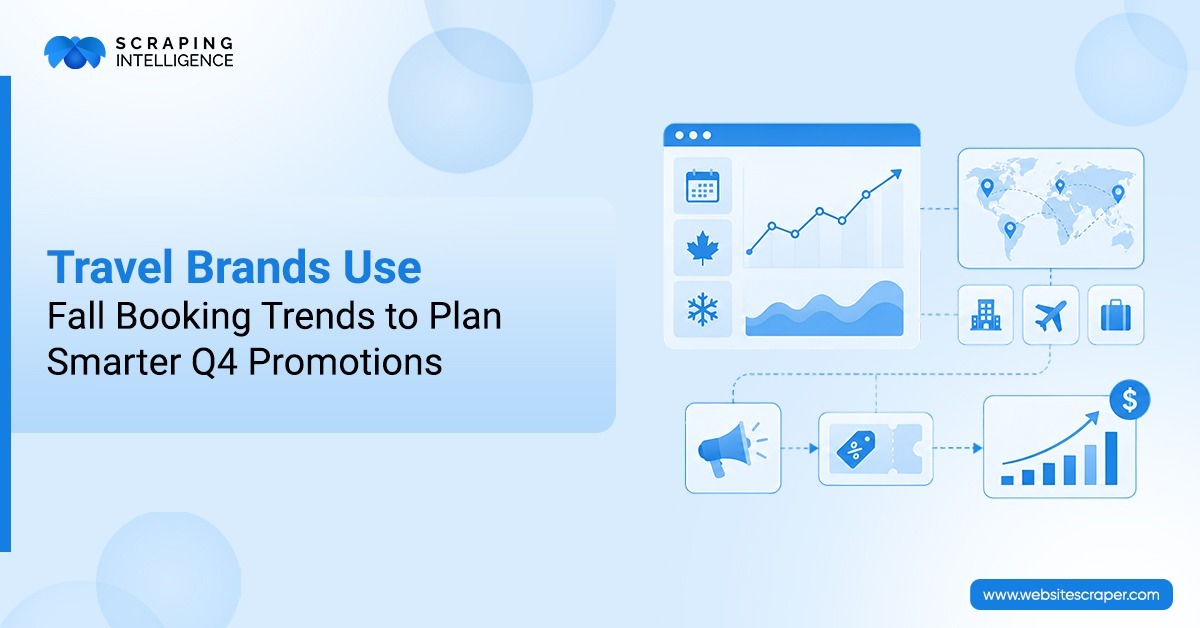
How Travel Brands Use Fall Booking Trends to Plan Smarter Q4 Promotions
Category
Hotel & Travel
Publish Date
Sep 09, 2026
Author
Scraping Intelligence
Introduction
Fall booking trends give travel brands an early view of how demand is likely to develop during Q4. Changes in flight searches, hotel bookings, destination interest, prices, and booking windows can reveal where travelers are planning to go, when they are likely to book, and how much they are willing to pay.
For travel marketers, these signals are more than seasonal observations. They can guide Q4 promotions, pricing decisions, advertising budgets, and campaign timing. A destination showing rising search interest but limited bookings, for example, may respond well to an early-booking offer, while a destination with tightening availability may require less discounting and more urgency-focused messaging.
This is why monitoring fall booking trends before the holiday rush matters. By combining booking data with competitor prices, availability, search demand, and historical performance, travel brands can identify demand shifts earlier and build promotions around real market conditions.
This blog explains how travel brands can use fall booking trends to plan smarter Q4 promotions, which data points matter most, how the underlying data pipeline works, and the common mistakes that can reduce campaign performance.
Why Fall Booking Trends Matter for Q4 Travel Promotions
Fall is not a slow lead-up to the holidays. It is the research season, and research is where buying decisions are quietly made. According to Expedia Group's traveler research, a large share of holiday-season trips are researched weeks before purchase, which means intent shows up in the data long before revenue does.
A few reasons explain why this stretch of the calendar rewards attention:
Intent surfaces early, so teams get a genuine head start on offer design rather than reacting after demand has already peaked.
Price sensitivity climbs as December nears, which makes demand-based pricing sharper and more defensible.
Regional interest rotates, with warm-weather escapes rising while shoulder-season destinations cool.
Competitor rate changes grow easier to detect once booking volume thickens across the major platforms.
Travel search and booking data can reveal demand before completed bookings appear in revenue reports. By comparing search interest, booking activity, prices, and availability, travel brands can identify emerging demand and adjust Q4 promotions before peak booking periods arrive. When a brand pairs that public search behavior with its own booking data, guesswork gives way to something closer to forecasting.
What Does the Fall Data Actually Reveal?
Fall booking data can reveal how quickly travel demand is building, which destinations are gaining interest, how booking windows are changing, and where prices or availability are tightening. These signals help marketers determine which promotions to launch and when to launch them. Search interest for holiday travel usually starts rising in September and holds through November, while booking windows compress as the season tightens. That compression is the signal planners care about most, because a shrinking booking window changes how and when a promotion should fire.
The snapshot below maps typical fall behavior against the promotional move it justifies.
Fall Period
Traveler Behavior
Booking Signal
Q4 Action It Supports
Early September
Research and comparison
High search, low conversion
Awareness content, retargeting setup
Late September–October
Serious planning
Rising add-to-cart activity
Early-bird holiday deals
Early November
Commitment phase
Booking spike for holidays
Urgency offers, bundled packages
Late November
Last-minute surge
Short booking windows
Flash sales, mobile-first prompts
Note: These patterns are illustrative and can vary by destination, traveler segment, product type, and year. Brands should validate them against their own historical booking and search data.
Phocuswright and Skift have both documented how booking lead times have shortened across much of the industry since 2020, a shift that pushes more revenue into these tighter late-season windows. Behavior like this repeat reliably enough that a team can plan against it, provided the underlying feed of pricing and availability data stays current.
How Travel Brands Turn Booking Trends into Q4 Promotions
Spotting a trend is the easy half. Converting it into an offer travelers say yes to is where discipline separates the strong campaigns from the forgettable ones. Most seasoned teams run a repeatable loop, and it tends to look like this:
Collect demand and pricing data.Gather booking activity, search demand, competitor prices, availability, and destination-level signals from relevant travel sources.
Identify demand shifts. Compare current activity with historical benchmarks to identify destinations, dates, and price ranges gaining momentum.
Match promotions to demand. Use the signals to determine whether an early-booking discount, package, limited-time offer, or urgency campaign makes sense.
Launch at the right time. Coordinate email, paid media, landing pages, and other channels around the period when traveler intent is increasing.
Monitor and adjust. Track bookings, conversion rates, pricing, and competitor activity after launch and adjust campaigns based on performance.
The quality of the underlying data determines how reliable this process is. Travel brands need consistent pricing, availability, booking, and competitor data to identify changes quickly and compare current conditions with historical trends. Automated travel and hotel data extraction can help teams maintain this data at scale without relying on manual collection. When the feed is clean, the strategy holds. When it is stale, even a smart plan runs on yesterday's prices. To see how organized extraction supports this exact workflow, take a look at our travel and hotel data scraping solutions.
What Is the Travel Data Pipeline Behind Q4 Promotion Planning?
Behind a well-timed fall campaign sits a data operation that rarely gets discussed, yet quietly powers the whole thing. Understanding its moving parts helps explain why some brands react in hours while others take weeks.
Consider how the technical side usually comes together:
Collection layer. Rates, room availability, and flight prices get pulled from booking sites, often through scheduled crawls or API endpoints where a partner exposes them.
Frequency. During peak fall weeks, many teams refresh competitor pricing several times a day, because a rate captured in the morning can be outdated by afternoon.
Normalization. Raw data arrives messy, so values like currency, room categories, and date formats get standardized before anyone can trust a comparison.
Storage and enrichment. Cleaned records land in a warehouse, where historical rates and occupancy signals get layered on to add context.
Dashboards and alerts. Visualization tools turn the feed into rate-parity views and trend charts, while automated alerts flag price drops the second a rival move.
Automation. Rules can trigger a pricing update or pause a promotion without a human in the loop, which is what makes same-day reaction realistic.
Delivery format matters as much as collection. Most teams want the output in JSON, CSV, or XML so it drops straight into their existing pricing engine or BI stack. Without that clean handoff, a rich dataset just sits unused. This is precisely where reliable price monitoring and consistent data structure earn their keep.
Which Travel Data Points Matter Most for Q4 Promotions?
Not every field carries equal weight when the goal is a converting campaign. A handful of signals do most of the heavy lifting, and knowing them keeps a team from drowning in noise. The inputs worth prioritizing tend to be:
Competitor room rates across major hotels and platforms, refreshed close to real time.
Flight price movement on popular holiday routes and seasonal corridors.
Occupancy and availability patterns that expose where supply is tightening.
Review sentiment that reveals what matters to travelers during the season.
Emerging-destination search interest that flags a trend before it goes mainstream.
Pulled together, these give a brand a market view wide enough to price with confidence and specific enough to build offers that feel timely. A destination climbing in search but still soft on bookings, for instance, is a near-perfect target for an early-bird push before the crowd arrives.
Whether bookings are translating into retained revenue
Common Q4 Travel Promotion Mistakes to Avoid
Even experienced teams lose ground in Q4, and the causes are surprisingly consistent. A quick scan of the common failures tends to prevent most of them:
Using inconsistent data sources
Ignoring mobile booking behavior
Changing prices without monitoring competitor movements
Running the same promotion across every destination
Failing to segment travelers by booking intent
Measuring clicks instead of completed bookings
Sidestepping these keeps a campaign relevant to the market that exists today rather than the one that existed twelve months ago. The recurring theme is timing and freshness, and both trace directly back to how good the data feeding the decision happens to be.
Conclusion
Fall booking trends give travel brands an important opportunity to prepare for Q4 before peak demand arrives. By monitoring booking activity, search interest, competitor prices, availability, and booking lead times, marketers can identify where demand is building and adjust promotions accordingly.
The goal is not to offer the biggest discount. It is to launch the right promotion at the right time, for the right destination and traveler segment. That requires fresh data, consistent monitoring, and a clear view of how market conditions are changing.
Automated travel and hotel data extraction can make this process more scalable by turning scattered pricing, availability, and market signals into structured data for analysis. With better visibility into fall demand, travel brands can make more informed pricing and promotional decisions throughout Q4.
If your team needs structured travel market data for pricing intelligence, competitor monitoring, or demand analysis, explore Scraping Intelligence's travel and hotel data scraping solutions.
Let's Talk About Your Data Needs
Tell us what data you need, and we'll help you find the right solution.
Scraping Intelligence Editorial Team is a collective of data specialists, analysts, and researchers with expertise in web scraping, data extraction, and market intelligence. The team produces well-researched guides, actionable insights, and industry-focused resources that help businesses unlock the value of data and make informed, strategic decisions.
Latest Blog
Explore our latest content pieces for every industry and audience seeking information about data scraping and advanced tools.
Compare real estate data APIs vs. web scraping costs, including setup, infrastructure, maintenance, and data quality, to find the right solution for your needs.
See how the travel industry uses web scraping to track fares, room rates, availability, and reviews, plus how to choose the right data extraction solution.