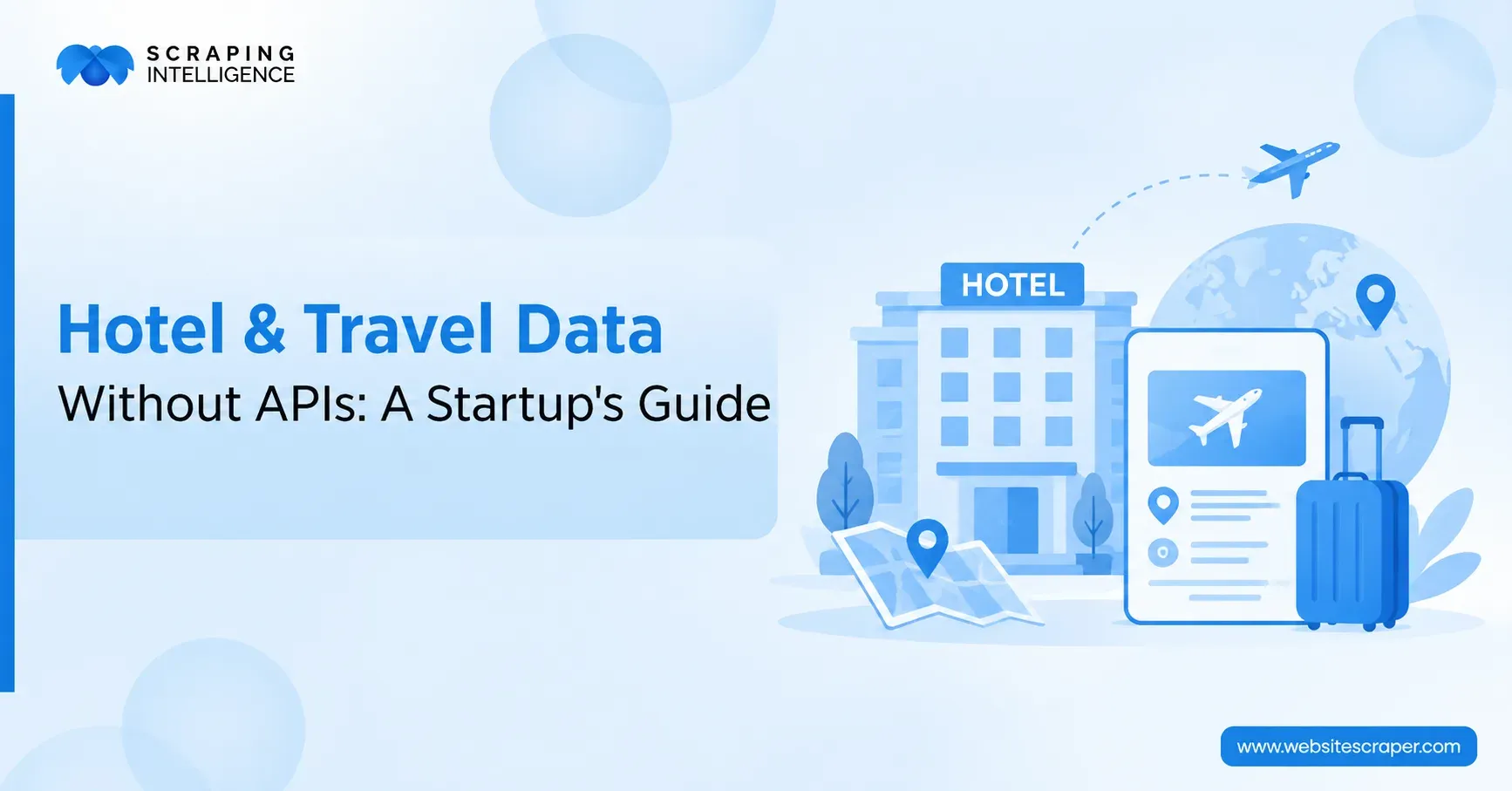
Hotel & Travel Data Without APIs: A Startup's Guide
Category
Hotel & Travel
Publish Date
Oct 14, 2026
Author
Scraping Intelligence
Did you know that the hotel and travel industry is a major contributor to the global economy, generating trillions of dollars annually and supporting millions of jobs? From hotels and restaurants to tourism and events, hospitality encompasses a wide range of sectors that drive economic growth and prosperity. In 2025, travel and tourism contributed US $11.6 trillion to the global economy, according to the World Travel & Tourism Council.
With such a large and competitive market, startups need reliable hospitality data to understand competitors, track pricing, identify market trends, and make informed business decisions.
However, accessing this data is not always as simple as connecting to an API. Many startups may not have access to third party APIs or may find them too restrictive, expensive, or limited in coverage.
So, how can startups collect hotel and travel data without APIs?
In this article, we will explore how startups can collect hospitality data from publicly available sources, what types of hotel and travel data they can gather, and how to turn that data into actionable insights for market research and competitive analysis.
What is Hotel and Travel Data?
As the name suggests, hotel and travel data are basically information collected and analyzed within the hospitality, travel, and tourism industry. It includes information related to customer preferences, booking patterns, travel trends, hotel occupancy rates, tourist arrivals, and other relevant metrics. With the help of these insights, businesses and organizations make informed decisions, improve customer experience, optimize operations, and develop effective marketing strategies.
Here is the list of data that falls under the hotel and travel industry:
Hotel and property information
Room types and occupancy
Room prices and deals
Availability
Amenities and facilities
Ratings and reviews
Location and destination information
Check-in/check-out policies
Cancellation policies
Promotions and packages
Taxes and additional fees
Why Startups Need Hotel & Travel Data
For startups entering the hospitality and travel market, timely, accurate data can help them understand competitors, identify market opportunities, and make informed decisions.
Hotel and travel data provides visibility into pricing, availability, room types, amenities, locations, reviews, ratings, and customer preferences across different properties and destinations.
Startups can use this information to:
Compare hotel offerings across locations and platforms.
Track competitor pricing and identify pricing gaps.
Discover market opportunities in high-demand destinations or segments.
Identify emerging travel trends and changing customer preferences.
Support pricing and revenue decisions with real-time or historical market data.
Monitor availability and promotions to understand market dynamics.
Strengthen market research without relying entirely on expensive third-party datasets.
For startups, collecting this information at scale can provide a clearer view of the market and help them respond faster to changes in customer demand and competitor strategies.
Why APIs Aren’t Always the Best Option for Startups
APIs are often the first choice for accessing hotel and travel information, but they are not always the most practical solution for startups. Many travel APIs come with limitations such as high subscription costs, restricted data access, usage caps, or coverage limited to specific platforms. For early-stage companies working with tight budgets, these constraints can make it difficult to gather the broad market insights needed for research and growth.
In most cases, startups need data from multiple sources, including hotel websites, online travel agencies (OTAs), review platforms, and local travel portals. Relying on a single API may not provide complete visibility into pricing, availability, promotions, reviews, or competitor offerings. That is why many businesses explore travel API alternatives, such as collecting publicly available data from multiple sources to build more comprehensive datasets.
For startups looking to scale efficiently, affordable travel data scraping can provide greater flexibility, wider market coverage, and access to the specific data points required for competitive analysis, pricing intelligence, and market research.
How Startups Can Collect Hotel & Travel Data Without APIs
Startups don’t need API access to gather useful hotel and travel data. OTAs, hotel websites, review platforms, and travel portals publicly display prices, room availability, ratings, reviews, amenities, and promotions. The real question is which collection method fits your budget, scale, and technical resources. Here are four practical options.
Manual Research
For a very small scope, such as tracking 10–15 competitor hotels in one city, a team member can record prices and details in a spreadsheet. It costs nothing to start and needs no technical skills. However, it is slow, prone to errors, and impossible to scale beyond a handful of properties.
No-Code Scraping Tools
No-code tools let non-technical teams extract data from web pages with a point-and-click interface. They work well for one-off research or small recurring projects. On the downside, they can struggle with dynamic pages, anti-bot protections, and large volumes. They may also break when a website changes its layout.
In-House Scrapers
Startups with developers can build custom scrapers using frameworks such as Scrapy or Playwright. This gives full control over which data is collected, how often, and in what format. The trade-off is ongoing effort: scrapers need regular maintenance as websites change, along with infrastructure for scheduling, storage, and data cleaning.
Managed Data Scraping Services
A managed service handles the entire process, including collection, cleaning, standardization, and delivery, in formats like CSV, JSON, or direct database feeds. This option suits startups that need reliable, large-scale data from multiple sources but don’t want to build or maintain the infrastructure themselves.
Which Method Is Right for Your Startup?
Method
Best For
Cost
Scalability
Technical Skills Needed
Manual research
Very small, one-time projects
Free (time-intensive)
Very low
None
No-code tools
Small recurring projects
Low
Low to medium
Minimal
In-house scrapers
Teams with developers
Medium (development + upkeep)
High
High
Managed services
Large-scale, multi-source data
Predictable, usage-based
High
None
Whichever method you choose, start with a clear goal. Decide which data points, sources, and update frequency your business actually needs. That way, you collect only what’s useful, without being limited by the coverage or restrictions of a single API.
Hotel & Travel Data Use Cases for Startups
For startups, hotel and travel data can provide valuable insights into pricing, customer preferences, competitor strategies, and market opportunities. By collecting and analyzing data from hotels, OTAs, travel platforms, and other public sources, startups can make faster, more informed decisions without relying entirely on traditional market research.
Dynamic Pricing and Demand Forecasting
Dynamic pricing and demand forecasting enable hotels to adjust room rates in real time by analyzing data points such as historical booking trends, competitor rates, and market demand. Together, they ensure hotels optimize revenue during peak periods and remain competitive during low-demand times.
Guest Experience Personalization
With data spread across multiple platforms, including CRM, PMS, and more, compiling and analyzing guest insights manually to offer personalized experiences is not only time-consuming but also error-prone. This can lead to missed upselling and loyalty opportunities and guests feeling misunderstood.
With data analytics, hotels can centralize guest data, uncover actionable insights, and deliver customized experiences. For example, hotels can analyze historic booking data, social media mentions, and past interactions to offer personalized messaging, upsells, and services.
Feedback Analysis
Since feedback comes in various forms, including in-house surveys, OTA reviews, and social media comments, collecting, analyzing, and interpreting the data can be resource-intensive and prone to human bias and mistakes.
Instead, data analytics does all the work. Hotels can gauge guest sentiment and identify areas for improvement more often and faster.
Targeted Marketing
With datasets, hotels can know which marketing channels, media, and messaging resonate with each guest segment. These insights let hotels double down on specific strategies and replicate results to increase conversion rates, optimize marketing spend, and boost ROI.
What are the Challenges of Collecting Hotel and Travel Data without APIs?
Starting on the journey of scraping data from popular hotel and travel websites comes with certain roadblocks such as:
Dynamic Structural Changes
One of the first challenges scrapers face is the dynamic nature of websites. The scraping process must be adaptive, as properties are added, removed, or change structure regularly. Machine learning models help recognize and adapt to website structure changes, ensuring accurate data extraction.
Anti-Scraping Measures
Most hotel and travel websites use advanced anti-scraping systems to protect their data. These measures include CAPTCHAs, IP blocking, and other deterrents that can impede or halt scraping activities. These protections can make large-scale data collection harder and require a reliable, responsible approach.
Data Volume and Scalability
Collecting data from thousands or millions of properties can generate large datasets. Startups need scalable infrastructure to efficiently process, store, and manage this information as their data requirements grow.
Data Quality and Validation
Raw data often contains duplication, missing fields, and outdated information. Cleaning and validating data help startups maintain accurate, reliable datasets for analysis.
Different Data Structures
Travel platforms may present information in different formats and structures. Standardizing fields such as hotel names, room types, prices, ratings, amenities, and availability is essential for creating usable datasets.
Rate Limits and Request Management
Websites may restrict the frequency of automated requests. Managing request volumes responsibly helps maintain a stable data collection process and reduce interruptions.
Legal and Compliance Considerations
Startups should review the terms of use and applicable laws before collecting data from websites. A responsible approach helps ensure that data collection aligns with legal, ethical, and platform-specific requirements.
How Can Startups Build a Scalable Hotel and Travel Data Pipeline?
Following best practices for web scraping data pipelines can significantly improve data quality, reliability, and overall project outcomes. These practices are based on proven approaches used across industries and a wide range of data collection projects.
Integrate Distributed Processing
Single-server setups can quickly reach their performance limits. Distributed processing frameworks like Apache Kafka support horizontal scalability. Apache Hadoop, on the other hand, efficiently handles large-scale batch processing. Together, these technologies can support a robust, scalable data pipeline architecture for data extraction.
Leverage Cloud-Based Services
Cloud platforms offer unmatched flexibility to scale operations up or down based on current demand. Cloud platforms like Microsoft Azure, Google Cloud Platform, and AWS provide managed services that eliminate infrastructure maintenance burdens. As a result, engineering teams can focus on business logic rather than server management.
Serverless architectures work well for web scraping workloads that can suddenly increase. Resources start when needed and shut down when they are no longer in use, helping reduce costs. You can also distribute cloud resources across regions to improve access to websites worldwide.
Automate with Intelligent Schedulers
Automated data scraping reduces manual work and keeps data collection consistent. Tools like Apache Airflow help manage multi-step workflows and ensure each task runs in the right order. Dependency management also prevents a task from starting until the required previous steps are completed successfully.
Web Scraping vs. APIs: Key Differences
Let’s put APIs and web scrapers side by side and compare how they work for real-world data collection.
Data Accessibility
APIs offer access to structured data through predefined endpoints, whereas web scraping can only extract publicly available data in an unstructured format. Web scraping APIs offer the best of both worlds: access to unstructured data and automation features.
Ease of Implementation
APIs are generally easier to use because they come with clear documentation and a predictable format. On the other hand, web scraping can be more complex to set up, especially for advanced use cases like dynamic content.
Cost Implications
Many API providers offer free services you can use for small data extraction, but pricing can get expensive at scale. For data scrapers, initial costs are low but can rise with proxies, maintenance, and scaling.
Conclusion
For startups, accessing reliable hotel and travel data doesn’t always require expensive or restrictive APIs. By collecting publicly available data from hotels, OTAs, and travel platforms, startups can obtain valuable information on pricing, availability, customer preferences, and market trends.
While collecting data without APIs comes with challenges such as changing website structures, data quality, scalability, and compliance, a well-designed data pipeline can help startups turn raw information into actionable business intelligence. Ultimately, the right approach can help startups make smarter decisions, identify new opportunities, and stay competitive in the fast-moving hospitality market.
Need hotel and travel data without building the infrastructure yourself? Scraping Intelligence can collect, clean, and deliver the data your startup needs, so you can focus on the decisions that drive growth.
Frequently Asked Questions
Is scraping hotel data legal?+
Collecting publicly available hotel data is common practice, but whether it’s legal depends on how you do it and where you operate. Review each website’s terms of use and robots.txt file. Avoid data behind logins, and don’t collect personal information such as reviewer names. Data protection laws like GDPR and India’s DPDP Act may also apply. When in doubt, consult a legal expert.
How often should hotel prices be collected? +
It depends on your goal. For competitor rate monitoring and dynamic pricing, daily collection is usually enough, and high-demand periods may call for several updates a day. For market research or trend analysis, weekly or monthly collection often works well. More frequent collection gives fresher data but raises costs and request volumes.
What hotel data can startups collect without APIs?+
Startups can collect publicly displayed information such as hotel names and locations, room types, prices, availability, amenities, ratings, reviews, cancellation policies, promotions, and taxes or extra fees. Internal data such as occupancy rates or booking history isn’t publicly visible, so it can’t be collected this way.
Which sources are best for hotel and travel data?+
The most useful sources are online travel agencies (OTAs), hotel websites, review platforms, and local travel portals. Combining several sources gives a more complete view of pricing, availability, and guest sentiment than relying on one platform. Government tourism statistics can add context on demand and visitor trends.
Is web scraping cheaper than using a travel API?+
Often, yes, especially when you need data from many sources. Travel APIs can involve subscription fees, usage caps, and limited coverage. Scraping has lower upfront costs, but expenses can grow with proxies, maintenance, and scaling. A managed scraping service can keep costs predictable without in-house infrastructure.
Do startups need technical skills to collect hotel data? +
Not necessarily. Small projects can use no-code scraping tools or even manual research. Larger, ongoing projects usually need developers to build and maintain scrapers. A managed data scraping service is a third option: it handles collection, cleaning, and delivery, so your team can focus on using the data.
Share this article:
About the Author
Scraping Intelligence
Scraping Intelligence Editorial Team is a collective of data specialists, analysts, and researchers with expertise in web scraping, data extraction, and market intelligence. The team produces well-researched guides, actionable insights, and industry-focused resources that help businesses unlock the value of data and make informed, strategic decisions.
Latest Blog
Explore our latest content pieces for every industry and audience seeking information about data scraping and advanced tools.
See how the travel industry uses web scraping to track fares, room rates, availability, and reviews, plus how to choose the right data extraction solution.