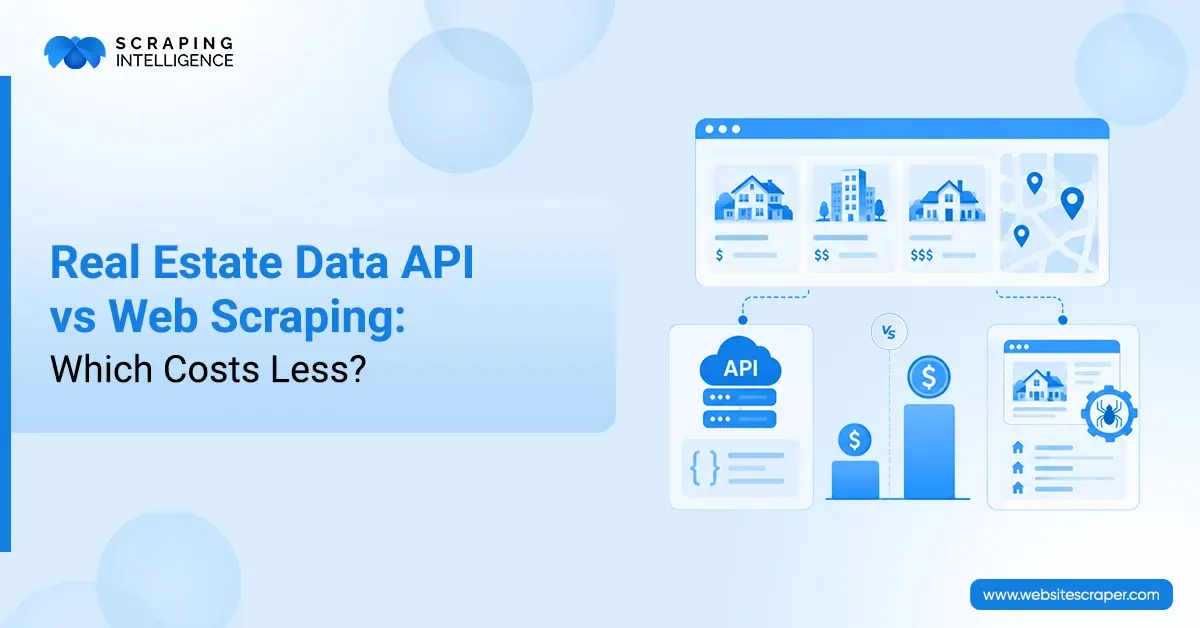
Real Estate Data API vs. Web Scraping: Which Costs Less?
Category
Real Estate
Publish Date
Oct 21, 2026
Author
Scraping Intelligence
Choosing between a real estate data API and web scraping can affect more than your data budget. It also determines how much time your team spends building, maintaining, and validating property data pipelines.
A real estate data API provides structured records through a provider, usually for a subscription or usage-based fee. Web scraping lets you collect information from selected websites, but you may need to account for infrastructure, proxies, development, data cleaning, and ongoing maintenance.
So, which option costs less? The answer depends on your data volume, the sources you need, and the resources available to your team. This guide compares the direct and hidden costs of both approaches, explains where each option makes financial sense, and outlines the factors to consider before choosing a solution for your real estate data project.
What Is a Real Estate Data API?
A real estate data API is a paid service that hands you clean, structured property records through a simple request. You send a query, such as an address or a ZIP code, and the provider returns organized results in formats like JSON or XML. All of the collection work happens on the provider's side, so you never touch a raw web page. Established providers such as ATTOM cover more than 158 million U.S. properties and track thousands of attributes per record, from tax history to automated valuations. In short, you pay for access and skip the labor of gathering and cleaning property data yourself.
What Does Web Scraping Involve?
Web scraping is the practice of pulling information straight from websites with your own code or tools. Rather than buying finished records, you build a system that opens listing pages, reads the underlying HTML, and extracts the fields you care about. The appeal is obvious, since the listings on public sites are free to view. The real cost lives underneath that surface, in the machinery needed to keep a scraping pipeline healthy as target sites shift their layouts and tighten their defenses.
A working scraping stack usually depends on several moving parts:
Proxies that rotate IP addresses so your requests are not blocked by the target site.
Headless browsers that render listings built with JavaScript, which plain requests cannot read.
Parsers that convert messy, inconsistent HTML into clean rows your database can use.
Monitoring that catches silent failures before stale data reaches your product.
Real Estate Data API vs. Web Scraping: Cost Comparison
The cost of a real estate data API depends on the provider, data fields, usage limits, and licensing terms. Web scraping costs depend on the number of sources, collection frequency, infrastructure, development effort, and ongoing maintenance.
To compare the two options fairly, use the same target dataset, update frequency, and reporting period. Also distinguish API requests from property records and scraped pages, since one request may return multiple records and one page may contain information about several properties.
Cost Factor
Real Estate Data API
DIY Web Scraping
Initial setup
API integration, authentication, and testing
Scraper development, source selection, and testing
Data access
Subscription, usage fees, or a licensing agreement
Access to permitted sources, plus collection infrastructure
Infrastructure
Often managed by the provider
Servers, storage, monitoring, and supporting tools
Data processing
Depends on the provider and fields supplied
Parsing, validation, normalization, and deduplication
Maintenance
Provider maintains its service; your team maintains the integration
Your team maintains collection logic and supporting infrastructure
Data coverage
Limited to the provider's available datasets and permitted use cases
Limited by accessible sources, extraction feasibility, and usage restrictions
Update frequency
Depends on the provider's refresh schedule and API capabilities
Depends on collection frequency and source availability
Best suited to
Standardized data available through an appropriate provider
Specialized fields or sources not adequately covered by available APIs
What Are the Hidden Costs of Real Estate Data Collection?
The initial price of a data solution does not always reflect its full operating cost. Before choosing a real estate data API or building a scraper, account for the expenses required to keep the data accurate, accessible, and usable.
Infrastructure: Scraping may require compute resources, storage, monitoring, and additional tooling, depending on the number of sources and collection frequency.
Proxy and browser costs: Some websites require more complex collection infrastructure. The actual expense depends on the permitted access method, page size, rendering requirements, and collection volume.
Engineering and maintenance: Developers may need to fix broken parsers, adapt to source changes, investigate failures, and monitor data quality.
Data cleaning: Duplicate records, inconsistent addresses, missing fields, and incompatible formats can create additional processing work.
Data licensing and compliance: Confirm the rights to collect, store, and use the data, along with any contractual or regulatory obligations.
API integration and usage: An API may reduce collection overhead, but subscription fees, usage limits, additional endpoints, and licensing restrictions can affect the total cost.
The most useful comparison includes both direct expenses and the value of staff time. Estimate these costs over the same period and for the same required dataset rather than assuming one approach is always cheaper.
Real Estate Web Scraping Cost Breakdown: A Monthly Example
A monthly scraping budget should separate infrastructure costs from engineering labor. For example, a small deployment may have relatively low server and storage expenses while requiring several hours of developer maintenance.
Use the following categories to build a transparent cost estimate:
Compute and hosting
Proxy or other permitted access costs, where applicable
Data storage and processing
Initial development, amortized over the expected project lifetime
Ongoing maintenance and monitoring
Data validation and quality assurance
Present each expense as a separate line item and state the assumptions used. Compare the resulting monthly total with a real API quote covering the same records, fields, update frequency, and usage rights.
When Does a Real Estate Data API Make Sense?
A real estate data API can be a practical choice when your application needs structured property records without requiring your team to build and maintain a collection system.
Consider an API when:
You need a fast integration. An existing API can reduce the work required to build data collection and parsing pipelines.
Your required fields are already available. Check the provider's coverage, data dictionary, and supported endpoints before committing.
You want a clearer operating budget. Subscription or usage-based pricing can make costs easier to estimate, provided your account for overages and licensing fees.
Your team has limited scraping expertise. Using a provider can reduce the need to maintain custom collection infrastructure.
Data usage rights matter. Review the provider's licensing terms to confirm that your intended application and downstream use are permitted.
Before selecting a provider, check the cost per usable property record, update frequency, geographic coverage, data quality, request limits, and contractual terms. An API is not automatically cheaper, but it may offer better overall value when it meets your requirements with less ongoing engineering effort.
When Is Web Scraping the Cheaper Choice?
Scraping can win on cost in specific cases. If you already run servers, employ in-house engineers, and need data that no provider sells, your own web scraping pipeline may pay off. Niche sources, custom fields, and total control are where a homegrown scraper earns its place. A small, self-hosted setup pulling roughly 10,000 pages a month can land near $455, which may undercut an enterprise API contract for a narrow, specialized need.
Here is where that $455 estimate comes from, based on published budget breakdowns for a setup at about 10,000 pages a month:
VPS compute for running the scrapers, around $50 a month.
Residential proxies at roughly $28, figured on about 3.5 GB of traffic at $8 per GB.
Storage for the collected records, near $2 a month.
Engineering maintenance, the largest piece at about $375, or roughly five hours at $75 an hour.
The math shifts as volume grows. At a million pages per month, self-hosted costs can push past $1,000, and evolving anti-bot systems make reliable collection harder every quarter. This is the exact burden managed services remove on your behalf.
A middle path exists.Explore managed real estate data scraping to get clean, ready-to-use records while the provider handles proxies, maintenance, and anti-bot defenses for you.
Is Real Estate Web Scraping Legal?
The legality of real estate web scraping depends on the data being collected, the source website, the collection method, and how the resulting data will be used.
In the United States, the Ninth Circuit's 2022 decision in hiQ Labs v. LinkedIn addressed whether accessing publicly available profiles could violate the Computer Fraud and Abuse Act in the circumstances before the court. It should not be interpreted as blanket permission to scrape any public website.
Before collecting real estate data, review:
Website terms: Check applicable terms of service and restrictions on automated access.
Privacy requirements: Determine whether records contain personal information and whether privacy laws apply to collection, storage, or downstream use.
Copyright and licensing: Confirm whether listing descriptions, photographs, and other protected content can be collected, reproduced, or redistributed.
Access restrictions: Avoid assuming that publicly viewable information can always be collected through any method.
Contractual obligations: Check the terms governing both the source and any third-party data provider.
An API does not automatically eliminate legal or licensing concerns, either. Review its data-use terms and confirm that the license covers your intended application.
For projects involving personal data, commercial redistribution, or uncertain access rights, obtain advice from qualified legal counsel before proceeding.
How Fast Can You Launch?
Speed often decides the whole thing. If you need data in your product this week, the two paths look very different.
With an API, you sign up, grab a key, and pull your first records the same afternoon. A scraper takes longer. You have to pick target sites, write the parsers, set up proxies, and test against each site's defenses before a single clean row lands in your database. For a small team on a deadline, that gap can stretch from hours into weeks. The slower build only pays off when the data you need sits nowhere else.
How Does Real Estate Data Accuracy Compare?
Data accuracy depends on the source, collection process, validation methods, and update frequency not simply on whether you use an API or web scraping.
A real estate data API may provide standardized addresses, property identifiers, valuation estimates, and other structured fields. However, the availability and reliability of these fields vary by provider and dataset.
Scraped data can also be normalized and validated, but your team may need to build additional checks to detect missing values, duplicates, inconsistent formats, and changes in source-page structure.
When evaluating either approach, assess:
Completeness: Are the required property fields present?
Consistency: Are addresses, identifiers, and numeric values formatted consistently?
Freshness: How frequently are records updated, and how quickly are changes reflected?
Accuracy: How closely do sampled records match a trusted reference source?
Coverage: Are the required property types, locations, and fields included?
Error handling: How are missing, conflicting, or invalid records identified?
Test a sample of records before committing to a provider or building a scraping pipeline. The most useful option is the one that delivers sufficiently accurate, complete, and current data for your intended use at an acceptable total cost.
Real Estate Data API vs. Web Scraping: Final Verdict
There is no universal cost winner. The right choice depends on the dataset you need, your team's capabilities, and the ongoing cost of maintaining reliable data.
Your Situation
Option to Evaluate First
Why
Standard property records available from a provider
Real estate data API
Less custom collection infrastructure may be needed
Small team with limited engineering resources
Real estate data API
Reduces the burden of building and maintaining scrapers
Specialized fields missing from available APIs
Custom web scraping
May provide access to permitted sources containing the required fields
Existing scraping infrastructure and experienced developers
DIY web scraping
Existing resources may reduce incremental operating costs
Need custom collection without managing infrastructure internally
Outsources much of the collection and maintenance work
Before making the final decision, compare total cost over the same period and for the same dataset. Include setup, subscriptions, usage charges, engineering labor, maintenance, data cleaning, and licensing.
Choose the approach that meets your data requirements at the lowest sustainable cost—not simply the one with the lowest initial price.
Conclusion: Choose the Right Approach for Your Property Data Budget
Choosing between a real estate data API and web scraping comes down to more than the initial price. An API may reduce development and maintenance work when a provider already supplies the property data you need. Custom scraping may offer greater flexibility when suitable APIs do not cover your required sources or fields.
Before deciding, compare both options using the same data volume, update frequency, quality requirements, and reporting period. Include engineering time, infrastructure, maintenance, and licensing in your calculation.
If you want property data without managing the full collection pipeline, a managed real estate data scraping service may be worth evaluating. The best choice is the one that meets your data requirements reliably while keeping long-term costs under control.
Share this article:
About the Author
Scraping Intelligence
Scraping Intelligence Editorial Team is a collective of data specialists, analysts, and researchers with expertise in web scraping, data extraction, and market intelligence. The team produces well-researched guides, actionable insights, and industry-focused resources that help businesses unlock the value of data and make informed, strategic decisions.
Latest Blog
Explore our latest content pieces for every industry and audience seeking information about data scraping and advanced tools.
Compare real estate data APIs vs. web scraping costs, including setup, infrastructure, maintenance, and data quality, to find the right solution for your needs.
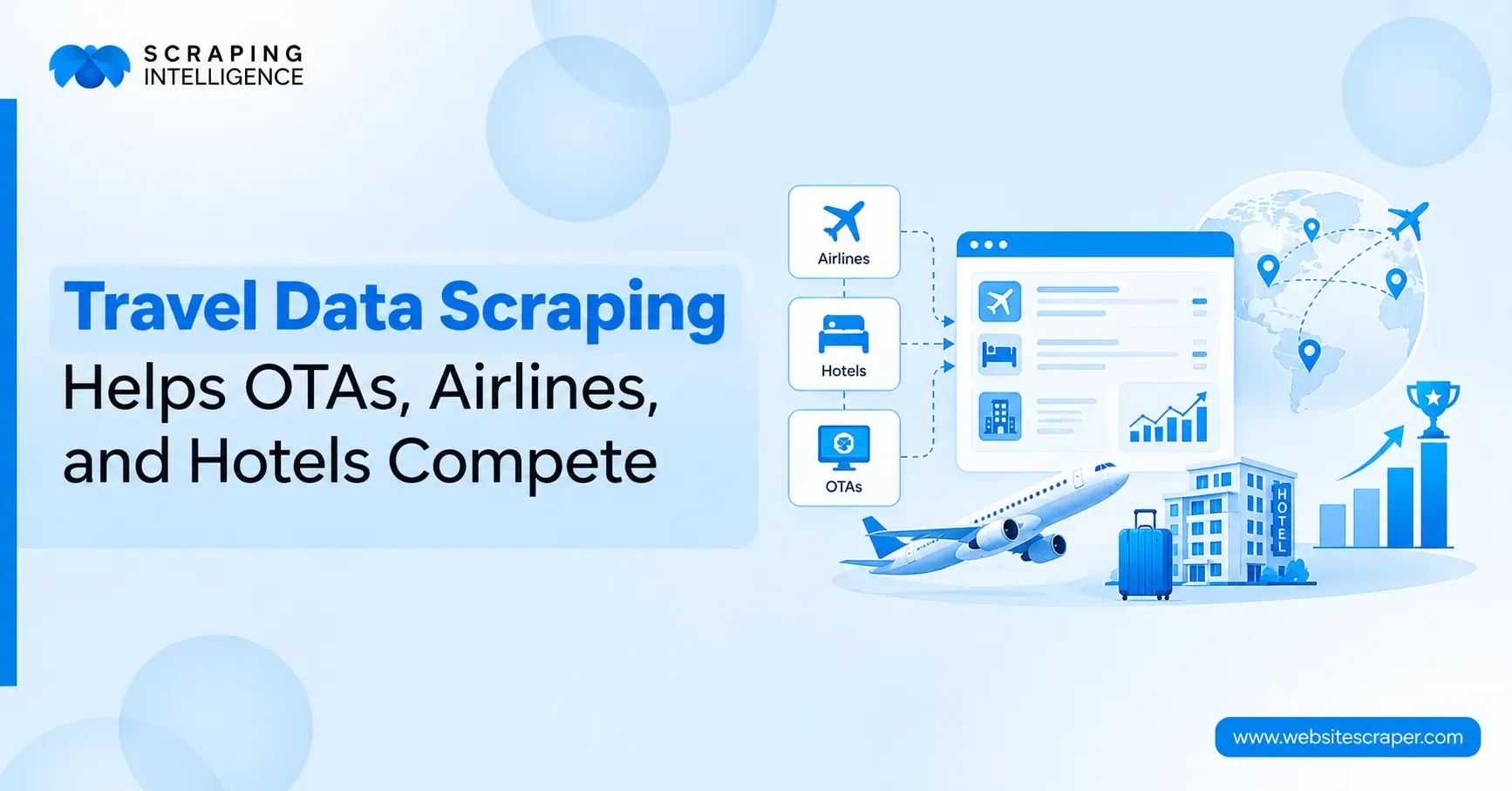
See how the travel industry uses web scraping to track fares, room rates, availability, and reviews, plus how to choose the right data extraction solution.