What Is News Monitoring? How to Track News Articles and Trends Effectively
Category
News & Media
Publish Date
February 04, 2026
Author
Scraping Intelligence
Today, information spreads quickly. An article can disrupt a business and harm its profits before the company even realizes it. Many companies, however, continue to experience delays in discovering key mentions of their products or services. Often, companies only find out about a key mention days or weeks later, resulting in a lower bottom line.
News Monitoring enables businesses to monitor all relevant articles, mentions, and trends in real time across primary sources without checking dozens of websites every day. You will receive alerts whenever something significant happens.
This guide explains what news monitoring is, why it is essential, and how to implement a media monitoring strategy. You will learn practical strategies for monitoring news and tracking trends that are useful for all types of businesses, from start-ups to large companies.
What Is News Monitoring?
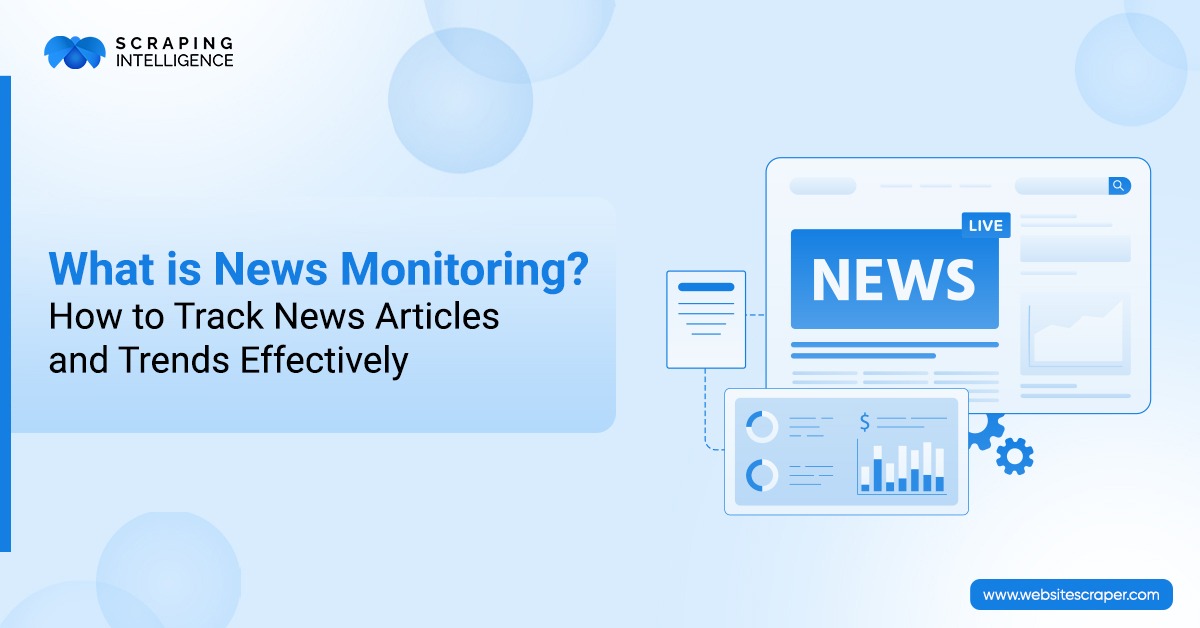
The act of news monitoring involves being proactive in tracking, researching, and measuring information about events, individuals, or companies in the news, using various methods to collect data from all available sources, including print, online publications, digital media, and social media.
Many organizations use automated systems to monitor these types of resources for specific keywords or topics related to their operations. Instead of manually sifting through countless articles and postings daily to find items that meet their criteria, these services provide users with an alert when a new article matches their criteria.
Scraping Intelligence is a company that focuses heavily on providing automated news monitoring for businesses. As a result, our solutions enable businesses to access all media coverage quickly and reliably. We achieve this through systems that quickly process hundreds of thousands of articles every day to provide instant, relevant insights.
Why Do Businesses Need News Monitoring?
To protect your company's reputation, identify opportunities for new products and services, and base your company's decisions on the best available current information, an organization's news monitoring is critical.
Reputation Management
Monitoring the media for brand mentions is essential because inadequate coverage can spread rapidly across social and traditional media. Monitoring enables companies to detect issues early and respond accordingly before they escalate. According to research, 78% of consumers are more likely to trust a company that takes the time to respond to negative reviews and media coverage.
Competitor Intelligence
Competition is constantly seeking ways to take your market share. Your competitors make business decisions every day that impact your ability to succeed. News monitoring lets you learn about your competitors' decisions before they go public, such as product launches, pricing adjustments, strategic partnerships, and executive hiring.
Crisis Prevention
Industry issues start small and grow into major crises. Trade journals and local newspapers break these types of stories before they reach mass media. Monitoring the news enables organizations to prepare for events well before they become major business concerns.
Identifying Market Opportunities
The emergence of trends, regulatory changes, and market shifts often presents good opportunities for prepared businesses. News monitoring enables organizations to see and capitalize on trends, regulatory changes, and shifting market demand as they unfold, not after the competition has already taken advantage of them.
Scraping Intelligence provides real-time monitoring, ensuring you never miss critical developments affecting your business.
What Types of News Sources Should You Monitor?
By monitoring all forms of media, Scraping Intelligence has created a complete picture of the global media landscape, including:
Traditional News Media
National newspapers, wire services
Regional/local media publications
Industry trade publications/journals
Business / Financial publications
Digital-First Publications
Online news sites and Blogs
Industry-specific publications/websites
Technology / Innovation blogs and News publications
Topic-specific blogs/websites
Press Release Services
PR Newswire/ Business Wire
Company announcements
Regulatory Filings
Investor Relations Sites
Social Media News
Twitter Breaking News
LinkedIn Professional Social Networking
Reddit Community News
News Aggregator Websites
International Sources
Foreign Language Publications
Regional Online News Outlets
International Wire Services
Country-Specific Online News Websites
Scraping Intelligence monitors each media type through a single central repository or dashboard. We have hundreds of thousands of publications gathered from across the globe, including news articles, blog posts, social media posts, and any other content considered a news source.
How Does Automated News Monitoring Work?
Automated news monitoring analyzes Internet-based information using state-of-the-art Web Scraping and natural language processing algorithms for monitoring thousands of media sources simultaneously.
First, you must configure the specific parameters you wish to track, such as keywords, phrases, or the names of companies or people, along with the subject matter type.
Secondly, automated news monitoring monitors all of your specified sources and continually scans them for newly published articles; the web scraping application scrapes articles from news sites and RSS feeds in real time as they are made available by their publishers.
Thirdly, the success of automated news monitoring depends on natural language processing's ability to analyze each article's relevance to the individual user, as configured above. NLP determines whether an article matches the user's criteria or is simply a false positive.
In addition to determining relevance, automated news monitoring uses NLP to extract key data, including sentiment analysis, the article's primary topic, and the major entities discussed.
Finally, you may deliver notifications via email alerts, dashboard notifications, or through existing application programming interface (API) connections to your current applications.
Scraping Intelligence creates customised monitoring solutions that seamlessly fit into your workflow by managing all the technical aspects, so you can focus on producing insights.
What Are the Key Features of Effective News Monitoring Tools?
By combining breadth of coverage with precision filtering and actionable delivery, practical news monitoring tools are available.
Comprehensive source coverage
Quality tools monitor thousands of sources globally and across categories. If you have limited coverage, you will likely miss mentions of your brand and will have incomplete intelligence. Therefore, the best way to ensure you have the most coverage possible for your monitoring solution is to use tools that monitor the full range of publication types.
Advanced searching
Advanced searching capabilities allow you to search using Boolean operators, phrase matching, and proximity searching. If your monitoring is too broad, you will generate a lot of noise; if it is too narrow, you will miss a lot of relevant information. Advanced searching allows you to find the best balance between these two extremes.
Alert notifications
For time-sensitive news to be useful, you must receive timely alerts. A delay of even a few hours can result in missed opportunities or exacerbated crises. Therefore, real-time processing and instant notification are critical features of effective monitoring.
Sentiment analysis
Not all mentions of your brand are created equal; for example, favorable coverage versus negative criticism. Sentiment Analysis will help you automatically categorize your coverage by tone and prioritize your responses.
Customizable dashboards
Help teams visualize trends and patterns over time and across sources. Customizable dashboards let you track the metrics most important to your organization.
Exporting and integrating
The data generated from monitoring must flow into other systems (reporting, customer relationship management, and analytics). API access (for automated feeds) and support for standard export formats ensure seamless integration with your organisation's existing systems.
How Do You Set Up an Effective News Monitoring Strategy?
To be successful in conducting effective news monitoring, you must create clear objectives, design search queries thoughtfully, and develop a systematic procedure to capitalize on findings when you receive them.
Begin by determining what type of monitoring you wish to undertake. You need to decide what you want to be aware of and why you need to be mindful of it. For example, protecting a brand may require a strategy different from identifying competitors or monitoring trends.
The second step is to build comprehensive keyword lists that will encompass all variations of what you are searching for. You must include the brand name, product name(s), the names of the company executives, and industry topics. You should also include common misspellings and abbreviations.
The third step is to choose the right sources based on your goals. Trade publications are best for B2B companies, while customers and consumer product companies should use lifestyle and general news outlets. Your sources should align with how your customers prefer to receive information.
The fourth step is to create an alert system based on urgency. If there's an urgent mention, send an SMS alert for quick attention. For less urgent updates, a daily email summary is a better choice.
After setting up alerts, assign team members to receive them. The marketing department, for example, would handle opportunities, while the public relations department would manage crises; hence, the legal department would review any regulatory mentions.
The fifth step to a successful news monitoring system is continual review and refinement of your process. Set up a regular weekly review to identify any "false positives" and/or "missed" mentions, and as a result, continuously improve your monitoring process.
Scraping Intelligence works with its clients to establish tailor-made monitoring strategies specific to their industry and individual objectives.
What Tools and Technologies Power News Monitoring?
Many different technologies work together to provide a comprehensive view of news coverage at scale.
Web scraping is done automatically by extracting information from news sites. It allows for simultaneous access to thousands of websites using an automated approach and also serves as a foundation for automated news monitoring.
RSS feed aggregation subscribes to thousands of RSS feeds, providing a way to receive the most recent updates in real time, enabling maximum efficiency when searching for news stories containing structured data.
Natural Language Processing (NLP) helps analyze the text of news articles to extract meaning, classify article content by relevance, and analyze sentiment, while trained machine learning models accurately classify content and rank it by relevance.
In news stories, Named Entity Recognition identifies individual names, businesses, and institutions. It enables one to locate articles without relying entirely on specific search terms.
With API Integration between monitoring and alerting solutions, users can access real-time alerts from any other system or process within their organisation (for example, dashboards or CRM systems).
By using the best-in-class technology solutions from Scraping Intelligence, companies can achieve a powerful combination of scalable news monitoring solutions for hundreds to millions of articles.
What Are Common News Monitoring Challenges and Solutions?
The first challenge is dealing with too much information. When you try to follow many sources using broad phrases and keywords, you will get a lot of irrelevant information. Your teams will receive numerous alerts, which can overwhelm them and cause them to miss important details hidden in the "noise."
To solve this, start with a few keywords and priority sources. As your organization gets better at handling alerts, you can gradually add more sources. You can also use advanced filtering techniques to remove obvious false positives automatically.
The second challenge is the language and translation barrier. Global organizations are required to monitor international sources and ensure they cover all information in multiple languages. Machine translations do not always adequately capture the nuances of meaning and cultural context.
The third challenge is duplicated content. The same story will be reported in dozens to hundreds of different outlets via syndication. It can create alert fatigue and make it challenging to conduct practical trend analysis.
Fourthly, when you monitor in real time, you see current coverage; however, you do not have a historical baseline to compare it with. Without this historical context, you cannot truly identify trends or determine if your current coverage is increasing or decreasing.
Scraping Intelligence has anticipated these challenges and built in solutions for each of its monitoring platforms. We have automated the technical details of these challenges. It lets your team focus on creating effective strategies.
What Is the Future of News Monitoring Technology?
As artificial intelligence continues to advance and more news sources emerge, the demand for sophisticated news monitoring technology is increasing.
Predictive analytics can play a crucial role in identifying essential stories early, often before traditional media cover them. By analyzing social media trends and niche news outlets, businesses can stay ahead of emerging trends and discover new stories before they make headlines.
As systems get better at understanding content (what it says) and context (what the article means), and as they learn to recognize sarcasm and subtle meanings that current technology often misses, these advancements will significantly reduce the number of incorrect "false positives."
In addition to providing an article, Automated Insight will also deliver strategic recommendations. Systems will be able to not only identify patterns but also connect the unconnected dots regarding the latest developments from news sources.
Multi-modal monitoring, which integrates video analysis, podcast transcription, and image and visual content recognition, will enable businesses to know when they have been mentioned across any/all forms of traditional/electronic media and visual content.
Enhanced personalization will automatically adjust relevance scoring and alert frequency based on each user's interactions.
Scraping Intelligence continues to lead the way by continually enhancing our platform's capabilities.
Conclusion
Businesses are looking to compete, so keeping up with the information out there is crucial. The way we keep track of what is going on has changed as technology has made it easier for us to keep up with the rapid pace of information generation. The successful use of news monitoring depends on clearly defining your goals, using the right technology, and having a systematic way to respond to what you find. While technology can automatically track thousands of different sources for you, it is essential to have human expertise to determine the relative importance of any event that occurs and what you should do about it.
Using Scraping Intelligence's news monitoring services will enable businesses to monitor their reputations and competitors in real time, while receiving actionable reports that give them a competitive edge when making decisions.
Frequently Asked Questions
What is the difference between media monitoring and news monitoring?+
Media monitoring includes TV, radio, and print, while news monitoring focuses primarily on digital publications, online articles, and blogs.
How often should businesses monitor the news?+
For high-risk industries, real-time monitoring is ideal. Others may opt for hourly or daily updates.
Is web scraping legal for news monitoring?+
Yes, when done ethically and in compliance with website policies. Scraping Intelligence follows best practices, including robots.txt compliance and responsible crawling.
Can small businesses benefit from news monitoring?+
Absolutely. Early trend detection and reputation tracking provide competitive advantages, regardless of company size.
How much data is required for trend analysis?+
Trend analysis works best with large datasets. Scraping Intelligence supports millions of articles daily.
Share this article:
About the Author
Scraping Intelligence
Scraping Intelligence Editorial Team is a collective of data specialists, analysts, and researchers with expertise in web scraping, data extraction, and market intelligence. The team produces well-researched guides, actionable insights, and industry-focused resources that help businesses unlock the value of data and make informed, strategic decisions.
Latest Blog
Explore our latest content pieces for every industry and audience seeking information about data scraping and advanced tools.