How Commercial Real Estate Brokers Use Market Data to Find Off-Market Deals Faster
Category
Real Estate
Publish Date
Sep 17, 2026
Author
Scraping Intelligence
Introduction
Finding commercial real estate opportunities before they reach the public market can give brokers a valuable head start. Instead of relying only on listings, brokers can use commercial real estate market data to identify ownership patterns, loan maturities, vacancy changes, property values, and other signals that may indicate a potential sale.
This guide explains how commercial real estate brokers use market data to find off-market deals, which data points are most useful, and how technology can turn scattered property records into actionable leads. You will also learn how brokers can combine data sources, prioritize high-potential properties, and build a repeatable workflow for reaching owners before a property is publicly marketed.
Here is what this blog covers:
What off-market commercial real estate deals are and why brokers pursue them
Which market data signals can indicate potential selling opportunities
How data aggregation, extraction, CRM, and analytics tools support prospecting
A five-step workflow for turning property data into qualified opportunities
Common data and outreach mistakes that can slow down an off-market acquisition strategy
For brokerage teams that need property information at scale, data extraction can help consolidate information from multiple online sources into a structured, usable format. Scraping Intelligence provides data extraction solutions that can support real estate research, market monitoring, and lead-generation workflows.
What Are Off-Market Deals in Commercial Real Estate?
An off-market deal is a property sale that never gets a public listing. Some sellers value privacy above everything else. Others simply want to skip the noise, the open bidding, and the parade of buyers walking through their building. These transactions can involve direct negotiations between owners, brokers, investors, and selected buyers without being broadly marketed through public listing channels.
Brokers pursue these opportunities because limited market exposure can reduce competition and give buyers or sellers more control over the negotiation process. Fewer competing bidders usually means a sharper price and a calmer negotiation. Early access can give brokers more time to evaluate the property, establish a relationship with the owner, and position a qualified buyer before broader marketing begins. The hard part, naturally, is locating these deals ahead of everyone else.
That challenge is exactly why commercial real estate market data has become so valuable. Rather than guessing which owners might sell, brokers now read the signals early. They watch ownership tenure, loan maturities, and shifting property values across an entire submarket.
Why Does Market Data Matter So Much?
Market data converts a slow, manual hunt into a focused, evidence-based search. A broker who studies the right figures can reasonably predict which owners are close to a sale. That shift can reduce the amount of time brokers spend manually researching properties and contacting low-probability leads.
Picture the contrast between two brokers working the same city. The first relies on a personal network and a bit of luck. The second studies hard evidence before dialing a single number. The second broker can prioritize outreach more efficiently because the available signals help identify owners who may have a stronger reason to consider a transaction.
The value of solid real estate market data shows up in three clear ways:
Speed: Identify potential opportunities earlier.
Prioritization: Focus outreach on properties showing multiple relevant signals.
Context: Approach owners with a better understanding of the property and market.
There is a second benefit that many brokers overlook. Good data protects your time. When you already know a property carries strong cash flow and a mortgage nearing maturity, your outreach feels timely instead of intrusive. That sense of relevance is what earns a callback from a busy owner.
Which Types of Market Data Reveal Off-Market Deals?
Not every data field carries equal weight. The strongest brokers concentrate on a handful of high-value data points that reliably surface hidden deals. The table below lays out the category’s worth watching, along with the reason each one matters.
Data Type
What It Reveals
Why It Matters for Off-Market Deals
Ownership Records
The current owner, plus how many years they have held the asset
Long ownership tenure can indicate accumulated equity or a potential change in investment strategy, making it useful for prospect prioritization.
Loan Maturity Dates
The point at which an existing mortgage comes due
An upcoming loan maturity or refinancing event can prompt an owner to reassess whether holding, refinancing, or selling the property makes the most sense.
Tenant and Lease Data
Current occupancy and the health of the rent roll
Changes in anchor tenancy, occupancy, lease expirations, or rent-roll performance can affect a property's income outlook and may prompt an owner to reassess the asset.
Sales History
What the property last traded for, and when
Historical sale prices and ownership duration can provide context on acquisition cost, potential equity growth, and the owner's investment timeline.
Zoning Changes
Recent shifts in what the land is allowed to become
Zoning changes can materially affect a property's permitted uses and development potential, which may influence its market value and investment appeal.
Distress Signals
Tax liens, code violations, and payment defaults
Tax liens, code violations, and payment issues can indicate financial or operational challenges that may warrant further research before targeted outreach.
Each row in that table marks a moment when an owner might choose to sell. A broker who tracks these signals together holds a genuine edge over one who watches only asking prices. The real skill lies in stacking several signals into one clear picture of intent.
Ownership records deserve a closer look. When a person or company has held a building for a decade or longer, the equity has usually grown into a substantial sum. That equity creates both the motivation and the financial room for a clean, well-timed sale. Loan data reinforces the picture, since commercial mortgages often carry five, seven, or ten-year terms that create predictable pressure points a broker can anticipate months ahead.
What Tools Help Brokers Move Faster?
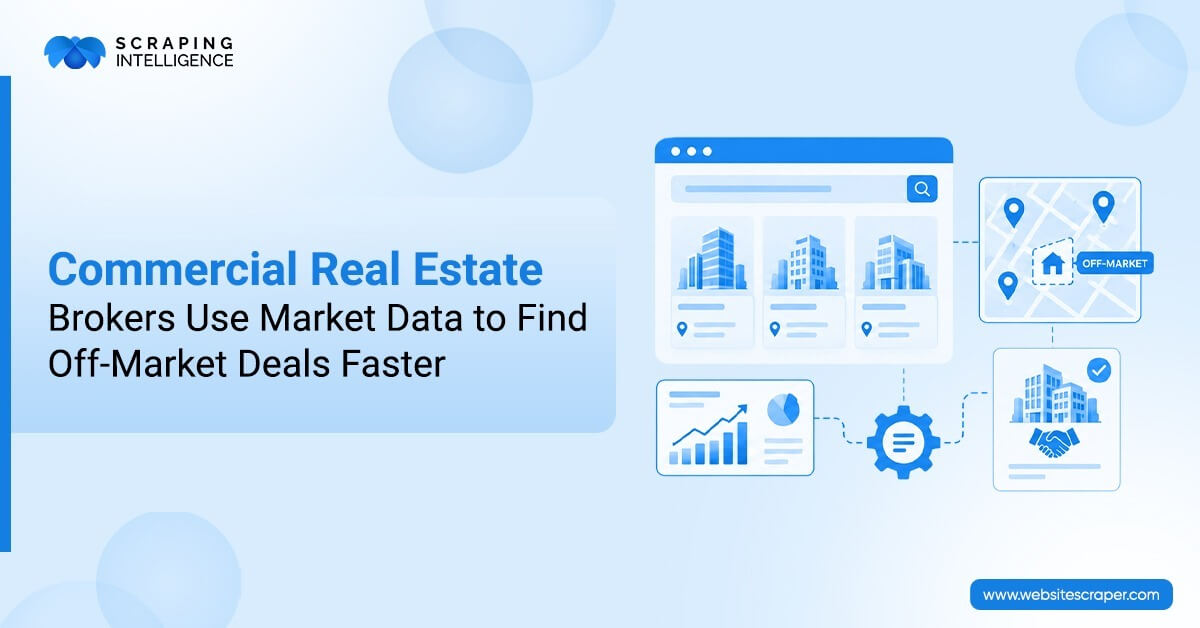
The right stack of tools turns scattered records into a ready-to-use deal pipeline. Modern platforms combine public filings, financial signals, and owner contact details in a single dashboard. That consolidation removes hours of manual digging from every single search.
The most useful tools for commercial real estate prospecting typically fall into five categories.
Data aggregation platforms that merge property records from many sources into one clean view.
Web scraping services that pull fresh listing and ownership data from across the web.
CRM systems that organize every lead and log each touchpoint with a prospect.
Skip tracing tools that link a property back to a real, reachable decision-maker.
Analytics and scoring software that ranks each lead by its likelihood of turning into a sale.
A broker who blends these tools builds a system that repeats itself month after month. The system surfaces signals, ranks them, and pushes the strongest ones to the top of the list. That structure lets the broker spend the day on outreach rather than on research.
This is exactly where a data extraction service earns its keep. At Scraping Intelligence, we help brokerage teams pull structured property and market data on demand, so their pipelines stay full of current, accurate leads.
How Do Brokers Turn Data into Closed Deals?
Data on its own never closes anything. The results appear only when a broker turns those numbers into a clear, repeatable process. The five-step workflow below reflects the approach many successful brokers follow.
Combine ownership, sales, valuation, loan, lease, zoning, and market information.
Identify and score potential sellers
Look for multiple signals rather than relying on one indicator.
Research the owner and personalize outreach
Connect the property to the appropriate decision-maker and tailor the conversation to the available context.
Qualify, negotiate, and advance the opportunity
Determine motivation, valuation expectations, buyer fit, due diligence requirements, and transaction feasibility.
This sequence keeps the broker locked onto the strongest opportunities. Instead of chasing every possible lead, the broker pours energy into the properties where the data points to real intent. That discipline is what shortens the road from first research to final closing.
A multi-signal approach is generally more useful than relying on a single indicator. When several independent signals point in the same direction, brokers can prioritize the property for deeper research and outreach. When a single property shows a maturing loan, rising vacancy, and long ownership at the same time, the case for reaching out becomes very hard to ignore.
Even sharp brokers stumble when they handle data carelessly. A little awareness of these traps goes a long way. Look closely at the common errors below, since each one quietly drains speed from a pipeline.
Reliance on outdated records that no longer match current ownership or valuation.
Over-focus on a single data point rather than the full picture of seller intent.
Poor data hygiene, which leaves duplicate, stale, or messy records clogging the pipeline.
Weak follow-up after the very first contact with a promising owner.
Neglect of compliance rules around data privacy, contact consent, and outreach limits.
Each of these missteps costs both time and trust. A broker who keeps data clean and follows up on schedule will steadily outperform a competitor who does neither. In this business, quality of data beats sheer quantity almost every time.
The strongest defense is a boring, consistent routine. Regular data refreshes, honest lead scoring, and timely follow-up keep a pipeline healthy through good markets and bad ones. Small improvements in data quality, refresh frequency, and follow-up can compound into meaningful results over time.
Conclusion
Off-market commercial real estate deals rarely come with a single obvious signal. The opportunity is often hidden across ownership records, loan maturities, lease activity, valuation changes, zoning information, transaction history, and other market indicators.
For commercial real estate brokers, the advantage comes from bringing these signals together and using them to prioritize the right properties and owners. A structured process collecting reliable data, enriching property records, scoring opportunities, personalizing outreach, and consistently following up can make off-market prospecting more efficient and repeatable.
The goal is not to predict every sale. It is to identify properties that deserve a closer look before they become widely marketed.
If your brokerage team needs structured property data for prospecting, competitive research, or ongoing market monitoring, Scraping Intelligence can help automate data extraction and organize information from relevant online sources.
Share this article:
About the Author
Scraping Intelligence
Scraping Intelligence Editorial Team is a collective of data specialists, analysts, and researchers with expertise in web scraping, data extraction, and market intelligence. The team produces well-researched guides, actionable insights, and industry-focused resources that help businesses unlock the value of data and make informed, strategic decisions.
Latest Blog
Explore our latest content pieces for every industry and audience seeking information about data scraping and advanced tools.