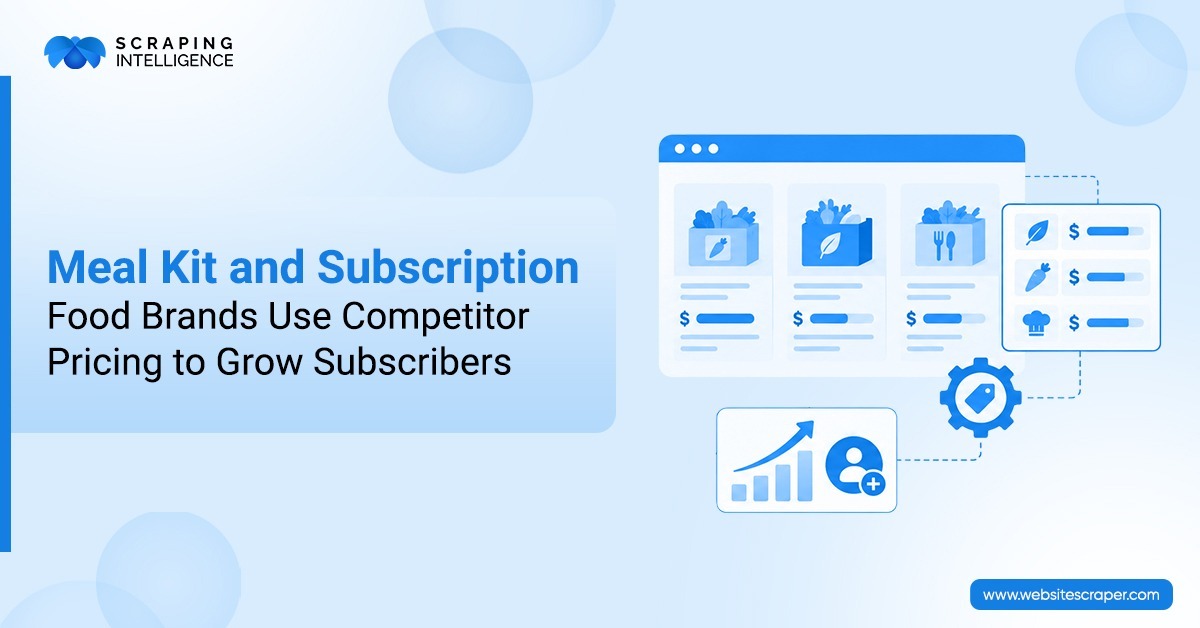
How Meal Kit and Subscription Food Brands Use Competitor Pricing to Grow Subscribers
Category
Food & Restaurant
Publish Date
Sep 15, 2026
Author
Scraping Intelligence
Introduction
Why does one meal kit brand attract more subscribers than another when their products look nearly identical? Price is often part of the answer. Competitor pricing gives subscription food brands a clearer view of what competitors charge, which discounts they offer, and how frequently those offers change.
For meal kit and subscription food companies, competitor price monitoring can reveal opportunities to improve first-box offers, pricing tiers, promotions, and retention strategies without relying on guesswork. By tracking box prices, per-serving costs, shipping fees, discounts, and promotional timing, brands can make pricing decisions based on current market conditions.
This blog explains how subscription food brands use pricing intelligence to attract subscribers, respond to competitor moves, and protect margins. It also covers how automated web scraping collects competitor pricing data at scale.
Why Competitor Pricing Matters for Meal Kit Subscription Brands?
The U.S. meal kit market is growing, but subscription brands face intense competition for customer acquisition and retention. According to Grand View Research, the U.S. meal kit delivery services market was estimated at USD 15.29 billion in 2025 and is projected to reach USD 28.57 billion by 2033. According to Grand View Research, the U.S. meal kit delivery services market was estimated at USD 15.29 billion in 2025 and is projected to reach USD 28.57 billion by 2033, growing at a CAGR of 7.3% from 2026 to 2033. That kind of money attracts a lot of players, and every player is fighting for the same hungry shopper.
Customer acquisition is particularly challenging in the subscription food market because brands are competing not only for a purchase but for an ongoing commitment. Customer acquisition cost in this category runs high because brands are asking people to change a daily habit, not just buy a one-off product. When one brand drops its first-box discount, competitors feel the pressure almost instantly, and a single blind spot on competitor pricing can send would-be subscribers straight to a competitor's checkout page.
There is also a hard financial truth underneath all of it. As a Quarter analysis of HelloFresh explained, brands must either enhance their Lifetime Value to Customer Acquisition Cost (LTV/CAC) ratio on a relatively small customer base or aggressively invest in brand growth and scaling. Smart pricing strategy, built on real market data, is often what tips that ratio in a brand's favor.
What Is Competitor Price Monitoring?
Competitor price monitoring is the ongoing habit of tracking, comparing, and analyzing what competitor brands charge across their websites and marketplaces. Unlike a one-time competitor price check, price monitoring is a continuous process that tracks changes over time. Think of it as a repeated, structured process that feeds a brand's own decisions week after week.
For subscription food companies, the practice usually covers a few clear data points:
Box prices across every plan size, from two-person to family-sized kits.
Per-serving costs, which make it easier to compare plans with different box sizes.
First-box discounts and the exact percentage each competitor is offering.
Shipping fees, add-on charges, and bundle deals that change the true cost.
Promotional timing, meaning when a competitor launches or ends a sale.
At scale, automated monitoring can make competitor pricing analysis more consistent and less labor-intensive than manual tracking. As one recent guide noted, monitoring competitor discounts and promotions is now a continuous, data-driven discipline rather than a reactive task, powered by always-on analytics that catch price changes and coupon codes in real time.
How Subscription Food Brands Use Competitor Pricing Data?
Collecting numbers is only the starting line. The real value shows up when a brand converts raw pricing intelligence into moves that grow the subscriber base. Several pricing strategies can turn competitor data into measurable acquisition and retention opportunities.
Optimize First-Box Offers
First-box discounts are one of the most visible acquisition levers in the meal kit market, and everyone is watching everyone else. Brands can compare competitor offers and adjust their introductory promotion to remain competitive while protecting acquisition economics. There is a catch, though. Hashmeta's meal kit marketing research points out that discounts of 50-60% off do pull in conversions, but a lot of those sign-ups are deal-chasers who vanish after the cheap box. Good pricing data is what tells a brand how far to push the offer before it starts buying customers who never stick around.
Build Competitive Pricing Tiers
Tiering is the second move, and it leans heavily on knowing where competitors sit. Brands map out competitor plans, then slot their own options just above and below the ones that matter. HelloFresh launched EveryPlate as a lower-priced alternative, allowing the company to target more price-sensitive consumers while maintaining differentiated positioning for its flagship brand. That let the parent company chase value seekers and premium buyers at the same time, without dragging down its flagship pricing.
Time Promotions Around Competitor Moves
Timing is the third piece, and it is easy to overlook. Say a competitor wraps up a big seasonal sale. This can create an opportunity to capture shoppers who remain actively engaged after a competitor's promotion ends. None of that works without real-time price tracking, since you cannot react to a promotion you did not notice ending.
Different pricing strategies serve different goals. The table below lays out the most common approaches subscription food brands use, along with what each one is best suited for.
Pricing Strategy
What the Brand Does
Best Suited For
Potential Risk
Penetration pricing
Comes in under the market to win share quickly
A newcomer trying to crack a crowded category, like EveryPlate did on price
Margins stay thin until volume catches up
Premium pricing
Charges above competitors so the price itself signals quality
Organic, chef-designed, or specialty diet kits
The audience willing to pay up is smaller
Dynamic pricing
Shifts prices as demand and competitor offers move
Peak seasons and holidays, when competitors reprice fast
Falls apart without solid data behind it
Discount acquisition
Leans on deep first-box deals to pull sign-ups
Fast subscriber-growth pushes
Can flood the funnel with deal-chasers who churn
Value-based pricing
Prices to the worth customers perceive, not just cost
Brands with a story competitors cannot copy
Only works once the brand has earned trust
Every row hides a trade-off. As FasterCapital's guide on meal kit strategy explains, brands can use penetration pricing to charge lower than competitors and win share, or premium pricing to charge higher and signal exclusivity. Which lever you pull depends on where your brand sits in its growth story.
How Pricing Intelligence Supports Subscriber Growth?
Research across ecommerce and subscription businesses suggests that pricing can influence both conversion and customer lifetime value. However, the impact varies by product category, customer segment, competitive environment, and discount strategy.
Consider these findings from across the ecommerce world:
A McKinsey report found that ecommerce companies using dynamic pricing saw 5-15% increases in conversion rates, with the best performers testing their own variations rather than only matching competitors.
Price is repeatedly cited as one of the top factors in a shopper's purchase decision, which is why brands treat competitor price tracking as essential rather than optional.
Retention, closely tied to fair and consistent pricing, is now viewed by industry analysts such as MARKETER as the single most important driver of profitability in the subscription meal kit space.
Pricing intelligence can influence acquisition and retention by helping brands make more informed decisions about offers, positioning, and price competitiveness.
How Web Scraping Supports Competitor Price Monitoring?
Effective competitor pricing analysis depends on having accurate and sufficiently current market data. Gathering it manually across dozens of competitor sites, plan sizes, and promotions would take an army. This is where web scraping earns its place.
Automated scraping tools collect competitor prices, plan structures, discounts, and availability across many websites at once. That structured feed becomes the raw material for every pricing strategy a brand runs, so teams plan instead of reacting late. For businesses looking to collect structured data from food delivery platforms, food delivery data scraping can provide valuable insights into pricing, menus, availability, and other market trends.
A partner like Scraping Intelligence helps subscription food brands pull clean, reliable competitor pricing data at scale, freeing their teams to focus on strategy instead of copy-pasting numbers.
What Does a Competitor Pricing Data Pipeline Look Like?
A polished dashboard hides a fair amount of engineering. Between a competitor's checkout page and a brand's pricing decision, competitor data moves through several stages:
Collection: Scrapers or price APIs pull plan pages, promo banners, and cart totals on a schedule. Refresh rates range from once a day for stable catalogs to seconds for enterprise tools tracking fast-moving prices.
Extraction: Raw page and checkout data can be processed into fields such as plan name, servings, box price, per-serving cost, shipping fee, and applicable promotion.
Normalization: Numbers are converted into a shared format, calculating a true per-serving figure after shipping and first-box offers, so a two-person plan on one site compares fairly against the same size plan elsewhere.
SKU matching: Each competitor plan links to its closest equivalent in your own catalog, since a raw price means little without an apples-to-apples pairing.
Delivery: Clean, matched data lands in a dashboard or flows into a repricing engine through an API, where pricing rules act on it.
Two details separate reliable feeds from noisy ones. Data normalization carries most of the weight, because unmatched serving sizes and hidden shipping fees are where naive comparisons quietly go wrong.
Scraping frequency, meanwhile, should match how often a competitor actually changes prices. The appropriate scraping frequency depends on how often competitors change prices and promotions. Meal kit brands may need daily or more frequent monitoring rather than second-by-second updates.
The big brands prove the payoff. HelloFresh, which holds a U.S. share some analyses put near 75%, launched EveryPlate in 2018 as a lower-cost alternative to fence off value shoppers. Blue Apron shows the flip side: before the pandemic, it rejoins offers grew so generous that people were signing up and canceling just to claim the benefits again, the classic failure of discount-led acquisition without retention.
Factor tells the winning version, tripling its market share within 18 months after adopting HelloFresh's pricing playbook. The common thread is that pricing grounded in market data beats pricing made in a vacuum.
Conclusion
The meal kit market is growing fast, and so is the competition for every shopper's attention and grocery budget. In this environment, guessing at prices is a costly gamble. The brands that win watch the market closely, price with purpose, and adjust with confidence.
Competitor pricing has moved from a nice-to-have into a core growth strategy for subscription food brands. From sharp first-box discounts to layered pricing tiers and well-timed promotions, every winning move traces back to good data and clear analysis. Paired with reliable data collection from a partner like Scraping Intelligence, that intelligence becomes a repeatable engine for growing and keeping subscribers.
For subscription food brands, the goal is not simply to match competitor prices. It is to understand the market well enough to make timely pricing decisions that balance acquisition, retention, and margin.
Share this article:
About the Author
Scraping Intelligence
Scraping Intelligence Editorial Team is a collective of data specialists, analysts, and researchers with expertise in web scraping, data extraction, and market intelligence. The team produces well-researched guides, actionable insights, and industry-focused resources that help businesses unlock the value of data and make informed, strategic decisions.
Latest Blog
Explore our latest content pieces for every industry and audience seeking information about data scraping and advanced tools.